

Sansan Borja: A journey with Ateneo's changing seasons
by Renee Nuevo
ASHS Principal Rosanna Borja talks growing up on campus, the shift to coed, God's love, and coming home to Ateneo
In 2015, with the school's transition to a K-12 curriculum, the Ateneo High School - freshly known as the Ateneo Senior High School - announced that it would be going co-educational beginning SY 2016-2017. The move came some 40 years after the school began accepting girls in college, breaking a 114-year tradition of being a school exclusively for boys. At the start, the ratio of boys to girls was 7:3. "They were severely outnumbered," said Rosanna "Sansan" Mallillin Borja (BS Psychology '88, MA Psychology '11), Principal of the Ateneo Senior High School and a seasoned teacher of Ateneo's Basic Education, having been faculty since 1988.
Herself the daughter of Ateneans (her father, Rogelio Mallillin, was Director of the Rizal Library from 1980 to 1997; her mother worked as a nutritionist in the kitchens of the Loyola House of Studies in the 1970s), Sansan grew up on campus grounds. "It's always been home to me, because I'm a second-generation employee," she says. "I grew up in the campus; both parents were working here at a certain point when I was really young, [so it] was very familiar. And then my brothers [studied] here."
She entered Ateneo in the 1980s with the goal of going to med school to become a doctor. Originally, she wanted to go to the University of the Philippines where all her friends were enrolling, but it was a tumultuous time in the country, so after finishing high school from St Scholastica's Academy of Marikina, she decided to go to Ateneo as a psychology major.
In college, her usual haunts were the benches in Bellarmine Hall, because that's where the Psychology Department was located, and the hill that the Church of the Gesù now stands on. "Where Gesù is now used to be a statue of the Sacred Heart," she says. "Ang ganda rin n'ung hill na ‘yun, because when you stay there, you could actually watch the sunset. It's still a favorite place now."
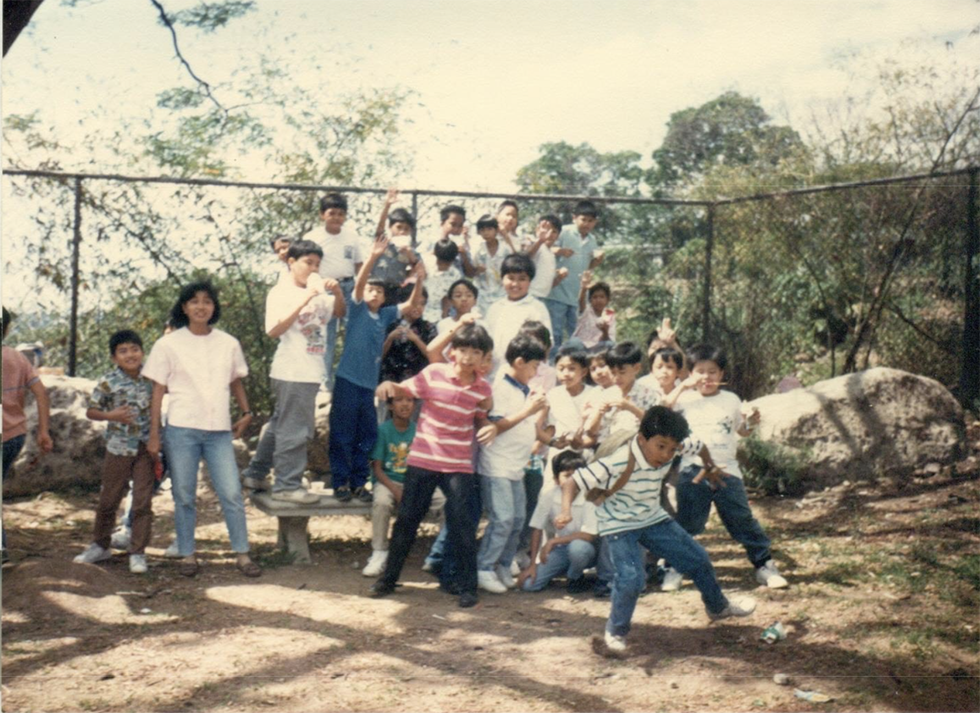
Watching the campus grow, she says, has been a privilege, especially since it's the place where she found her calling: a life as an educator, which became increasingly clear as she chipped away at her pre-med classes. "The culprit was chemistry," Sansan says laughing, explaining why she made the shift from medicine to education. Medicine, after all, is an expensive thing to study, so to augment the costs, she began teaching, just until she could save enough money for med school. "I decided to go the education route," she says. Her future as a teacher was solidified at the Ateneo Grade School, where she did her course on Practice Teaching. She wore something similar to the uniform of the faculty, and as a result, she got called ‘Teacher' a lot. It was like music to her ears. "Ang sarap pakinggan," she says. "Nakakakilig."
"After that course, deretso na - I applied to the Grade School."
Journeying through—and with—Ateneo's Basic Ed
At the Ateneo Grade School, Sansan taught various subjects: English, Science, Filipino, and CLE (Christian Living Education), with English being what she taught most consistently. In 1999, she became the Language Subject Area Coordinator, holding that role for 6 years. But after 25 years since she first started teaching at the Grade School, she felt like she needed a change. It was during this time when Fr Anthony C Pabayo SJ, Vice President for Basic Education at the time, suggested she move to teaching the higher levels.
She was assigned to the Ateneo High School, which by then hadn't yet transitioned to the K-12 curriculum, much less become co-ed. Sansan shares that she didn't feel that much apprehension since the kids would've come from her classes back when she still taught at the Grade School. "It was - I don't wanna say seamless - but it was easier than I thought it would be," she tells us, "especially [because my] colleagues welcomed [me] very well."
But when it was time for the High School to be split into Junior High and Senior High, Sansan was expecting to stay behind with the Junior High. And yet, she was assigned to Grades 11 and 12—another post she wasn't expecting. "I knew that there was a possibility that I would be Subject Area Coordinator again but I expected JHS, because those were the levels that I had taught — from Grade 7 all the way to 10. It was such a huge surprise for me," Sansan says.
Sansan's experience as a teacher and administrator became indispensable when the Senior High School finally began the shift to co-education. At the time, her biggest concern was the department's readiness for the change. They had just learned a year prior that they were going co-ed. "Not even a year, siguro mga months lang," Sansan says. "Sabi ko, 'Are we prepared? I don't think we have all the time to prepare for this.' The goal at that time was very altruistic [kasi walang] mapupuntahan itong mga very good students, kasi wala pang Senior High sa mga public schools. The target was really public and parochial schools."
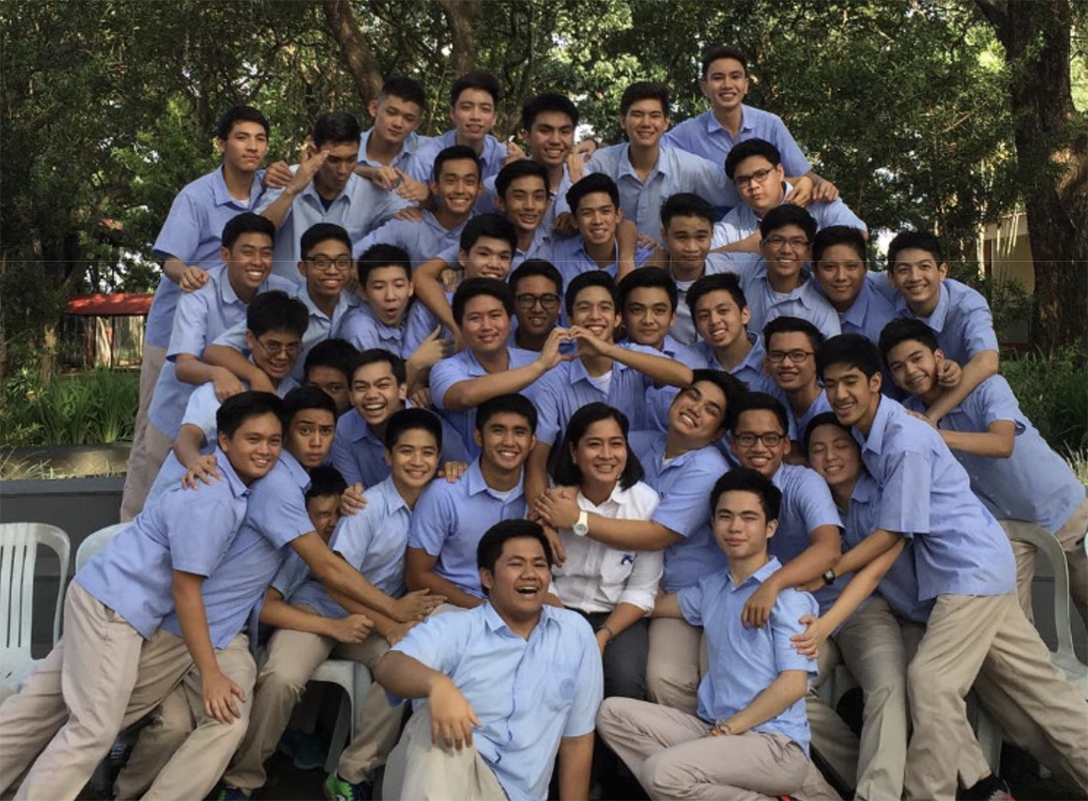
So when school opened for that year, there was much anxiety from everyone. Sansan admits she had her own. "I wasn't sure I could teach girls," she says, citing her temperament as a teacher, and her experience of only having taught boys. "Ang lalaki, kahit ilang beses mo ‘yan pagalitan, wala lang ‘yun. They know that it's nothing personal. I wasn't sure that the girls would be [like that too]."
She also shares how that first year was full of upheavals. "It was difficult because at first I felt we just treated the girls like boys. We just expected that they would just follow what we had, to a point where [they really rebelled]. They started questioning. 'Why is it like this? It's not fair.' That first year, it was so tumultuous. You were fighting so many battles on so many fronts. Kaya ko nasabi na hindi tayo handa kasi hindi natin ine-expect ‘yung mga ganito."
Another challenge the SHS had to contend with were the increasing number of reported cases of sexual harassment. "Part of the gulo in the first years were the relationships. Kasi nga first time, diba? Ang daming mga cases ng sexual harassment," she says. "D'un nagsimula ‘yung Lakambini, [a student-run committee on Sexual Orientation, Gender Identity and Expression (SOGIE) Equality and Women Empowerment]."
"[It was established to] make sure that their voices would be heard," Sansan continues. "Eventually, it wasn't just female - it became all-inclusive. But the ones who were in that were really the ones who were advocating for reforms in [how the school approached the topic of] gender, and what they felt to be was unequal [treatment]. I moderated Lakambini for a while and d'un ko nakita na they will really exert all efforts in trying to make sure that the school is a safe place."
"‘Yung mga first years talaga, Lakambini became the voice for those who felt that they needed a space for that. Meron pa ring Lakambini ngayon pero feeling ko it's not as [top-of-mind] anymore. On a positive note, I want to look at it as, baka hindi na siya kailangan, which is good. Ang tingin na nila sa school ay inclusive na and you don't need this group to be your voice. We'll see this year how it turns out. Napansin ko nga, medyo dwindling na, and not as out there as before."
Even as they also faced difficulties when it came to the homegrown boys versus the transferees, plus the added challenge of a worldwide pandemic closing down in-person schooling, Sansan says that they've learned to become more resilient. "There's always something that will happen next," she says. "We've learned to roll with the punches." Most recently, the DepEd mandate of strengthening the senior high school curriculum is what they have been preoccupied with. Despite these challenges, Sansan is proud of the work the Senior High School has accomplished, and even prouder of the students that have come to be their own.
"On the academic side, it was a pleasant surprise," Sansan says. "Kasi nga with the addition of the girls, it pulled up everything. Iba ‘yung work ethic ng girls. Ako, ang tingin ko, hinila pataas talaga. And the Junior High is experiencing that now also. Tumaas daw ‘yung quality." In 2021, the Ateneo Senior High School named its first-ever female valedictorian, Ninna Beatrice V Rivera of the Science, Technology, Engineering and Mathematics (STEM) Strand.
A glorious sunset, and God's love
In 2024, Sansan was appointed Principal of the Senior High School. In a way, it had been a long time coming. She's had varying levels of experience throughout Basic Ed, after all, and she's taught different grades and years, too. "The only thing, perhaps, that made me eligible for it was the years of service. Usually, [in] the road to being principal, you have to take on the different leadership positions leading to that."
She's excelled in the different roles she's taken on since entering the Ateneo Grade School as a fresh grad, and her journey wouldn't be complete without paying tribute to all the teachers that have mentored her since day one. "If not for them, I wouldn't even have stayed this long siguro. It's a combination of all these veteran teachers who just made sure that we had the rigor to keep at the work. That's what trains you to be prepared for anything. Even when I became principal it was so touching for me to see them super proud. It's really the teacher you thought was super strict, pero they're really the ones who will prepare to be who you're destined to be."
Funnily enough, just before her appointment as principal, Sansan was already fantasizing about retirement. "I was looking forward to, 'Ok, the last years are just going to be spent in the classroom.' Just teaching," she says. When she was approached by the Search Committee to become ASHS' principal, she had her apprehensions. "Sabi ko, it's the sunset. Sunsets are supposed to just fade into the [darkness]," Sansan recalls, laughing.
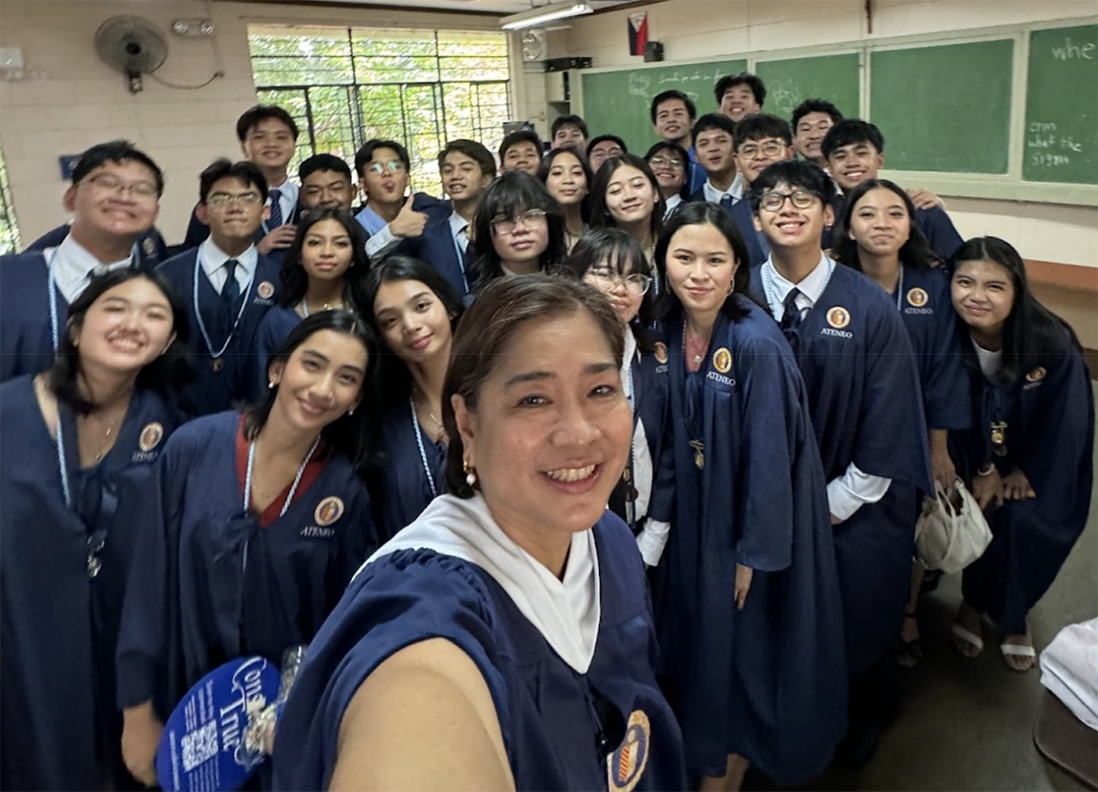
But AVP for University Partnerships and Internationalization and Chair of the ASHS Principal Search Committee Ma Cristina Alikpala, told her, "No, sunsets are glorious."
And so Sansan enters her second year in her 3-year term. "You discover that the job is [being] present to all. ‘Yun lang naman ‘yung hinihingi niya. It doesn't ask for too many qualifications as long as, if people need you to be there, you're there. And you just listen."
"I didn't think I would [be happy]," Sansan shares candidly. "Is this the right decision? But somehow, for every challenge that comes, there's always been a lot of blessings and a lot of grace that come with it. After malagpasan mo na, you just say, okay, what did I learn from that? My favorite catchphrase is God's love. When something happens, and lalo na ‘yung mga unexpected, sasabihin ko, 'God's love ‘yan.' Just be more observant because you don't know what God is telling you when you're not paying attention. Sometimes there's so many papansin ni God na 'pag hindi ka tumigil, you're going to miss it - and sayang. ‘Yun lang naman ang everyday ko. I just try to find God's love in the everyday."
Even after all these years, Sansan still calls Ateneo home. "There's a certain atmosphere that the Ateneo provides that makes one feel at home. Even our [Senior High] graduates who stay here for just two years say that. Even in the short time, they felt that this was a place that they could go back to anytime. That's what I tell them. Ateneo's home. When the world gets too difficult, just come home. And they do."



Published by the
Office of University Development and Alumni Affairs
Ateneo de Manila University
Fr Raymund Benedict "RB" Hizon SJ
Publisher
Rica Bolipata-Santos PhD
Editor-in-Chief
KD Suarez
Editor
Meyanne Plamenio-Cortezano
Franchette Mary Therese Silva
Renée Nuevo
Contributors
Andrea Bautista
Art Director/Graphic Designer
Ateneo alumni can update their information by emailing OUDAA at
alumnirelations@ateneo.edu
Contributions
fabilioh@ateneo.edu
Facebook
facebook.com/AteneoOAR