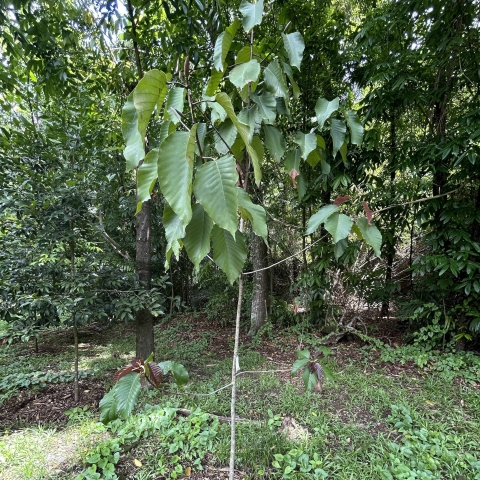
Dipterocarpus grandiflorus, also known as Apitong, is a native dipterocarp species.
A large tree that can reach up to 45 meters in height. Alternate phyllotaxy, leaves are coriaceous and glabrous , the leaves are broadly elliptic in shape and measure from anywhere between 10 to 18 cm long and 5 to 12 cm wide. Its leaves are petiolate, with the petioles being 5 to 7 cm long with swollen tips. Flowers are radially symmetrical and are 5-merous, averaging somewhere around 5 cm in diameter, it has fragrant rose colored petals with a prominent cream or white stripe in the middle that are around 5 cm long and are oblong or narrowly oblong in shape, stamens 30 and ovary is 3-celled with the base enclosed by the calyx tube. Fruit oblong or ellipsoid and 6 to 7 cm long in length and 3.5 cm wide with 5 wings derived from sepals, 2 large wings that average at 22 cm long and 3 cm wide while the 3 lesser wings are 2 cm long and 1.5 cm wide.
Used for its timber which is valued highly for construction, charcoal making, paper making, and woodworking. Produces a resin that is used as varnish. The bark is used in traditional medicine to treat dizziness, rheumatism, and liver problems. Apitong tends to flower and fruit annually and more consistently than other Dipterocarp species. It takes 3-5 months for the fruit to mature and the seeds tend to shed at the onset of the rainy season. The tree produces Oleo-resin. It can also be planted to aid in soil improvement and erosion control. The wood is used for posts, beams, rafters, flooring, bridges and wharves, and other construction that requires hard and heavy timber. Dipterocarp seeds are recalcitrant and easily lose viability when dried or stored long. After cutting the wings, the seeds should be planted in a potting medium as soon as possible.