

SDG 7: Affordable and Clean Energy
Highlights
Ateneo de Manila University in the UNFCCC Race to Zero Campaign
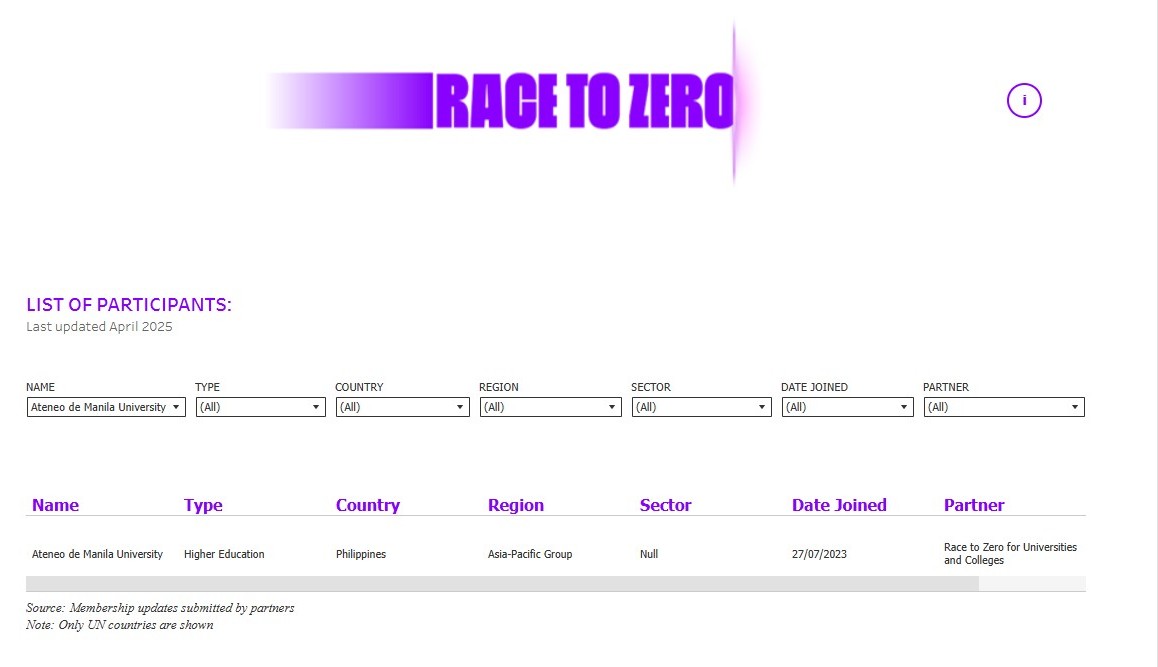
Ateneo de Manila University is officially listed as a participant in the UNFCCC Race to Zero campaign, last updated in April 2025. The University joined the movement on 27 July 2023 under the Higher Education category, representing the Philippines and the Asia-Pacific Group, through its partnership with the Race to Zero for Universities and Colleges network. This membership affirms Ateneo’s commitment to halving emissions by 2030 and achieving net-zero carbon emissions by 2050. Through initiatives such as the Ateneo Solar Power Project, energy efficiency upgrades, and green building programs, the University actively contributes to working toward climate resilience.
Energy Efficiency and Climate Action
Energy Efficiency and Conservation
Ateneo de Manila University continues to uphold its sustainability goals through systematic efforts to manage and reduce its energy consumption. Guided by the Ateneo Sustainability Guidelines and Policies, the University promotes energy conservation by prioritizing energy-efficient appliances and renewable energy use across its campuses. The shift to LED lighting and split-type inverter air-conditioning units has been a key milestone in reducing electricity demand and operational costs.
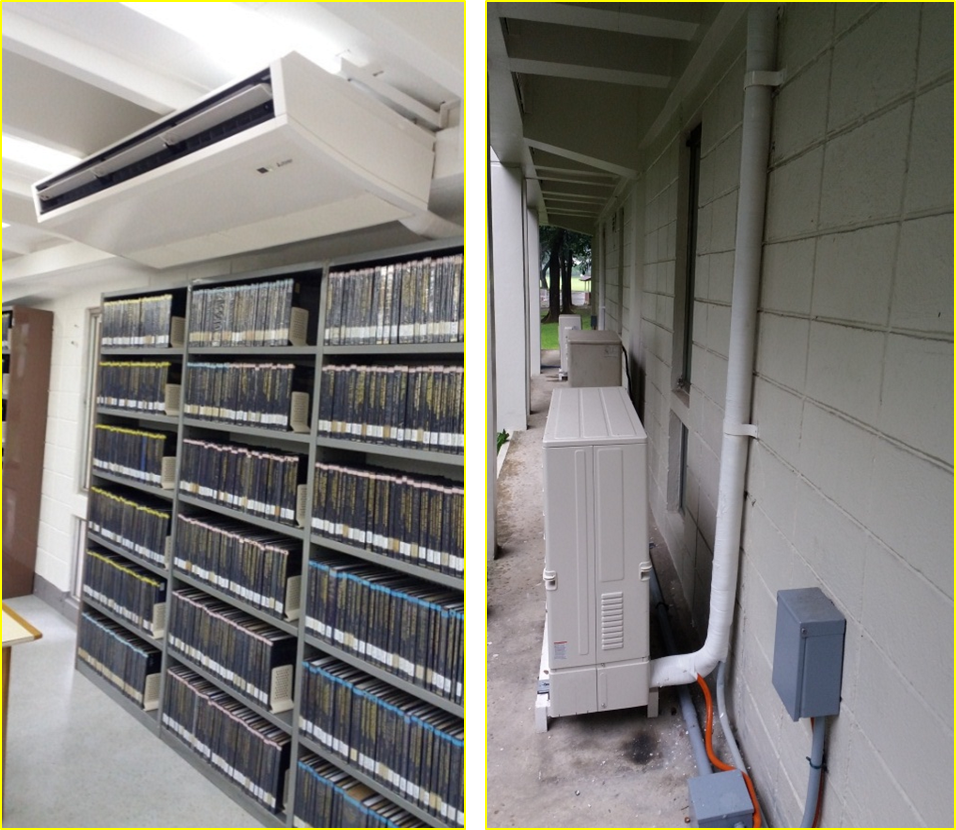
Across its buildings, 85% of lighting systems, 64% of air-conditioning units, and 47% of pumps and motors have transitioned to energy-efficient models—reflecting an average efficiency rate of 81%. These measures not only lower energy use but also demonstrate Ateneo’s proactive approach to sustainable infrastructure management.
Renewable Energy Expansion
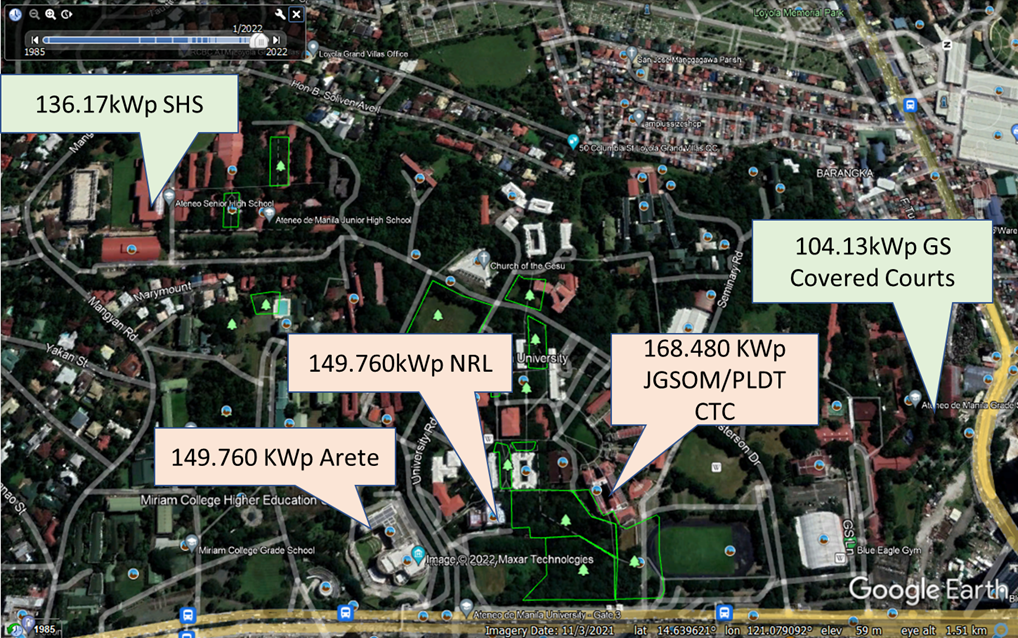
The Ateneo Solar Power Project, launched in 2020, represents the University’s commitment to clean energy generation. As of 2025, solar panels installed on five key buildings—Arete, the New Rizal Library (First Pacific Hall), PLDT-CTC/JGSOM, Senior High School Main Building, and the Ateneo Grade School Covered Courts—have a combined capacity of 695.50 kWp, producing 725,071.80 kWh annually, equivalent to nearly 6% of campus energy needs.
On May 24, 2024, Ateneo signed a renewable energy supply agreement with SolX Technologies Inc. and Shell Energy Philippines, marking its transition to 100% renewable energy for the Loyola Heights campus, six years ahead of its 2030 carbon neutrality goal. This agreement ensures that all grid-supplied electricity—14,086,848.65 kWh in 2024—is sourced from renewable producers. Combined with solar generation, 87.8% of the University’s total electricity consumption of 16,869,687.45 kWh now comes from renewable sources.
Electricity Management and Green Building Practices
Ateneo’s annual electricity consumption across its four campuses totaled 15,384,439.90 kWh in SY 2024–2025, with 836.86 kWh per person. To monitor and optimize this usage, the University employs a Supervisory Control and Data Acquisition (SCADA) system that tracks sub-metered energy consumption in real time, enabling data-driven management decisions.
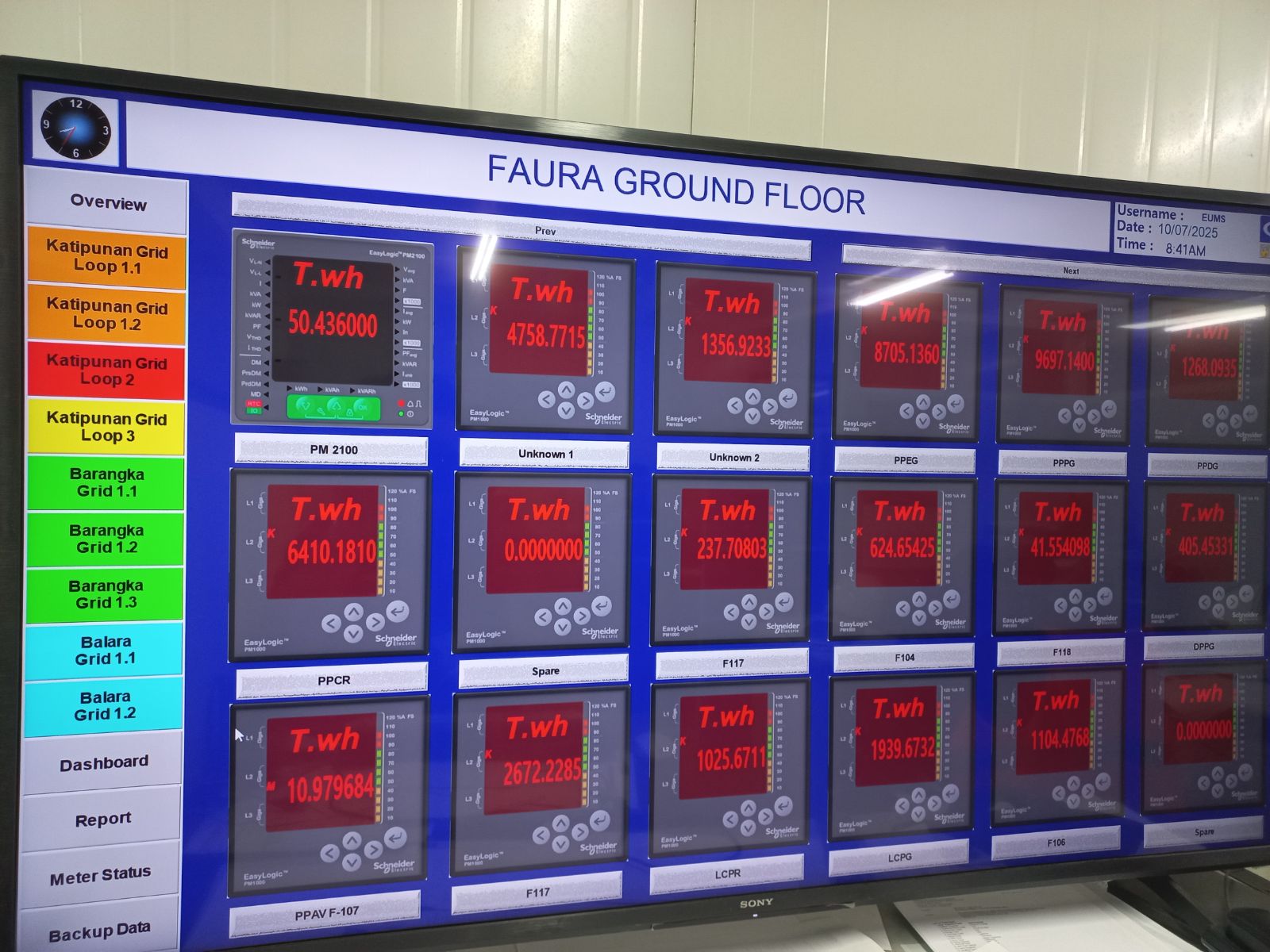
In support of its energy goals, the University has embedded Green Tropical Built Environment principles into its infrastructure. Buildings feature rainwater harvesting systems, solar-ready roof designs, LED-based lighting systems, and decentralized wastewater treatment systems (DEWATS)—ensuring that efficiency and sustainability are integral to every stage of construction and maintenance.
Carbon Footprint and Emission Management
In FY 2024–2025, Ateneo de Manila University recorded a total carbon footprint of 1,512.73 metric tons of CO₂ equivalent across its four campuses. Scope 1 emissions, totaling 85.67 tCO₂e, were primarily generated from fuel use in generator sets, school activities, campus fleets, and refrigerant leaks. Scope 2 emissions from purchased electricity accounted for 1,427.06 tCO₂e, with the Loyola Heights campus comprising the largest share. Emissions from renewable energy sources were considered zero. The University also recorded a carbon intensity of 0.08 metric tons per person.
These measurements are part of Ateneo’s ongoing climate accounting efforts, with Scope 3 emissions set to be quantified by 2027. The data reinforce the University’s focus on emission reduction through renewable energy adoption, energy-efficient infrastructure, and behavioral interventions.
|
Source of Emission |
Emissions (tCO₂e) |
Scope |
Notes |
| Generator Sets | 18.05 | Scope 1 | Fuel combustion for backup power |
| Fuel Use in School Activities | 4.67 | Scope 1 | Fuel for labs and events |
| Campus Fleet | 60.23 | Scope 1 | Fuel for university-owned vehicles |
| Lawn Equipment | 0.46 | Scope 1 | Fuel for maintenance tools |
| Refrigerant Leakage | 2.26 | Scope 1 | Fugitive emissions from AC units |
|
Total Scope 1 |
85.67 |
||
| Loyola Heights Campus | 63.09 | Scope 2 | Purchased electricity (partly renewable) |
| Rockwell Campus | 998.57 | Scope 2 | Purchased electricity |
| Salcedo Campus | 147.72 | Scope 2 | Purchased electricity |
| School of Medicine and Public Health (ASMPH) | 217.69 | Scope 2 | Purchased electricity |
|
Total Scope 2 |
1,427.06 |
||
|
Combined Scope 1 & 2 |
1,512.73 |
Innovation and Climate Change Programs
Ateneo leads multiple innovative programs in energy and climate change, including the Ateneo Solar Power Project, the Green Energy Option Program, the SCADA monitoring system, the Green Nudges campaign, and educational initiatives like Energy in Transition. These programs integrate technological innovation, behavioral science, and education to foster an institutional culture of sustainability. Complementing these are international programs such as Climate Voices, Climate Research as If People Mattered, and Race to Zero, which engage global and local communities in climate literacy, adaptation, and resilience planning.
Institutional Commitment and ICT Integration
The University utilizes ICT systems such as SCADA and renewable energy monitoring tools to plan, implement, and evaluate its energy and climate initiatives. These systems allow real-time tracking of energy data, enhancing transparency and supporting the continuous refinement of the Ateneo Climate Action Plan. The integration of ICT ensures efficiency in energy management and provides a digital backbone for achieving the University’s sustainability goals.
CFMO's Energy Efficiency Initiatives: Reducing Wastage through Preventive Maintenance
Ateneo de Manila University, through the Campus and Facilities Management Office (CFMO) identifies various areas in which energy use and consumption may not be efficient in order to reduce and eliminate wastage.
CFMO implements routine energy reviews, specifically through semi-annual preventive maintenance services. Regular energy reviews include works inspection and audits on the quantity, type, and condition of units, as well as cleaning of the system, testing, securing electrical connections, and tracking energy levels in operations. In addition, preventive maintenance includes reporting and making recommendations for mitigating energy wastage.
To illustrate, in May 2023, CFMO embarked in converting and upgrading inefficient AC units to inverter-type AC units, assuring energy efficiency ratios (EER) of 12 or above. Furthermore, it conducted energy reviews as part of its generator set preventive maintenance, which involved regular inspections, data logging, and identification of inefficient systems. It conducted financial planning while ensuring safety compliance. It conducted routine maintenance safety checks on all elevators, ensuring the prevention of energy wasting breakdowns.
CFMO has undertaken annual and ongoing energy reviews for SY 2023-24, and SY 2024-25 as illustrated by CFMO’s preventive maintenance works.
Terms of References
TOR - Elevators (2023)
TOR - Generator Sets (2023)
TOR - AC (2023)
TOR - Elevators (2024)
TOR - Generator Sets (2024)
TOR - AC (2024)
TOR - Schmitt Hall (2024)
Empowering Sustainable Change: Ateneo de Manila's renewable energy initiatives
Ateneo de Manila University is committed to enhancing energy efficiency in its existing buildings. As of 31 March 2023, the university has initiated the Ateneo de Manila Solar Power Project in partnership with Mspectrum, Inc., with 0.41 MW already installed out of a potential 0.468 MW capacity. This project aligns with the university's Sustainability Policies and Guidelines 2024, prioritizing energy-efficient and ecologically designed standards in the built environment.
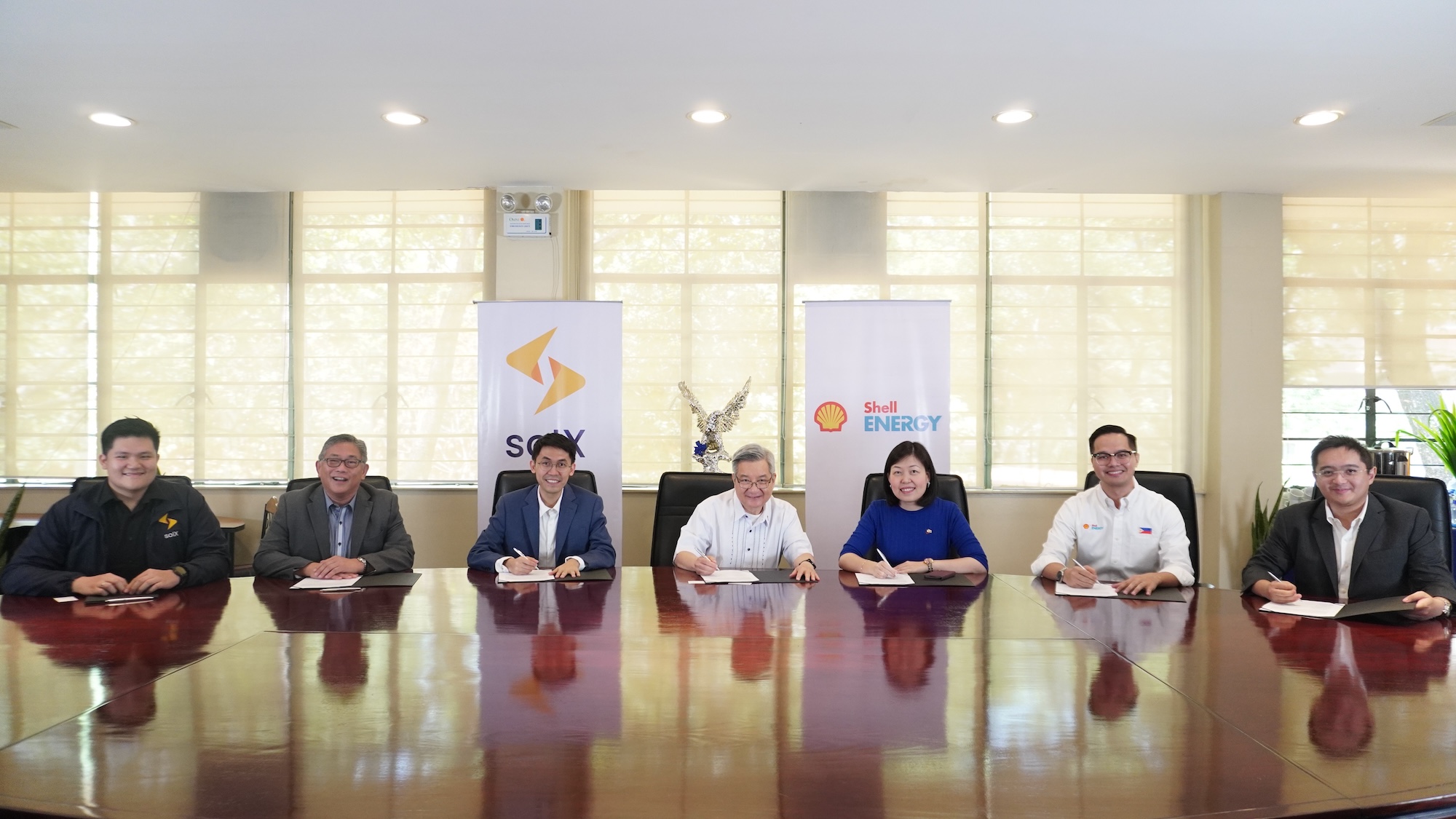
Ateneo has partnered with SolX Technologies Inc. and Shell Energy Philippines, which is a significant step toward renewable energy. This collaboration has led to a supply agreement that will enable the university to transition to 100% renewable energy, starting with the Loyola Heights campus. The transition, which began on 26 May, 2024, aims to increase the campus's self-produced renewable energy to 20% through Phase 2 of the Solar Power Project.
For more information see the Awarded Solar Projects as of 31 March 2023, Department of Energy; and the Ateneo website.
Ensure access to affordable, reliable, sustainable and modern energy for all
The University has put in place a number of efforts to lower energy use and promote environmentally friendly behaviors. The ADMU Solar Project (2019), which includes installing solar rooftop systems in eight campus buildings, is one such endeavor. The project intends to expand energy saving and efficiency initiatives. Energy recycling and conservation guidelines from the Ateneo Institute of Sustainability also encourage sustainable behavior and increase awareness. Through Clean Energy Living Laboratories (CELLs) project, the Ateneo School of Government has also contributed to the conversation on clean energy.
Efficient Energy Management: Ateneo de Manila University's Upgrades to Campus Facilities and Systems
Ateneo de Manila University's Campus Facilities and Management Office has plans to upgrade existing buildings to higher energy efficiency. The actions taken include making energy efficiency a priority for the university. The Equipment Terms of Reference (TORs) indicate that the university has implemented measures such as repairing chiller pumps, replacing old AC units with more efficient ones, and implementing regular preventive maintenance for various buildings and facilities to ensure AC systems operate efficiently.
Based on the Terms of Reference (TOR), Ateneo de Manila University has considered energy efficiency for both new building construction and existing building improvements. The TOR requires that new buildings be oriented to minimize solar exposure and heat gain. Roof paints and coatings with infrared-reflecting pigments also reduce building heat buildup. Non-irritant and non-toxic roofing insulation creates a barrier to heat gain. At the same time, thermal glazing of the external window and door glass minimizes the load on cooling equipment. The proper design of building envelope openings allows natural light and air circulation, while AAC blocks will be introduced as an alternative to concrete hollow blocks for significant construction projects.