Tagpuan Ateneo
Center for Dialogue, Research, and Collaboration

Research
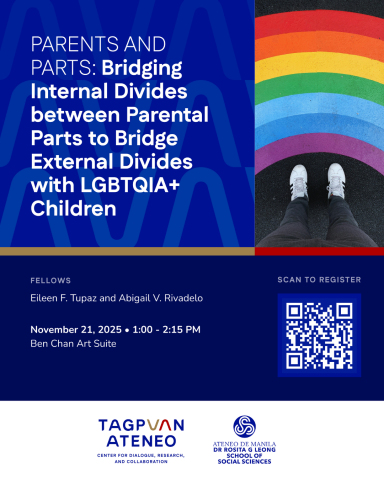
Parents and Parts: Bridging Internal Divides between Parental Parts to Bridge External Divides with LGBTQIA+ Children
RESEARCH FELLOWS:
Abigail Vitug Rivadelo, MA, RPsy
Eileen Fulache Tupaz, PhD
PROJECT DESCRIPTION:
Discovering that their child is queer can be overwhelming for many parents—even for parents who have progressive views about the LGBTQIA+ community. Reactions can range from shock, dismay, and disbelief to fear, anxiety, and anger. Whatever the circumstances happen to be, non-supportive parental reactions to the coming out of a queer child can be profoundly hurtful and harmful to the child, to the parents themselves, and to the family as a whole.
This project was born out of an intention to reduce the hurt and the harm that Filipino children and families can suffer upon the discovery of a child’s queer identity. Its aim was to create a set of asynchronously-available learning materials that cover:
- foundational concepts concerning sexual orientation, gender identity, gender expression, and sex characteristics (SOGIESC);
- the critical role that family reactions play in the health and well-being of an LGBTQIA+ child or youth and what the spectrum of typical reactions involves; and
- some conceptual tools and practical skills that Filipino parents and families can use to foster greater acceptance and affirmation of queer children and youth.
COMMUNITY:
While the materials developed from this project are aimed primarily towards English-speaking
Filipino parents with at least one LGBTQIA+ child, any individual or organization wishing to foster greater acceptance and affirmation of Filipino queer children and youth can make use of its content.
INNOVATIVE RESEARCH DESIGN:
To develop the aforementioned learning materials, we reviewed the existing affirmative parenting literature and interviewed six Filipino queer youth, five Filipino parents of queer youth, and 12 Filipino educators, researchers, and psychology practitioners. We also drew upon conceptual and practical tools devised from the Dutch psychologist Hubert Hermans’ Dialogical Self Theory, the American psychotherapist Richard Schwartz’s Internal Family Systems model, the Israeli researcher Dina Nir’s Negotiational Self Method, and a number of other intrapersonal and interpersonal relational approaches.
KEY INSIGHTS:
- Self-identified progressive parents can still have a variety of misconceptions that complicate accepting and affirming their queer children. (Even queer children and youth themselves can have misconceptions about what it means to be queer.)
- Grief over foreclosed possibilities, anxiety about adverse futures and hiya over social consequences were predominant parental reactions.
- Parental support is vitally needed but often missing...and also daunting to access or solicit because of stigma.
- Religion can be a help or a hindrance depending on the specific views held and practices espoused by one's religious community.
- For both parents and children, simply getting to share their stories is already healing and transformative.

Tagpuan Ateneo
Center for Dialogue, Research and Collaboration
2nd Floor, Old Communications Building,
Seminary Road,
Ateneo de Manila University Loyola Heights Campus,
Katipunan Avenue, Loyola Heights
1108 Quezon City
Philippines