"Sandali Bilang Kontra-Naratibo: Pagbakas sa Kasaysayan ng Dagling Andergrawnd sa Panahon ng Diktadurang Marcos" by Jomar G. Adaya

Escaler Hall
 15 Sep 2025 05:00 pm
-
15 Sep 2025 07:00 pm
15 Sep 2025 05:00 pm
-
15 Sep 2025 07:00 pm




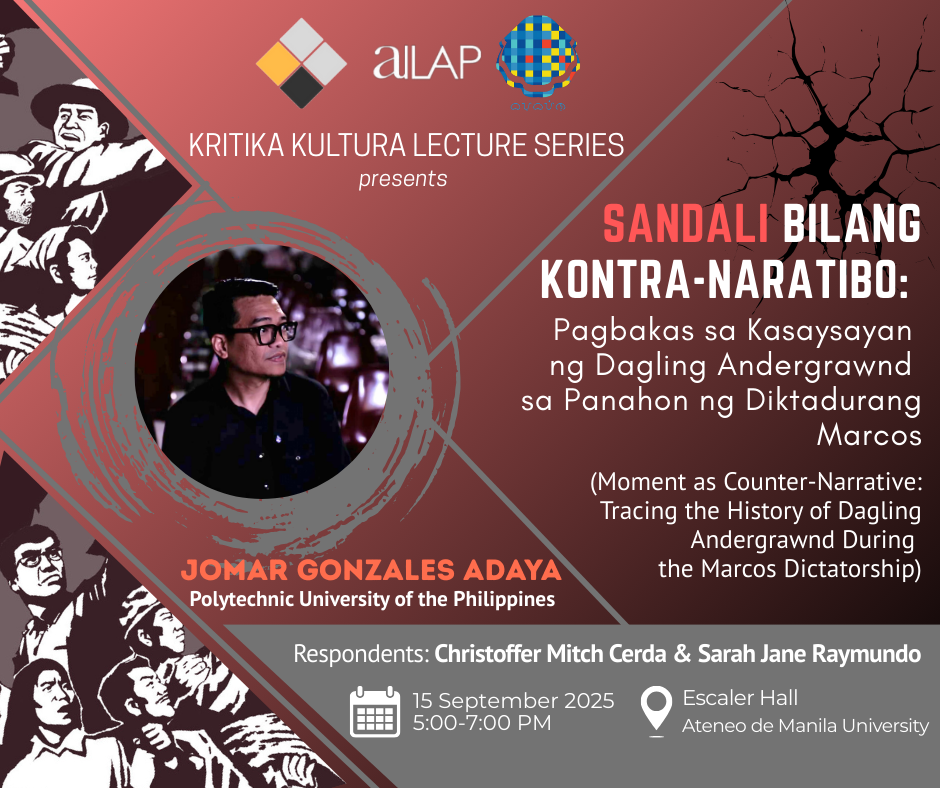
The School of Humanities of the Ateneo de Manila University invites the general public to
Sandali Bilang Kontra-Naratibo: Pagbakas sa Kasaysayan ng Dagling Andergrawnd
sa Panahon ng Diktadurang Marcos
(Moment as Counter-Narrative: Tracing the History of Dagling Andergrawnd
During the Marcos Dictatorship)
by Jomar G. Adaya
Part of the Kritika Kultura Lecture Series
To register, visit https://go.ateneo.edu/KKLecture-Adaya or scan the QR Code.

Kritika Kultura, in collaboration with the Ateneo Institute of Literary Arts and Practices (AILAP) and Baybayin Ateneo, invites you to a lecture titled “Sandali Bilang Kontra-Naratibo: Pagbakas sa Kasaysayan ng Dagling Andergrawnd sa Panahon ng Diktadurang Marcos” (“Moment as Counter-Narrative: Tracing the History of Dagling Andergrawnd During the Marcos Dictatorship”), to be delivered by Jomar G. Adaya of Polytechnic University of the Philippines. Sarah Jane S. Raymundo of the Center of International Studies-UP Diliman and Christoffer Mitch C. Cerda of the Ateneo Institute of Literary Arts and Practices (AILAP) will serve as respondents to the lecture. The event will take place on 15 September 2025, 5:00–7:00 PM, at the Escaler Hall, Ateneo de Manila University.
This lecture traces the relegated history of dagli by focusing on its reemergence and transformation during the national democratic struggle of the 1970s. While this literary genre is commonly historicized through institutional literary publications and its early 20th-century iterations, the study investigates its potency during the Marcos dictatorship. By reading the dagling andergrawnd as a counter-narrative form that disrupts authoritarian conceptions of time, the lecture offers a critical intervention in how literary forms shape political resistance.
Admission is free and open to the public. Books will be available for purchase before and after the event. Please bring a valid ID for campus access.
ABSTRACT IN FILIPINO
Taong 2007 nang ilathala ng Ateneo de Manila University Press ang Ang Dagling Tagalog, 1903–1936 na pinamatnugutan nina Aristotle Atienza at Rolando Tolentino. Masasabing naging instrumental ang aklat na ito sa paglaganap ng dagli sa mga institusyong pampanitikan sa bungad ng ika-21 siglo. Ang introduksiyon nina Atienza at Tolentino ang karaniwang ginagamit na batayan kapag tinatalakay ang pag-ugat sa kasaysayan at tradisyon ng dagli na sinasabing namayagpag sa mga publikasyong popular sa panahon ng kolonyalismong Amerikano at biglang maglalaho sa huling bahagi ng dekada ‘30, sa panahon ng paglaganap ng ganap na porma ng maikling kuwentong Tagalog. Mula sa tala ng ilan pang pag-aaral, muli raw mabubuhay ang dagli sa bungad ng ika-21 siglo, hindi na sa espasyo ng magasing popular, kundi sa lunan ng university at mainstream press. Bagama’t nabanggit sa aklat ang pagsulpot ng dagli sa mga aksyong masa ng kilusang pambansa demokratiko ng dekada ‘70, hindi na ito komprehensibong natalakay bunsod ng limitasyon ng isinagawang pananaliksik arkaybal. Maging sa sumunod na mga pag-aaral, wala pang nagtuon sa dagli na nasa lunan ng pambansa demokratikong pakikibaka. Sa ganitong konteksto, nilalayon ng panayam na maugat ang puwang sa kasaysayan ng dagli sa pamamagitan ng pagtuon sa dagling andergrawnd ng kilusang pambansa demokratiko sa panahon ng diktadurang Marcos ng dekada ‘70. Tinatangka ng panayam na ito na panimulang matalakay ang kasaysayan ng dagling andergrawnd bilang materyalisasyon ng “sandali” na porma ng kontra-naratibo na lumilikha ng antala o paghinto sa namamayaning konsepto at praktika ng “panahon” na “pare-pareho at hungkag” na nirerepresenta naman ng kapangyarihan ng diktadurang Marcos. Iginigiit ng pag-aaral na ito hindi lamang ang naging kontribusyon ng panitikang pambansa demokratiko sa paglinang sa tradisyon ng dagli, kundi higit, ang pagbabagong hubog nito sa anyo bilang “rebolusyonaryong sandali” tungo sa pagsulong ng kilusang anti-diktadura.
ABSTRACT
In 2007, the Ateneo de Manila University Press published the Ang Dagling Tagalog, 1903–1936, edited by Aristotle Atienza and Rolando Tolentino. This book may be considered instrumental in the proliferation of dagli within the literary institutions at the turn of the 21st century. The introduction by Atienza and Tolentino is commonly used as a primary reference in tracing the history and tradition of dagli, a form said to have flourished in popular publications during the American colonial period, only to abruptly disappear in the late 1930s with the rise of the fully developed short story in Tagalog. According to accounts of other studies, the dagli would re-emerge at the dawn of the 21st century—not in the pages of popular magazines, but within the spaces of the university and mainstream press. Although the emergence of dagli in the 1970s mass actions of the national democratic movement is briefly mentioned in the book, it was not explored in depth due to the limitations of the archival research conducted. Even in subsequent studies, no focused inquiry has yet been made on the dagli situated within the context of the national democratic struggle. It is within this context that this lecture seeks to trace the dagli’s historical discontinuities by focusing on the dagling andergrawnd of the national democratic movement during the Marcos dictatorship of the 1970s. This lecture attempts a preliminary discussion of the history of the dagling andergrawnd as a materialization of “moment”—a form of counter-narrative that creates a rupture or interruption in the dominant conception and practice of “time” as “homogeneous and empty,” a temporality represented by the authoritarian power of the Marcos dictatorship. This study asserts not only the contribution of national democratic literature to the development of the tradition of dagli, but more importantly, its remolding of the form as a “revolutionary moment” towards the advancement of the anti-dictatorship movement.
BIONOTE IN FILIPINO
Si Jomar Gonzales Adaya ay nagtuturo ng mga kurso sa panitikan at Filipino bilang Kawaksing Propesor sa Kagawaran ng Filipinolohiya ng Politeknikong Unibersidad ng Pilipinas (PUP). Nagsisilbi rin siyang Hepe ng PUP Sentro sa Araling Pilipino, Editor ng Bisig Journal, at Kawaksing Editor ng Entrada. Kasalukuyan kumukuha ng PhD in Philippine Studies sa Unibersidad ng Pilipinas Diliman, ang kaniyang tinatangkang disertasyon ay pagsiyasat sa kasaysayan at tradisyon ng dagling NatDem bilang anyo ng kritikang pangkultura at pampolitika. Kasapi siya ng Concerned Artists of the Philippines, PUP Chapter.
BIONOTE
Jomar Gonzales Adaya is an Associate Professor at the Kagawaran ng Filipinolohiya of the Polytechnic University of the Philippines (PUP), where he teaches literature and Filipino courses. He also serves as Chief of the PUP Center for Philippine Studies, and as Editor of Bisig Journal and Associate Editor of Entrada. Currently pursuing his PhD in Philippine Studies at the University of the Philippines Diliman, his dissertation explores the literary history and tradition of the “dagling NatDem” as a form of cultural and political critique. He is a member of the Concerned Artists of the Philippines, PUP Chapter.
ABOUT KRITIKA KULTURA
Kritika Kultura is acknowledged by a host of Asian and Asian American Studies libraries and scholarly networks and indexed in the MLA International Bibliography, Arts and Humanities Citation Index (Clarivate), Scopus, EBSCO, the Directory of Open Access Journals, and the International Consortium of Critical Theory Programs (ICCTP). Read KK issues and learn about submission guidelines and events on https://archium.ateneo.edu/kk or email the editors at kk@ateneo.edu.
Latest Events
Retreat / Recollection
2026 Alumni Holy Week Triduum Retreat: Holy Week Triduum Reflections
Thu, 02 Apr 2026
Lecture / Talk / Discussion
The Cybercrime Wave in the Philippines: Institutionalizing Digital Forensics Toward Risk Management and Corporate Resilience
Wed, 08 Apr 2026
Lecture / Talk / Discussion
Imagining the Roads Ahead: Futures Thinking in Sustainable Development
Fri, 10 Apr 2026
Lecture / Talk / Discussion
Ateneo Intellectual Property Week 2026: IP and Sports – Ready, Set, Innovate!
Mon, 13 Apr 2026