2025 Leong Institute Fellows Forum

Leong Hall Auditorium
 09 Oct 2025 01:00 pm
-
09 Oct 2025 03:30 pm
09 Oct 2025 01:00 pm
-
09 Oct 2025 03:30 pm



The Ricardo Leong Institute for Global and Area Studies of the Dr Rosita G Leong School of Social Sciences would like to invite you to the 2025 Leong Institute Fellows Forum which will now be held on 9 October 2025, Thursday, 1-3:30 PM, at the Leong Hall Auditorium.
Kindly register using the new link (2025 LIFF) or the QR code on the poster below.
We look forward to seeing you!
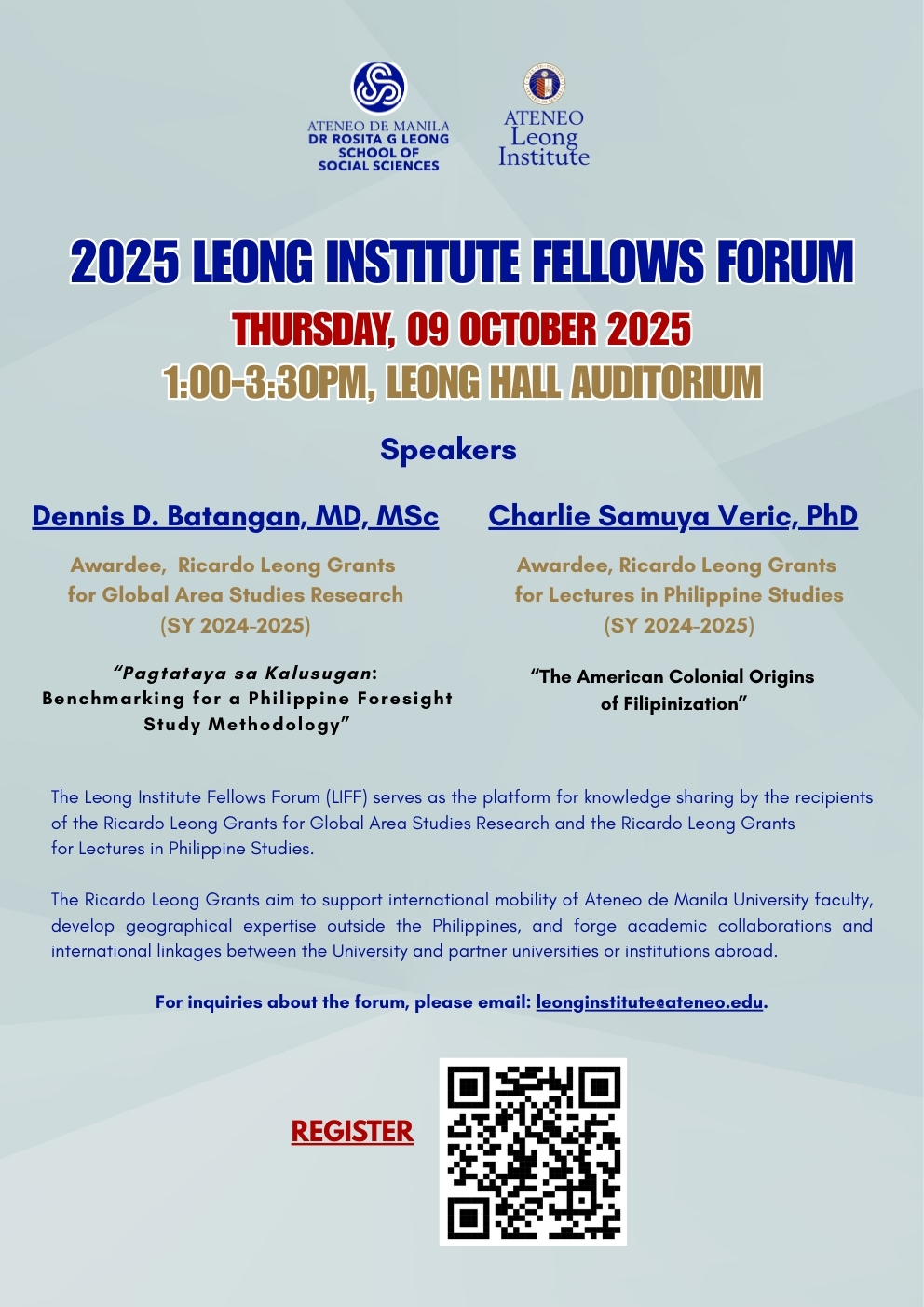
Speakers:
Dennis B. Batangan MDMSc
Leong Institute Global Area Studies Research Fellow
Dr. Batangan is a public health specialist, esteemed faculty member of the Dr. Rosita G. Leong School of Social Sciences and Ateneo School of Government, research scientist at the Institute of Philippine Culture, and awardee of the 2025 Philippine Association for the Advancement of Science and Technology (PhilAAST) Lourdes Campos Award for Public Health.
His host institutions for his research were the Korea Institute of Science and Technology, Evaluation and Planning (KISTEP), Vietnam National University Hanoi - University of Social Sciences and Humanities, and the EPI Northern Region Communicable Disease Control Department, Thailand.
Charlie Samuya Veric, PhD
Leong Institute Lectures in Philippine Studies Fellow
Dr. Veric is associate professor and the founding director of the Literary and Cultural Studies Program at the Ateneo de Manila University, Vice Chair of the Humanities Division of the National Research Council of the Philippines, and former fellow of the Stellenbosch Institute for Advanced Study and the Johannesburg Institute for Advanced Study.
He delivered his lecture at Brown University hosted by the Brown University Southeast Asian Studies Initiative and the Brown University Filipino Alliance, USA.
Abstracts:
Pagtataya sa Kalusugan: Benchmarking for a Philippine Foresight Study Methodology
Dennis B Batangan MD MSc
Leong Institute Global Area Studies Research Fellow
As a methodological study, this RLIGAS Research Fellowship conducted benchmarking activities with foresight study methodologies in South Korea, Vietnam, and Thailand. The Philippines’ Ambisyon Natin 2040 and Pagtanaw 2050 were referenced as well in piloting an emerging foresight methodology using an electronic Delphi Survey platform. The 2022 National Health Demographic Survey (NDHS) major health issues were framed as Delphi survey questions with indicators in identifying possible health interventions and its realization through WHO’s health system building blocks. Thirteen (13) Delphi survey respondents using the eDelphi platform assessed the urgency of each major issue as an anticipated health need and evaluated the importance, awareness, and realization of identified possible health interventions. The research process and results of the pilot study will be presented in this public lecture.
The American Colonial Origins of Filipinization
Charlie Samuya Veric PhD
eong Institute Lectures in Philippine Studies Fellow
The lecture reconstructs how Filipinization as a colonial policy became the basis of postcolonial identity. Contrary to conventional wisdom, I argue that decolonization did not take place after colonization. Rather, Filipino decolonization evolved with US colonialism. The story of how Filipinization came to be is, in short, the yet untold story of the strange but successful American experiment with a new form of governmentality in the 20th century: Imperialism without imperialists. Looking at American colonial policies following the successful occupation of the Philippines in 1898, I will reconstruct the twin rise of US colonialism and Filipino decolonization, demonstrating how the former became the enabling context for the emergence of the latter. Using historiographical methods in American Studies and Philippine Studies, as well as archival documents and newspaper accounts, I will track the emergence of Filipinization and shed light on its development as a colonial policy and, later, as a political thought from 1898 to 1946 when the US granted independence to the Philippines. Contained in this evolution—wherein Filipinization, independence, and decolonization bled into each other—was the dual development of the colonial US into a neocolonial power, and of the colonized Philippines into a postcolonial nation.
Latest Events
Retreat / Recollection
2026 Alumni Holy Week Triduum Retreat: Holy Week Triduum Reflections
Thu, 02 Apr 2026
Lecture / Talk / Discussion
The Cybercrime Wave in the Philippines: Institutionalizing Digital Forensics Toward Risk Management and Corporate Resilience
Wed, 08 Apr 2026
Lecture / Talk / Discussion
Imagining the Roads Ahead: Futures Thinking in Sustainable Development
Fri, 10 Apr 2026
Lecture / Talk / Discussion
Ateneo Intellectual Property Week 2026: IP and Sports – Ready, Set, Innovate!
Mon, 13 Apr 2026