
Graduate School of Business
MBA Program - Standard


About MBA Program - Standard Track
Program Learning Outcomes: MBA
Track Learning Outcomes: MBA Standard
The MBA Standard track is targeted at early-career professionals who are ready to assume greater responsibilities and broader leadership roles. MBA Standard guides students to become proficient in management fundamentals, grounding them concepts, frameworks, and their applications appropriate to leaders undergoing the passage to early leadership roles.
For students who do not have a business or management background, MBA Standard offers five pre-MBA courses to prepare them for the rest of the MBA
The program follows a trimestral schedule.
PLO1: Demonstrate proficiency in the foundational skills of management
PLO2: Demonstrate proficiency in the functional management disciplines
PLO3: Create an integrative management plan that integrates the core functional courses, as well as Responsible Business perspectives and Digital Transformation requirements
PLO4: Assemble a leadership portfolio that demonstrates how they have practiced their leadership skills based on Ignatian values
PLO5: Demonstrate proficiency in the specialized disciplines of chosen electives
TLO1: Demonstrate proficiency in the foundational skills of management suitable for supervisory or individual contributor roles
TLO2: Demonstrate proficiency in the functional management disciplines in situations suitable for supervisory or individual contributor roles
TLO3: Create an integrative management plan that integrates the core functional courses, as well as Responsible Business perspectives and Digital Transformation requirements
TLO4: Assemble a leadership portfolio that demonstrates how they have practiced their leadership skills based on Ignatian values
TLO5: Demonstrate proficiency in the specialized disciplines of chosen electives

Distinctive Features
Curriculum
- Modular approach, with specified daily learning outcomes, activities and assignments
- Focused not just on theories and techniques but also on values and personal transformation
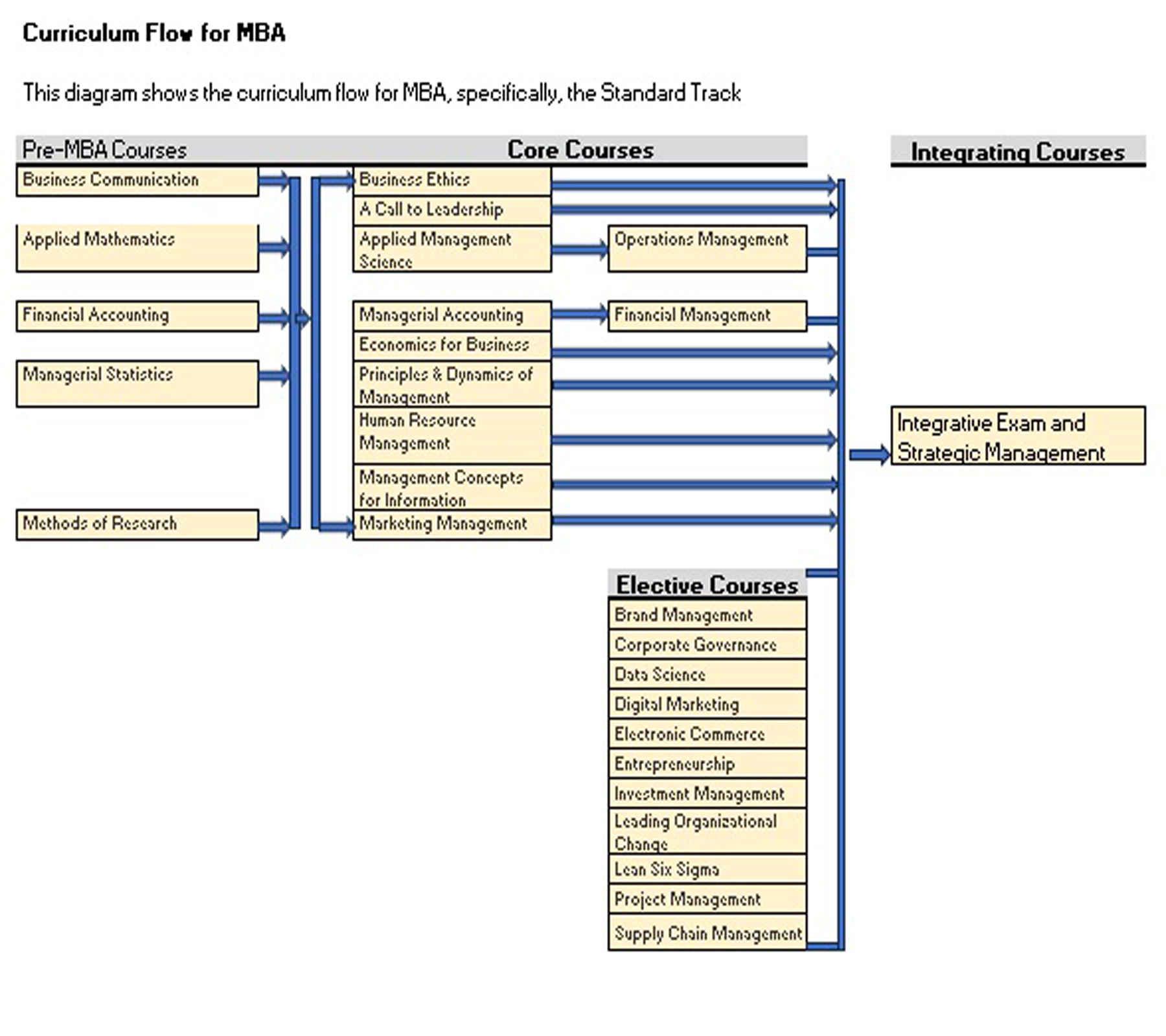
- Made up of a total of 19 courses (52 units in total): 5 pre-MBA courses, 11 core courses, 2 electives, and a final, integrating course
- Non-thesis program, with an integrating Strategic Management paper as the terminal requirement
Delivery
- MBA Standard is offered on a part-time basis. All classes are offered either on week nights, or on Saturday.
- Students who pass validating examinations before the start of the trimester may be exempted from the pre-MBA courses.
- The learning mode is hybrid: a combination of asynchronous sessions via the Canvas learning management system; synchronous online sessions via Zoom; and onsite/flex sessions.
- MBA Standard follows a trimestral schedule; the entire program can be completed in seven trimesters of 15 weeks each, or a total of two years and four months.
- Students can take up to three courses per trimester.
- MBA Standard is offered at the AGSB main campus in Rockwell Center, Makati City, and Satellite Campuses in Cebu and Clark.

The MBA Standard Track Curriculum
General Description
MBA Standard consists of the following courses:
-
Pre-MBA Courses 10 units Core Courses 33 units Elective Courses 6 units Integrating Course 3 units Total 52 units
The program allows exemption in the Pre-MBA Courses (with the exception of Research for Management), upon validation by the Office of the Registrar
COURSE CODE UNITS
| COURSE | CODE | UNITS |
|---|---|---|
| 1. Pre-MBA Courses | ||
| Business Communication | SPBUSCOM | 2 |
| Applied Mathematics | SPAPMATH | 2 |
| Financial Accounting | SPFINACC | 2 |
| Managerial Statistics | SPMASTAT | 2 |
| Methods of Research | SPMETRES | 2 |
| 2. Core Courses | ||
| A Call to Leadership | SPLEADER | 3 |
| Business Ethics | SPETHICS | 3 |
| Principles & Dynamics of Management | SPPRIMAN | 3 |
| Marketing Management | SPMARKMA | 3 |
| Human Resource Management | SPHUMRES | 3 |
| Managing Concepts for Information Technology | SPINFOTE | 3 |
| Applied Management Science | SPMANSCI | 3 |
| Managerial Accounting | SPMANACC | 3 |
| Financial Management | SPFINMAN | 3 |
| Operations Management | SPOPEMAN | 3 |
| Economics for Managers | SPECOMAN | 3 |
| 3. Elective Courses | ||
| Brand Management | SPBRANMA | 3 |
| Corporate Governance | SPCORPGOV |
3 |
| Data Science for Managers | SPDATSCI |
3 |
| Digital Marketing | SPDIGIMA | 3 |
| Electronic Commerce | SPE-COMME | 3 |
| Entrepreneurship | SPENTREP | 3 |
| Investment Analysis and Portfolio Management | SPINVEMA | 3 |
| Leading Organization Change | SPLEADOC | 3 |
| Lean Six Sigma | SP6SIGMA | 3 |
| Project Management | SPPROJMA | 3 |
| Supply Chain Management | SPSUPMAN | 3 |
| 4. Integrating Course | ||
| Integrative Exam | SPINTEXM | 0 |
| Strategic Management | SPSTRAMA | 3 |
MBA Standard Track Course Sequence
Course Descriptions
Pre-MBA Courses
Business Communication (SPBUSCOM)
- This course provides an in-depth look at communication strategies for effective leadership. It covers analytical writing, persuasive speaking, and digital literacy. Students learn to adapt communication for diverse contexts, resolve conflict, and leverage technology for strategic success in a global business environment.
Applied Mathematics (SPAPMATH)
- This course is designed for students and business practitioners who need to learn how modern mathematics can be applied to business. It prepares students for courses in production, statistics, managerial economics, management accounting, and management science. The course aims to help students apply mathematical principles to business and personal financial decisions, such as investments, mortgages, and insurance.
Managerial Statistics (SPMASTAT)
- This online course equips students with the skills to use statistical tools and techniques for decision-making under uncertainty and for conducting research. It is a conceptual and problem-oriented course covering descriptive and inferential statistics, as well as probability concepts, with statistical computations performed using Excel.
Financial Accounting (SPFINACC)
- This pre-MBA course introduces financial accounting as a tool for planning and control. It focuses on fundamental financial statements and their underlying principles, including Philippine and International Reporting Standards. Students learn to construct, present, and interpret financial information to make sound, ethical decisions that benefit firms and society.
Methods of Research (SPMETRES)
- This course equips students with the skills to use statistical tools and techniques for decision-making under uncertainty and for conducting research. It is a conceptual and problem-oriented course covering descriptive and inferential statistics, as well as probability concepts, with statistical computations performed using Excel.
2. Core Courses
Business Ethics (SPETHICS)
- This course helps students develop a sense of moral and social responsibility. It discusses the foundations of ethics in general and business ethics in particular. The course presents a model for ethical reasoning to analyze dilemmas in employee relations and corporate-community relations. The course also aims to teach that business should contribute to the well-being of its employees and community, not just profits.
A Call to Leadership (SPLEADER)
- This course guides students in developing a deeper understanding of leadership concepts and practices by encouraging reflective analysis of their personal and professional experiences. It emphasizes critical thinking, ethical reasoning, and decision-making to help students understand leadership dynamics and patterns.
Applied Management Science (SPMANSCI)
- This online course provides formal training on using quantitative tools to solve management problems in various functional areas. The course is problem-oriented, using Excel spreadsheets and other software to develop mathematical models for real-world situations. Students learn to formulate problems, interpret results, perform sensitivity analysis, and gain managerial insights from quantitative solutions.
Operations Management (SPOPEMAN)
- This practical course gives a comprehensive understanding of operations management (OM) concepts, techniques, and applications. It covers strategic, tactical, and operational issues in manufacturing and service sectors, focusing on creating a competitive advantage using operational skills and tools. The course also discusses the ethical, social, and environmental implications of OM decisions.
Managerial Accounting (SPMANACC)
- This course introduces learners to the use of accounting information for internal reporting and decision-making functions in an organization. It covers topics such as cost concepts, cost accumulation methods, CVP analysis, and budgeting. The course emphasizes how cost and profit data guide managers in making operational and strategic decisions, while also considering ethics, corporate governance, and social responsibility.
Financial Management (SPFINMAN)
- This course focuses on applying contemporary finance theory to solve management problems. It emphasizes policy formulation and decision-making under uncertainty while tackling ethical issues and dilemmas a finance manager may face. The course also illustrates the implications of financial management decisions on an enterprise and the national economy.
Principles & Dynamics of Management (SPPRIMAN)
- This course is a comprehensive study of management and its critical dimensions, designed to provide learners with the knowledge, skills, and competencies to operate as managers in a complex and rapidly changing business environment. As a core MBA subject, it prepares students to successfully complete succeeding course requirements.
Human Resource Management (SPHUMRES)
- This course emphasizes aligning Human Resource Management practices and programs with an organization's goals, strategies, and values. It provides a fresh perspective on the role of HR as a change agent in partnership with top management to build a critical source of sustainable competitive advantage. The course addresses human resource topics from a strategic perspective, including reward systems, performance management, training, and recruitment.
Management Concepts for Information Technology (SPINFOTE)
- This course provides an overview of Management Information Systems (MIS) concepts using a framework that integrates management, organization, and technology. It covers the core principles of MIS and their impact on today’s business environment, exploring challenges like cybercrime and emerging technologies such as big data, cloud computing, and AI. The course aims to help students bridge technology and business strategy to become effective decision-makers.
Marketing Management (SPMARKMA)
- This course provides learners with the knowledge, skills, and competencies to make effective marketing decisions within a complex and rapidly changing business environment influenced by technology and innovation. The course also aims to demonstrate how ethical and socially responsible marketing practices can contribute to nation-building.
Economics for Managers (SPECOMAN)
-
This course provides a working knowledge of economics for MBA students. It consists of microeconomics for sound managerial decisions and macroeconomics for understanding the business environment. The course provides analytical tools to help students navigate the turbulence of the national and global economy.
3. Elective Courses
Brand Management (SPBRANMA)
- This course provides a comprehensive study of brand marketing, covering fundamental concepts and frameworks for making effective brand marketing decisions in a rapidly changing business environment. It equips students with the knowledge and skills to create a brand plan, formulate product and pricing strategies, develop a communication plan, and measure brand plan effectiveness. The course also emphasizes ethical and socially responsible brand marketing practices that contribute to nation-building.
Corporate Governance (SPCORPGOV)
- This course introduces students to corporate governance with local and global practical perspectives. It presents a case study approach to various governance practices and challenges, focusing on ASEAN integration and globalization. The course tasks students to explore the dynamics of corporate governance and how it adds value to organizations.
Data Science for Managers (SPDATSCI)
- This course is meticulously crafted to furnish students with the indispensable tools and expertise required to transform an organization into a data-driven powerhouse. As a visionary business leader, it is imperative not only to grasp what an organization’s data can do and the potential of available cutting-edge technologies but also to possess the skills and knowledge necessary to seamlessly integrate them into the fabric of the organization’s culture and operations.
Digital Marketing (SPDIGIMA)
- This course combines a strategic view of digital marketing with a tactical assessment of essential digital tools and platforms. The goal is to help students augment their knowledge of Marketing Management by integrating digital technology into their overall marketing strategy. The course highlights local examples and applications and features guest speakers from the digital marketing field.
Electronic Commerce (SPE-COMME)
- This course is designed to guide managers through embracing the benefits of e-commerce for customers, employees, and shareholders. It covers the design of e-commerce architectures, evaluation of suppliers, and management of projects to create competitive advantage. The course also discusses the role of senior management, ethical principles, the Philippines’ Electronic Commerce Law, and the role of e-commerce in nation-building.
Entrepreneurship (SPENTREP)
- This course inspires and encourages entrepreneurship by examining, discussing, and analyzing contemporary entrepreneurs. It provides principles, concepts, and evaluation techniques for assessing entrepreneurial capability, resource requirements, and risks to increase the likelihood of strategic success.
Investment and Portfolio Management (SPINVEMA)
- This course applies the principles of investment analysis and portfolio management to corporate and personal finances. Students will discuss and simulate the steps of the investment process to develop skills in creating and managing investment portfolios. The course analyzes risk and return management strategies in global and Philippine markets, including the ethical dimensions of investment decisions.
Leading Organizational Change (SPLEADOC)
- This course is designed to strengthen your thinking and practice in organizational change. You will learn to diagnose, plan, and lead an organization that is always ready for change, focusing not just on a specific change but on transforming your organization into an adaptive one that continually senses and adapts.
Lean Six Sigma (SP6SIGMA)
- This course covers Lean and Six Sigma concepts for both manufacturing and service businesses. It is a data-driven, process-oriented approach focused on reducing waste and minimizing defects to increase profitability and customer satisfaction. The course provides an overview of Lean, Six Sigma, and the DMAIC problem-solving methodologies.
Project Management (SPPROJMA)
-
This course provides a framework for effective project management and leadership. Students will use appropriate tools and concepts to handle complex problems encountered when planning and executing projects. The course also covers the core processes for initiating, planning, executing, controlling, and closing projects.
Supply Chain Management (SPSUPMAN)
- This course covers the concepts, trends, and techniques for managing activities from material procurement to product distribution. It discusses key topics such as logistics, electronic procurement, and warehousing, with a focus on how these managerial processes and technologies impact global competition and business strategy across the supply chain.
Note that Elective Courses are under constant development. There will be new ones not yet listed at the time of publishing this catalogue.
4. Integrating Course
Integrative Exam (SPINTEXM)
- The integrative exam, as the title indicates, integrates learning from the core courses to enable the student to complete the preparation for the capstone course.
Strategic Management (SPSTRAMA)
- This is the capstone course for the MBA program, where students learn to develop and implement cross-functional strategic decisions to achieve organizational goals. It covers the strategic management process, analytical frameworks, and tools for strategy formulation, implementation, and evaluation, emphasizing ethical decisions and corporate social responsibility.
Contact Details
Admissions Services
Ateneo Professional Schools
#20 Rockwell Drive, Rockwell Center, Makati City
Email: admissions.gsb@ateneo.edu
Cebu Satellite Campus
Unit 102, Ground Floor, Cebu Holdings Center Cebu Business Park, Cebu City
Email: cebu.gsb@ateneo.edu
Clark Satellite Campus
Units 7 & 8, Ground Floor, 2Workplus Building
Acacia Drive, Mimosa Leisure Estate, Clark Freeport Zone, Pampanga
Email: clark.gsb@ateneo.edu
Office Hours
Monday to Friday 12:00pm - 8:00pm
Saturday 8:00am - 12:00pm
Ateneo de Manila
Graduate School of Business
Ateneo de Manila University Rockwell Campus
#20 Rockwell Drive, Barangay Poblacion
1210 Makati City
Philippines