Klim@Bàsketbol
01 Jul 2025 | Julia Isabelle Cruz and Isabella Movido




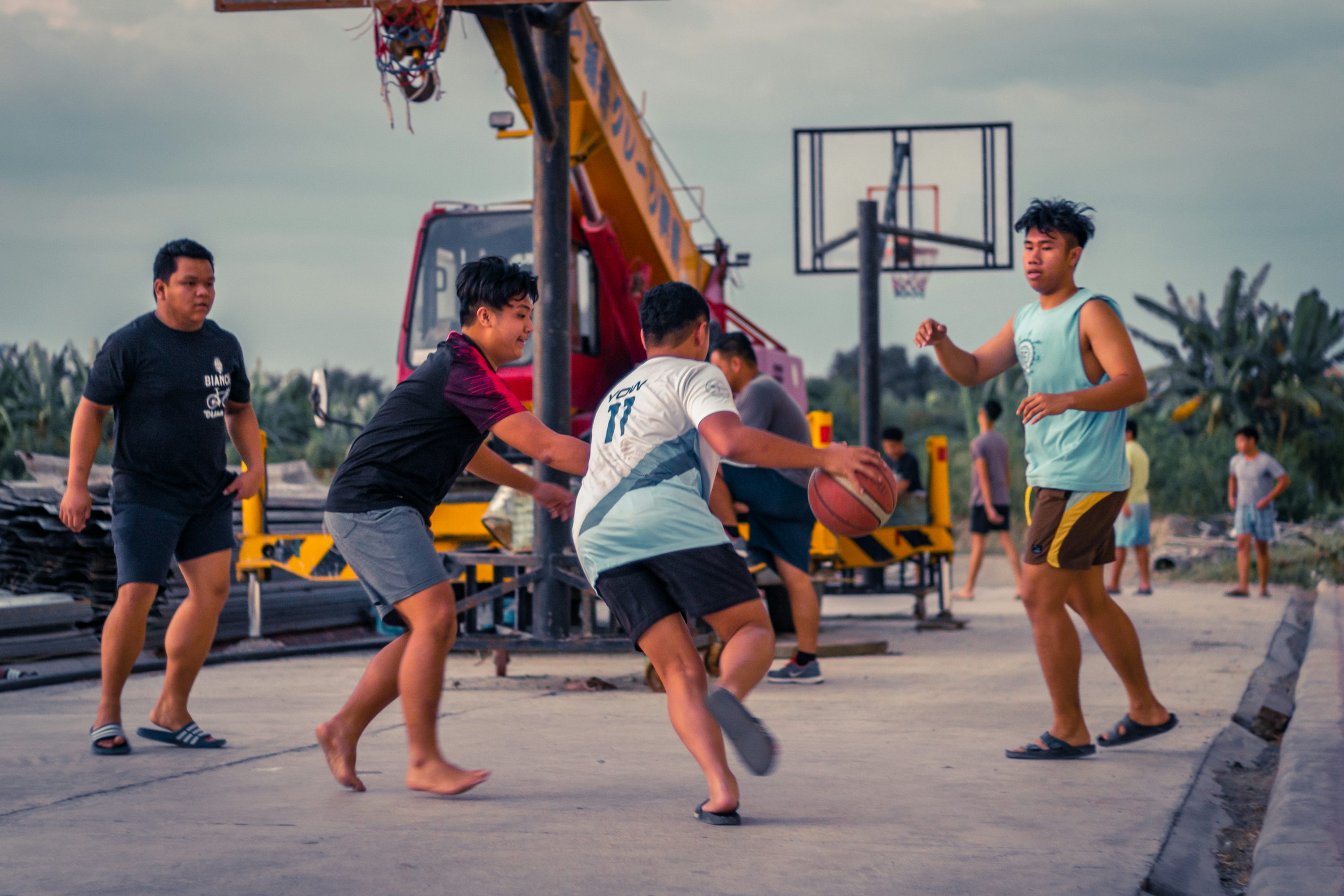
Basketball is at the heart of Filipino culture. It’s alive on every level, from the local barangay basketball tournaments to international competitions featuring the game’s biggest stars. Where basketball goes, waves of adoring fans follow. They fill courts, homes, and arenas with an energetic concoction of joy, awe, and nervous anticipation as the ball flies through the air and dances around the hoop’s rim, carrying with it all the hopes and dreams of a fanbase — of a nation. After spirited matchups, winners and losers alike can both take solace in knowing they’ve left it all out on the floor. Though it represents the extreme effort athletes expend, “leaving it all out on the floor” could also be used to express, in a literal sense, the waste generated in its wake.
Slam Dump!: Basketball's Waste Problem
According to former Department of Environment and Natural Resources (DENR) Secretary Maria Antonia Yulo-Loyzaga, the Philippines generates at least 61,000 million metric tons of waste daily, with 24% being plastic waste (Cariaso, 2023). Plastic is embedded in many aspects of the sporting experience, especially in food concessionaire items, fan paraphernalia, and even athletic wear (Dayrit, 2022). Balloons, streamers, and confetti may go a long way in supporting your favorite team, but they do not support the environment. These single-use and disposable plastics are merely dumped into landfills and take years to decompose.
Concerns about waste in Philippine sporting events have been raised since 2018, peaking when the country hosted the 2019 SEA Games. The DENR called for zero-waste policies to be implemented during this 12-day event, where they "[anticipated] large volumes of waste to be generated in the venues where food and drinks are sold…[expecting] plastic food and beverage containers, aluminum cans and cardboards as among the wastes to be produced" (Department of Environment and Natural Resources [DENR], 2019). In 2024, a study from Ifugao State University showed that the university's sporting grounds obtained the second highest amount of municipal solid waste (MSW) in the campus. According to the article, this was likely due to the high amount of sports spectators that leave behind MSW, and the large area covered by the sports grounds which increased the area to cover for maintenance (Latugan et al., 2024).
"Traveling" Violations: Pollution and Inaccessibility of Transport
Travel arrangements during sporting events also tend to expel high amounts of greenhouse gas emissions. In fact, Watson (2015, in Vienažindienė et al., 2023) indicated that travel comprises 73% of a basketball game's carbon footprint. For fans, this means attending games in venues with difficult or inaccessible commuting routes that are far from population centers (Vienažindienė et al., 2023). For example, the Mall of Asia Arena, a common venue for larger basketball games, has direct access from the EDSA Carousel bus route, but not from the MRT or LRT train stations. The Philippine Sports Stadium in Bulacan is also a great distance from many sports fans and is not easily accessible through public or mass transportation. This inaccessibility thus requires audience members to turn to less sustainable means of transportation, such as private cars. In turn, venues design their spaces with the mental model of needing to accommodate sprawling parking lots to accommodate this high volume of cars, which adds to their physical footprint. In contrast is the Araneta Coliseum, which is situated within a hub for convenient public transportation in Cubao, Quezon City.
According to Ritchie (2020), transportation accounts for around one-fifth of global CO2 emissions. Air travel, in particular, is a large part of this (Wynes, 2022 in Vienažindienė et al., 2023), which spikes when athletes compete in international leagues and have to fly out multiple times. Road travel also emits a similar level of CO2 emissions. When the Philippines hosts international competitions like the SEA Games, local road travel emissions undoubtedly increase because of the country's lack of a robust public transport system.
Athlete's Foot: Shoes and Sponsorships in Excess
Furthermore, athletes' massive sponsorships contribute to the more materialistic aspect of sports. Athletes are drowned in the latest products sent to them by major companies: endless pairs of shoes and a never-ending supply of athletic wear clutter their homes, never to be used. Fans' obsessions with merchandise add to the problem. From the jerseys and signature shoes to the players' endorsed products, fans are encouraged to purchase all these in droves. This leads to an oversupply of items, and when the demand is not met, resources are squandered and more waste is generated.
In these ways, basketball undeniably affects the environment (as a source of materials, and as a sink of waste), and as a result, the climate too. Notice though that in all these ways, it is not the sport itself producing waste nor emissions. Rather, what instead affects the environment are all the things that surround this sport–like the fan paraphernalia, the travel to and from the arena, and sports merchandise. In all these regards, we are in control of our waste and emissions. Thus, lessening our carbon footprint is not necessarily about lessening basketball, but about changing how we should be fans of our teams (i.e. realizing that we really only need to bring ourselves to support our teams), adopting less consumerist mindsets and controlling our consumption, and on the government’s end, ensuring our transportation infrastructure truly supports us.
Notice though that in all these ways, it is not the sport itself producing waste nor emissions. Rather, what instead affects the environment are all the things that surround this sport–like the fan paraphernalia, the travel to and from the arena, and sports merchandise.
Switching Courts: How Climate Affects Basketball
As much as basketball affects climate, it is essential to ponder too over the reverse of the interaction: how this volatile climate affects the game we love.
Any basketball player was first a kid who went outside, amused themselves with the hoop and ball, and despite the sweat and strain, fell in love with the sport. While basketball is an indoor sport, to play outdoors in community or makeshift courts is unmistakably a significant share of basketball culture in the Philippines.
Not only are these courts where children have their early beginnings with the sport, it is also where community is forged. Inter-barangay basketball leagues of course hold their games in their barangay basketball courts, where crowds come together to watch the same game. Some of these courts may be roofed, but regardless are open-air.
With rising temperatures, this culture of outdoor basketball, for both children and amateur players, is then clearly at stake. It is extremely valid for parents, coaches, and children themselves to hesitate playing outside. Perhaps one might float—among the tests of sports anyway is to accept and endure. However, the level of heat we are experiencing is not something we can simply bear, especially as temperature increases faster than our species can adapt to. The heat, especially on its worse days, can become physiologically too much to handle. For sports in general, many outdoor athletic meets in the Philippines have moved to hold their events not within the hours of 9 am to 3 pm, like in the Central Visayas Regional Athletic Association since 2024 (Saavedra, 2024). However, even these measures do not seem to sufficiently protect athletes from the heat. Despite sticking to the hours above, the 2024 Provincial Sports Meet of Negros Occidental saw more heat-related injuries than sports-related injuries (Prietos, 2024).
In this light then, climate change could very well affect the development of our young athletes, especially at the grassroots level, and consequently, the future of Philippine basketball.
Powering Forward: The Future of Philippine Basketball
How will this affect basketball in the Philippines? We can hypothesize–
If temperatures become too dangerous to even casually play basketball outside, we might see children move to indoor basketball courts where there is air conditioning. This might seem like a harmless trend, but for children without access to air conditioned courts, what will be their entry into the sport of basketball? Will accessing the sport then include an additional barrier? Where will they first curiously pick up a basketball and realize that they love this game?
In this light then, climate change could very well affect the development of our young athletes, especially at the grassroots level, and consequently, the future of Philippine basketball. Clearly, this hypothesis can also apply to other sports such as football, biking and swimming. What could be seen as an equalizing, or democratizing aspect of society, may develop into one that spurs inequality.
This is besides all the other practical ways that climate affects basketball—
A heavy water supply is needed for the hydration and hygiene of its athletes and the cleaning of its facilities. Raw materials such as synthetic rubber are used for the balls themselves while a supply of wood is needed to produce the hardwood flooring for all professional and collegiate basketball leagues. We know that the supply of clean water and raw materials is at stake with the rising temperatures, thus in these ways as well, climate also affects basketball.
It is often discussed how climate change will affect our economies and public health, but in this light, we also see how climate change affects entertainment, culture and the very passions of our children. Truly, there is no stone that climate change will not turn. As much as climate change affects us though, the first half of this essay, more particularly how basketball affects the climate, tells us that we are in control. This control only matters if we harness this together, and strategically, rather than in isolation.
References
Cariaso, B. (2023, August 6). Philippines produces 61,000 million metric tons of waste daily. PhilStar. https://www.philstar.com/headlines/2023/08/06/2286595/philippines-produ…
Dayrit, F. (2022). Overview on Plastic Waste: The Philippine Perspective. Transactions of the National Academy of Science and Technology, 41(2019), 1–25. https://doi.org/10.57043/transnastphl.2019.1953
Department of Environment and Natural Resources. (2019, November 30). DENR bats for ‘zero-waste’ SEA Games. https://denr.gov.ph/news-events/denr-bats-for-zero-waste-sea-games/
Junckers. (n.d.). Basketball floor: Upgrade your court. https://www.junckers.com/basketball
Labiano, M.C. (2020, March 9). Group of people playing basketball during daytime [JPG]. https://unsplash.com/photos/group-of-people-playing-basketball-during-daytime-sahai-UFyFA
Latugan, P., Carabacan, J. J., Bonicillo, G., Cayog, J., Eyawa, M. Q., Cairel, M. T., & Ngohayon, J. M. (2024). Analysis and Characterization of Municipal Solid Wastes Generated in Ifugao State University Potia Campus: A Basis For Planning of Waste Management. Nature Environment and Pollution Technology, 23(1), 281–294. https://doi.org/10.46488/NEPT.2024.v23i01.024
Nivia. (2024, August 7). How are basketballs made: A step-by-step guide. https://www.niviasports.com/blogs/news/how-are-basketballs-made-a-step-by-step-guide
Prietos, A. (2024, April 4). Athletes in Negros sports meet experience heat stress. GMA
Network. https://www.gmanetwork.com/regionaltv/sports/101251/athletes-in-negros-sports-meet-experience-heat-stress/story/
Ritchie, H. (2020, October 6.). Cars, planes, trains: Where do CO₂ emissions from transport come from?. OurWorldinData.org. https://ourworldindata.org/co2-emissions-from-transport.
Saavedra, J. (2024, April 30). 12K C. Visayas athletic meet delegates’ safety assured amid heat index. Philippine News Agency. https://www.pna.gov.ph/articles/1223771
Vienažindienė, M., Perkumienė, D., Atalay, A., & Švagždiene, B. (2023). The last quarter for sustainable environment in basketball: The carbon footprint of basketball teams in Türkiye and Lithuania. Frontiers in Environmental Science, 11, 1197798. https://doi.org/10.3389/fenvs.2023.1197798
Recent News
You may also like these articles

[Hot Off the Press] Arkipelago
New book from the Ateneo Press Arkipelago provides a fascinating and fantastical twist on Philippine politics and history Our country is an archipelago of stories

Matthew General clinches gold at Excalibur Fencing Tournament
Ateneo de Manila Senior High School standout Matthew General (12-Miki) added another gold medal to his decorated season at the Excalibur Fencing Tournament, held from

Silver success for Belarmino at Wilson Epee Invitational
Ateneo Senior High School student-athlete Hannah Belarmino (12-Ogilvie) demonstrated her mastery of the blade at the Wilson Epee Invitationals, held on 22 February 2026 at

From AGS to ASHS: Ateneo fencers haul 6 medals at 1st Estudio de Espada League
Fencers from across Ateneo de Manila Basic Education demonstrated their competitive edge at the 1st Estudio de Espada Fencing League, held from 31 January to
Ethan Santos grabs bronze at Hampton Fencing Club’s 3rd Winter Cup
Ateneo de Manila Junior High School (AJHS) student-athlete Ethan Santos (7-Aranha) added another medal to the Blue Eagles' tally after a strong showing at the
Blue Eagle blades Santos and General grab gold in Young Musketeers meet
Student-athletes from the Ateneo de Manila Junior High School (AJHS) and Senior High School (ASHS) showcased their prowess on the strip at the Young Musketeers