Bending Toward Justice: ALS Forum Examines the ICC, the Duterte Case, and Victim Participation
31 Mar 2026


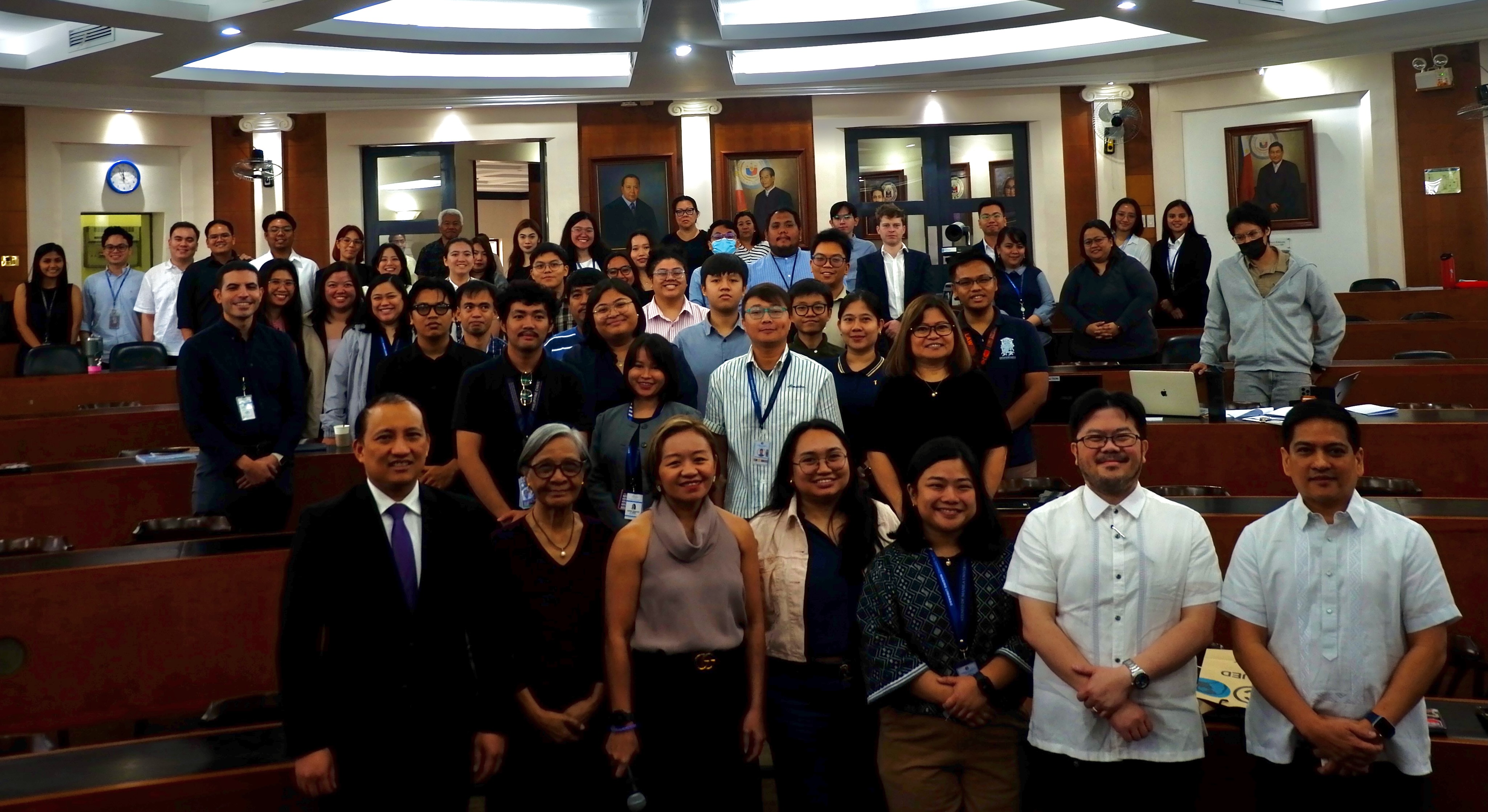
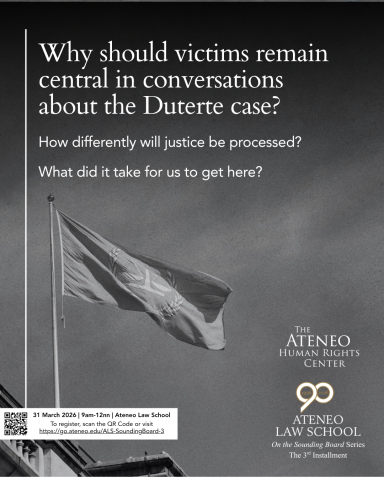
The Ateneo Law School, through the Fr. Joaquin G. Bernas, SJ Institute for Continuing Legal Education, in partnership with the Ateneo Human Rights Center, held the third installment of its On the Sounding Board series, entitled “Bending Toward Justice: A Forum on the ICC, the Duterte Case, and Victim Participation,” on March 31, 2026, at Justitia Hall of the Ateneo Law School and online.
The forum brought together members of the legal community, civil society, and the Ateneo community to examine the legal and institutional dimensions of proceedings before the International Criminal Court involving former President Rodrigo Duterte. It provided a space for informed and thoughtful discussion amid heightened public attention and competing narratives surrounding the case.
In her opening remarks, Acting Ateneo Law School Dean Maita Chan-Gonzaga underscored the significance of the moment, noting that international justice is no longer an abstract concept for Filipinos, but one that is unfolding in real time. She emphasized the importance of engaging these developments with clarity and responsibility, particularly in the face of competing narratives in public discourse.
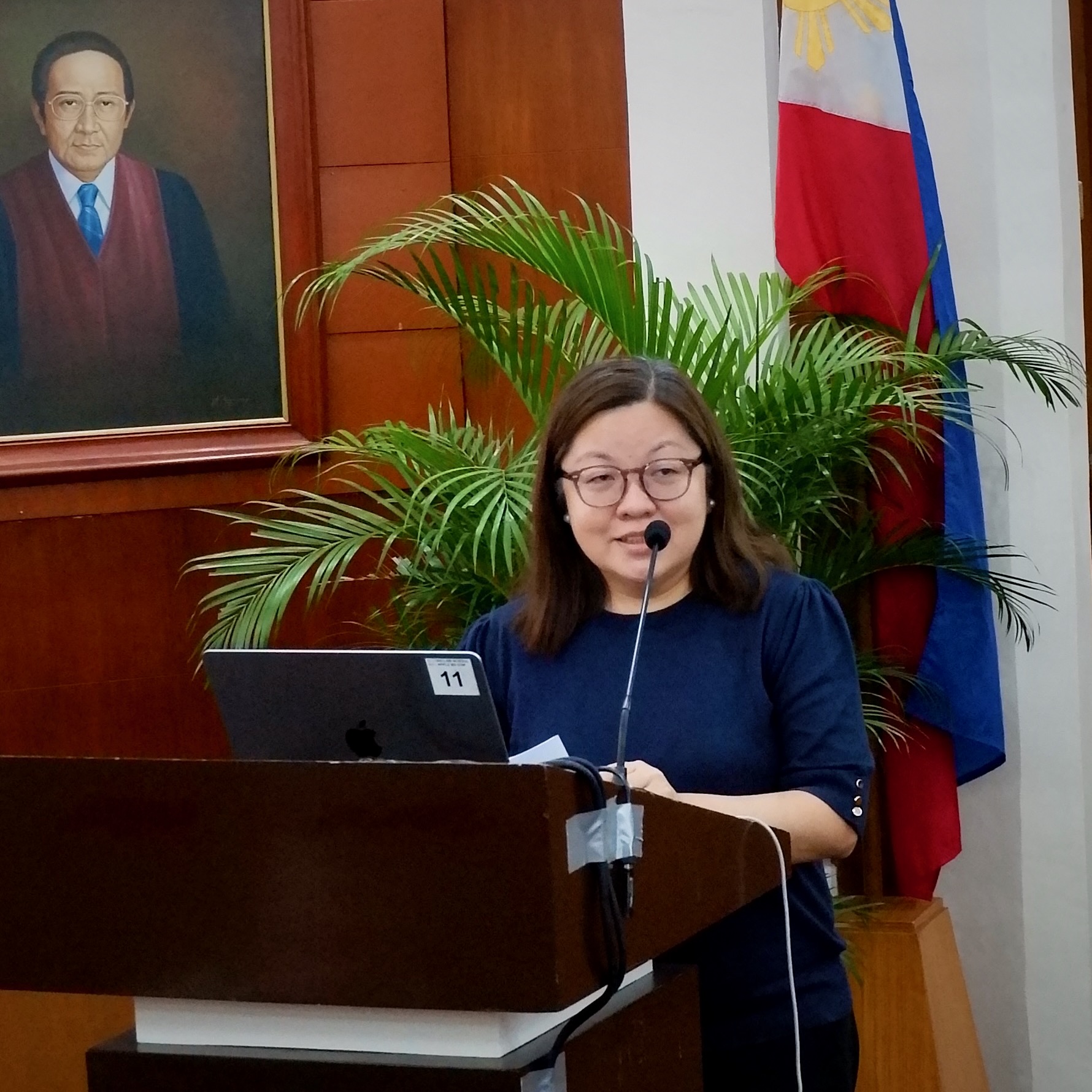
Central to the forum was the role of victims in the pursuit of justice. Drawing from the philosophy of Emmanuel Levinas, Dean Chan-Gonzaga highlighted the moral dimension of encountering the “other,” noting that the face of the victim calls for recognition and responsibility. In this context, victim participation before the Court was framed not merely as a procedural matter, but as an affirmation of dignity.
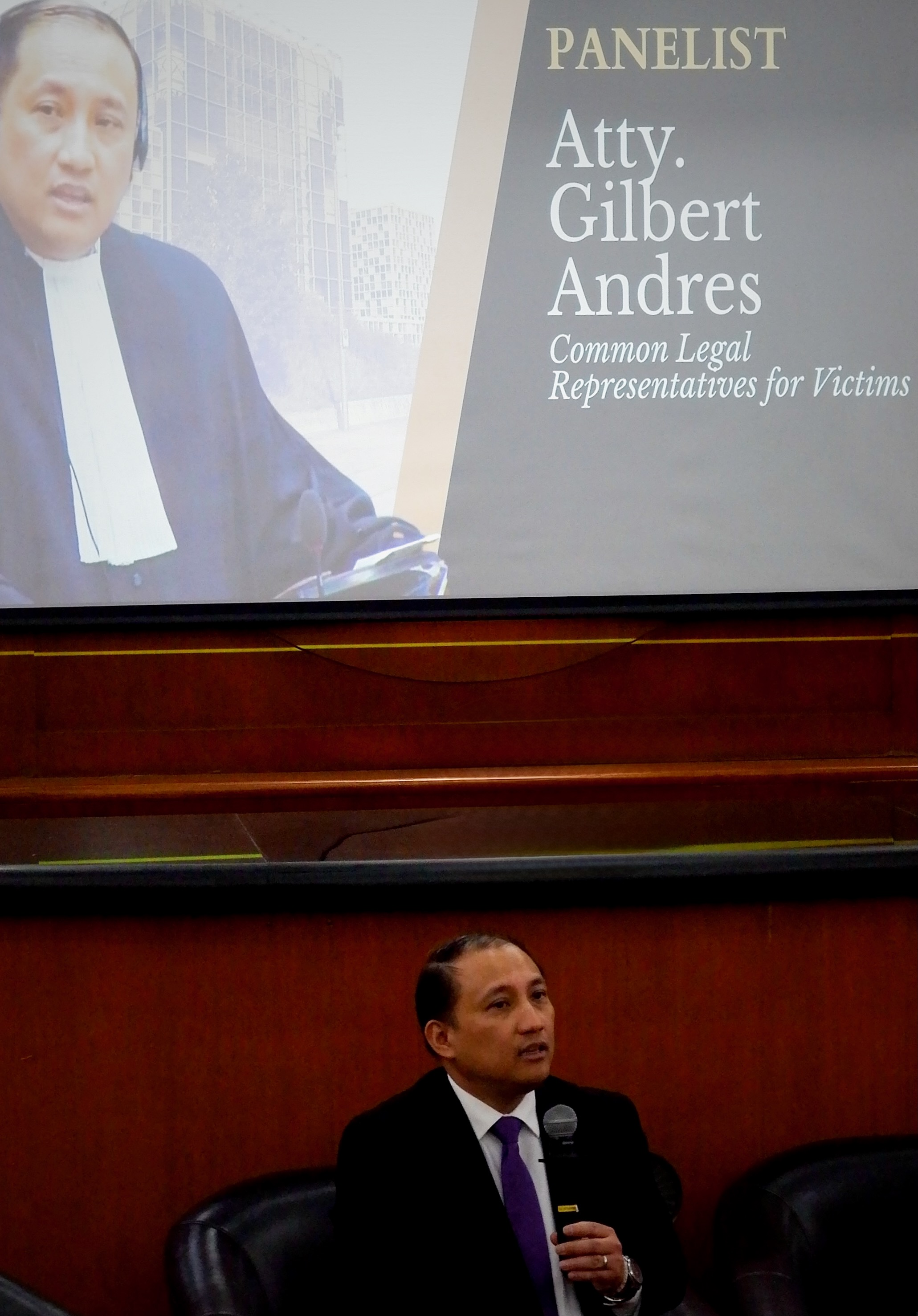
Atty. Gilbert T. Andres, one of the Common Legal Representatives for Victims before the Court, opened the panel discussion by situating the case within the framework of international criminal proceedings and outlining key developments at its current stage. He explained aspects of the process before the Court, providing context for how such proceedings unfold and the roles played by the different actors involved.
He also reflected on the role of legal representation in conveying the experiences and perspectives of victims within formal proceedings. In doing so, he underscored how participation before the Court is mediated through legal structures, requiring careful translation of lived experiences into forms that can be meaningfully engaged within the judicial process.
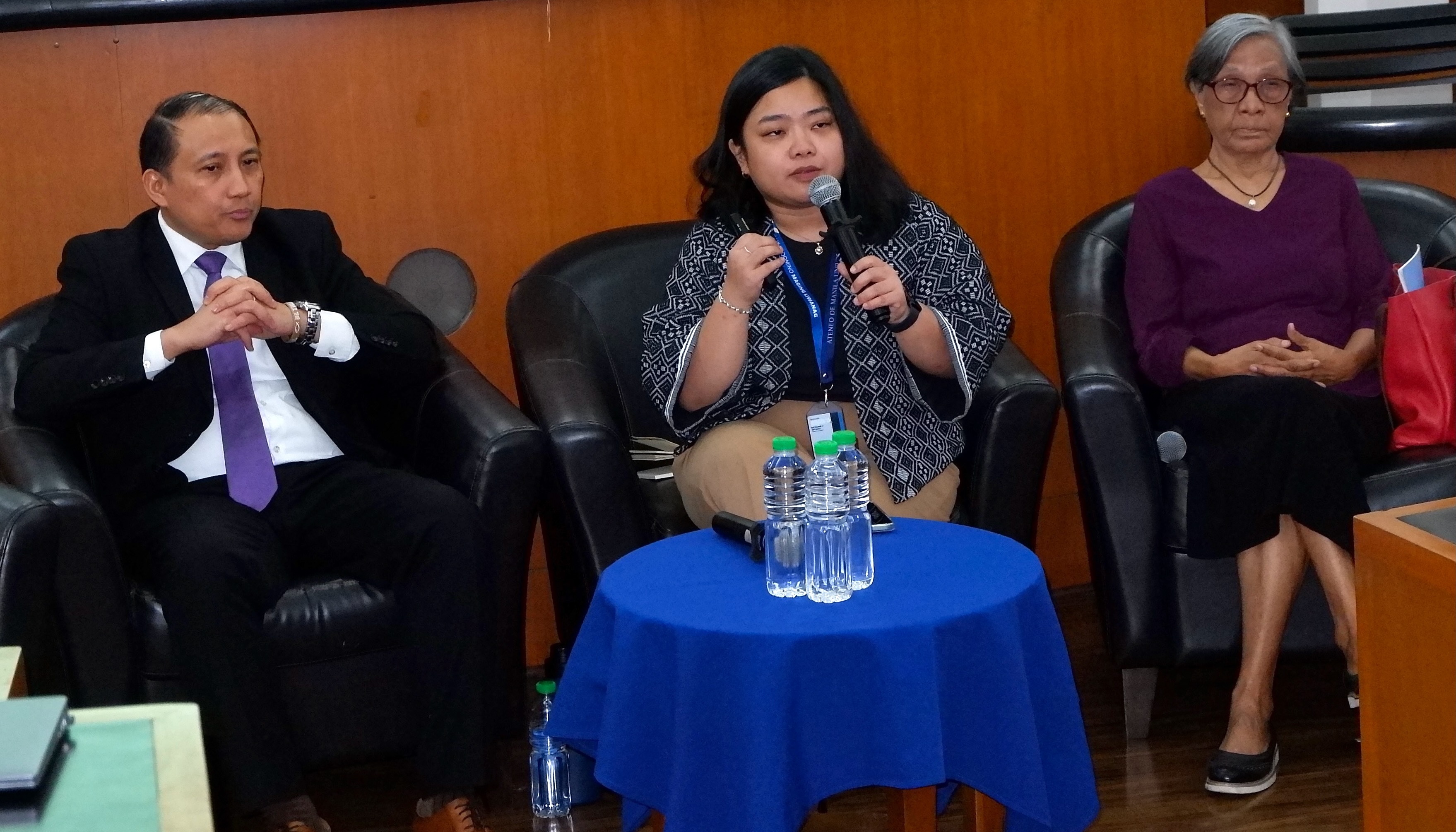
Atty. Nicolene S. Arcaina, Executive Director of the Ateneo Human Rights Center and Case Manager for the Legal Representatives of Victims, followed with a discussion on victim participation before the Court. She explained how victims are able to take part in proceedings through legal representatives and outlined the structures governing their participation within the ICC process.
She also emphasized the practical dimensions of participation, noting that engagement with the Court involves not only legal mechanisms but also sustained coordination with victims and their communities. In this context, she highlighted the importance of ensuring that participation remains meaningful and responsive to the realities faced by those directly affected.
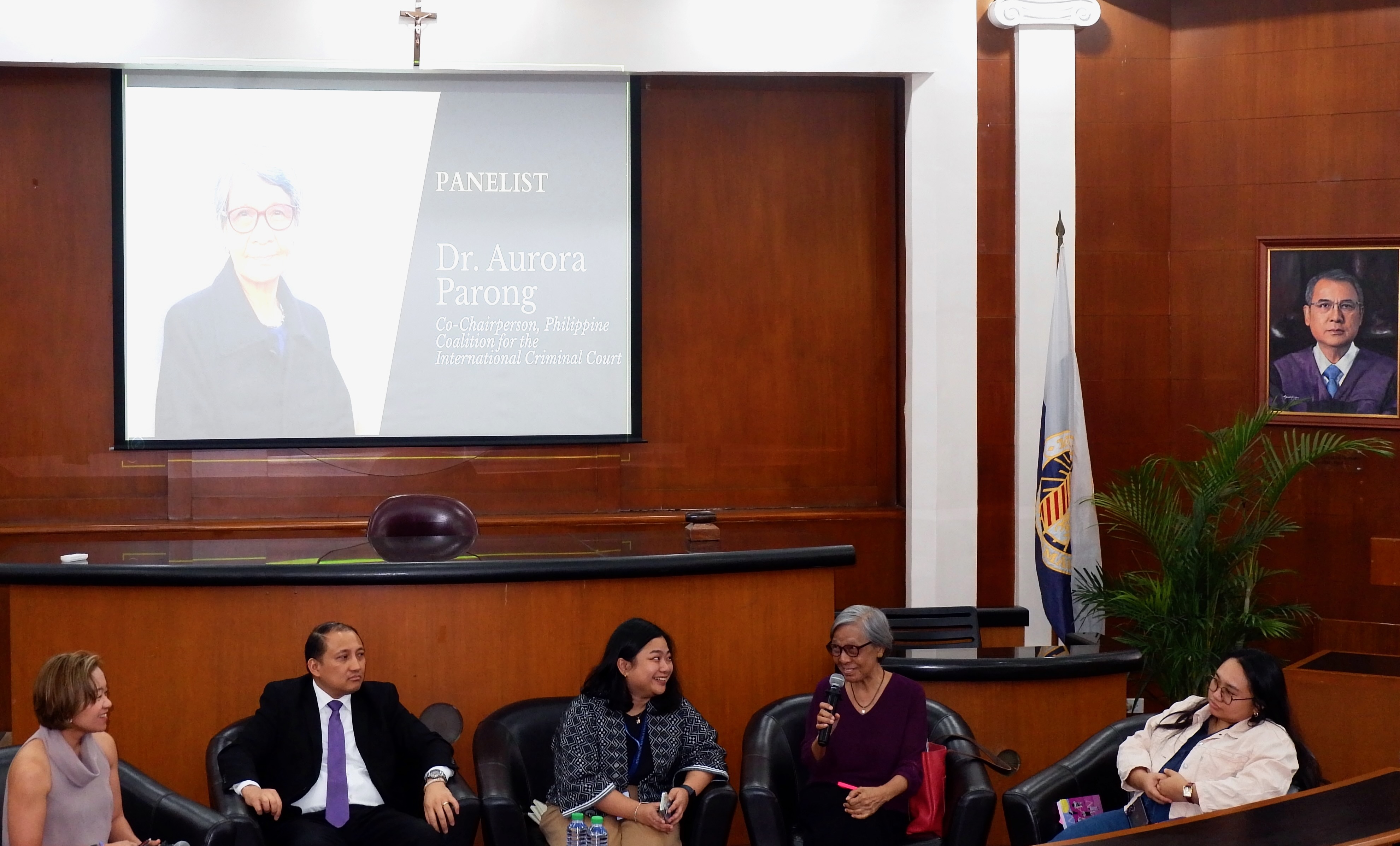
Dr. Aurora Corazon A. Parong, Co-Chairperson of the Philippine Coalition for the International Criminal Court, situated the proceedings within the broader context of civil society efforts toward accountability. She discussed the role of advocacy and public engagement in supporting victims and sustaining attention on issues arising from the Philippine drug war.
She also underscored the importance of sustained engagement beyond legal proceedings, noting that accountability is shaped not only within the courtroom but also through continued advocacy, public discourse, and collective action. In this light, she highlighted the role of civil society in keeping victims’ experiences visible and ensuring that calls for justice remain part of the national and international conversation.

Ms. Mary Anne Baybay of the Philippine Human Rights Information Center (PhilRights) spoke on her work with victims and their families. She shared insights into the realities faced by affected communities and highlighted the forms of support extended to them, including psychosocial and community-based interventions.
She also reflected on the importance of sustained engagement with victims beyond formal legal processes, emphasizing the role of community-based organizations in ensuring that support remains accessible and responsive to their evolving needs. Her discussion underscored how these efforts contribute to preserving the dignity of victims while complementing ongoing accountability mechanisms.
Across the panel, speakers emphasized that while international legal processes provide avenues for accountability, meaningful participation is shaped by legal, institutional, and practical considerations. They underscored the importance of sustained engagement among legal practitioners, civil society, and communities in navigating these processes.
After the panel discussion, an open forum provided participants the opportunity to raise questions on the legal and practical dimensions of the case. The discussion touched on issues relating to victim participation, public understanding of international proceedings, and the relationship between international and domestic accountability mechanisms.
The forum was hosted by Atty. Evecar B. Cruz-Ferrer, who guided the discussion and facilitated the exchange of insights among panelists and participants.
As part of the On the Sounding Board series, the forum reflects the Bernas Institute’s continuing effort to foster critical, informed, and respectful dialogue on pressing legal issues. It also affirms the Ateneo Law School’s commitment to engaging questions of justice not only as matters of law, but as concerns that implicate human dignity, public accountability, and the broader social order.
Recent News
You may also like these articles

Bending toward justice: A forum on the ICC, the Duterte Case, and victim participation
Following the successful conclusion of the third installment of the On the Sounding Board Series, entitled Bending Toward Justice: A Forum on the ICC, the
Protecting Creativity: AIPO and Rizal Library Host Copyright Awareness Session for the Ateneo Community
On March 18, 2026, the Ateneo Intellectual Property Office (AIPO), in collaboration with the Rizal Library, successfully conducted a Copyright Awareness Session held on the

Ateneo Law School joins international effort to strengthen graduate legal education through EU-Funded CALSADA Project
The Ateneo Law School (ALS) is part of a global consortium under the Erasmus+ programme through the CALSADA R.S.D. Project —a collaborative initiative that seeks
Bending toward justice: A forum on the ICC, the Duterte Case, and victim participation
The Fr Joaquin G Bernas SJ Institute for Continuing Legal Education introduces the first half of its panel for the third installment of its On
Bending toward justice: A forum on the ICC, the Duterte case, and victim participation
Amid growing public attention to proceedings before the International Criminal Court involving former President Rodrigo Duterte, questions of accountability, due process, and victim participation have
Administrative Arrangement in the Ateneo Law School from March to May 2026 (HE Memo#Y4.13)
HE Memo#Y4.13 10 March 2026 TO: The Higher Education Cluster and Central Administration Offices FROM: [Sgd] Maria Luz C Vilches, PhD Vice President for Higher