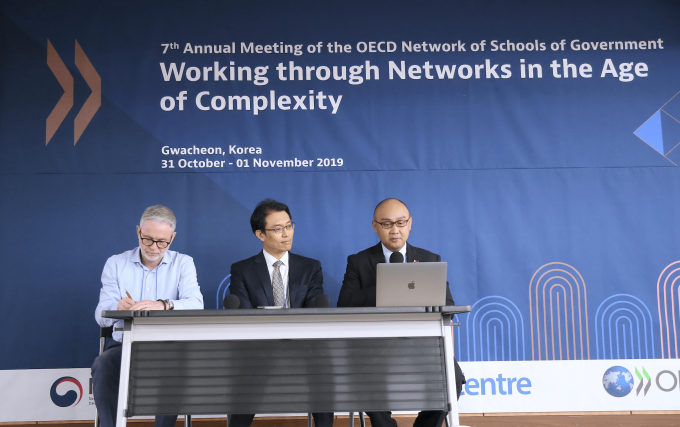
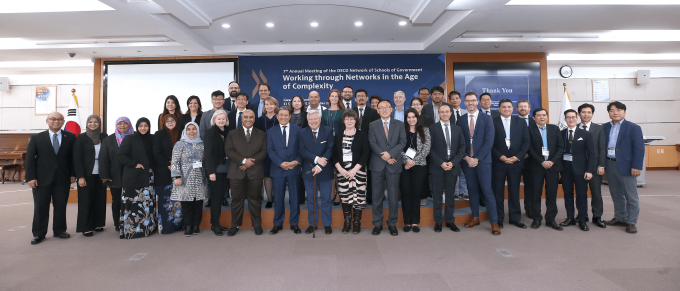
Dean Ronald Mendoza's Presentation in the OECD-South Korea Conference Panel on Networks in the Future of Work in the Public Service
20 Nov 2019

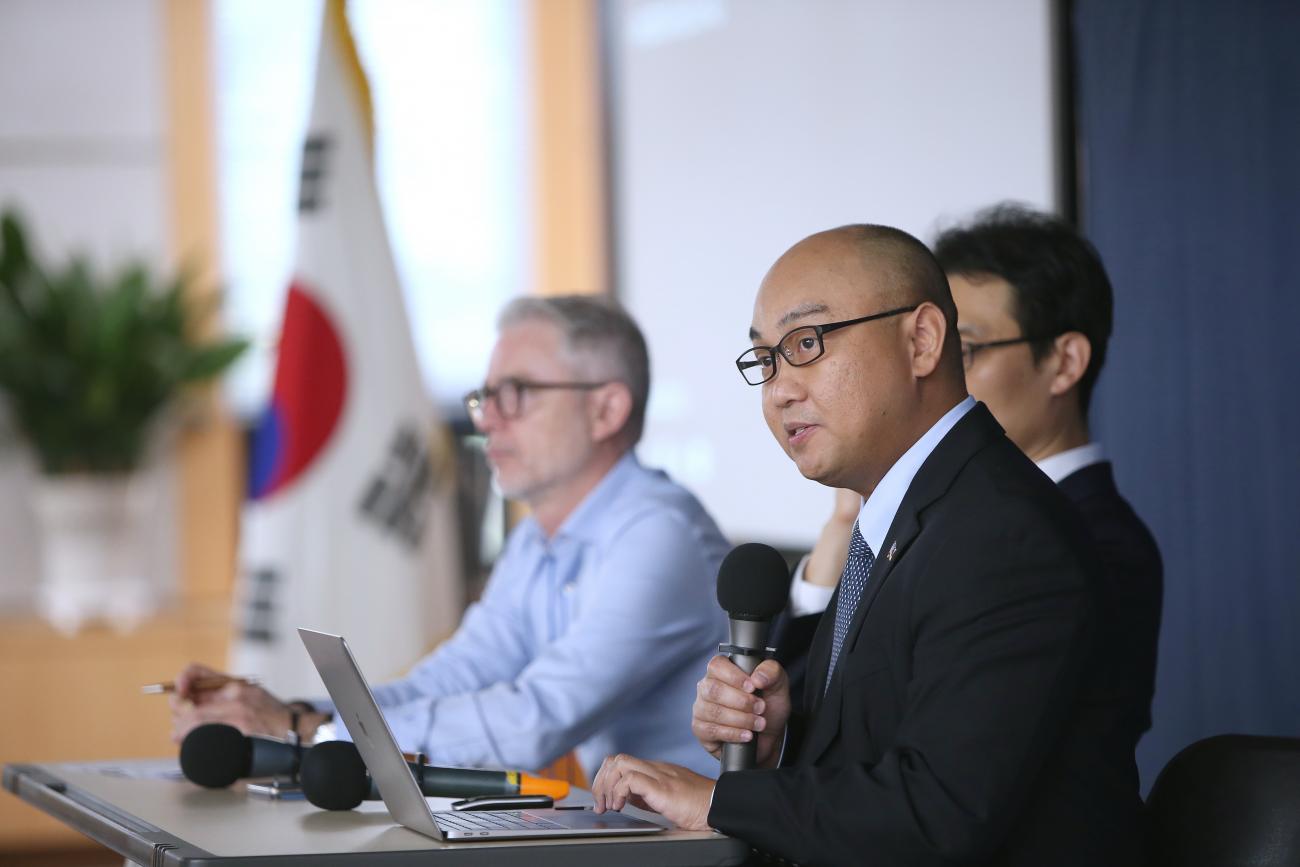
“Training the Modern Public Sector Manager”
COMMENTS DELIVERED AT OECD-SOUTH KOREA CONFERENCE PANEL ON
Networks in the Future of Work in the Public Service
RONALD U. MENDOZA, PH.D.
ATENEO SCHOOL OF GOVERNMENT
7th Annual Meeting of the OECD Global Network of Schools of Government, with the theme “Working Through Networks in an Age of Complexity”, October 31st-November 1st 2019 National HRD Institute (NHI)
Gwacheon City, Republic of Korea.
Please let me start with some brief facts about my school. The Ateneo de Manila University is a private Catholic, Jesuit university in Quezon City, Philippines. Founded in 1859 by the Society of Jesus, Ateneo is the third-oldest university in the Philippines.
We have four professional schools—law, business, medicine and government. My school, the Ateneo School of Government (ASOG), is over twenty years old and is one of the two larger schools of government in the Philippines (the other being the state school of government). We offer a Masters Degree in Public Management and a PhD in Leadership Studies.
As many mentioned in yesterday’s discussion, technology is a tool. In the hands of a good public servant, we can produce many public goods and better public services in cooperation with other stakeholders (as Geert has transformed into a rallying cry, Co-Co-Co!). But good public servants are not the only ones talking about co-co-co these days—many baddies are also using technology with ruthless effect: autocrats, crime syndicates, unscrupulous politicians, even terrorists.
So I think our discussion today is very timely. If technology is a tool like a hammer, then we listened last night to the hammer manufacturers (Samsung, LG, IBM). Today we listen to those that produce the hands that will wield that hammer. And many of my ideas are not new – they have to do with pre-existing leadership and public management challenges we already face even with old tools. (And unlike IBM, LG and Samsung, I cannot issue a recall when one of my ex-students behaves differently from how he or she was trained!)
1. OPPORTUNITIES AND RISKS. Examples of technology empowered networks in the Philippines include crowd-sourcing to provide near real time data on disaster risk mitigation; anti-crime and anti-drugs initiatives; and civic engagement and mobilization for responding to disasters. We should note however, that while these may be enabled by new technologies, these innovations are nevertheless built on good old fashioned basic building blocks like trust among stakeholders and the integrity of public sector agencies and their officials.
2. Hyper connectedness raises risks: a) polarization and bias in social media; b) fake news, manipulation of perceptions and breakdown of social cohesion; c) risks to key institutions (e.g. elections). Perhaps it’s a cliché, but the times require us to humbly acknowledge that technology is a double-edged sword that could be used to improve collective action, as well as debilitate cohesion among community stakeholders.
3. In a recent Oxford University study that analyses the trends of computational propaganda, they found evidence of organized social media manipulation campaigns which have taken place in 70 countries, up from 48 countries in 2018 and 28 countries in 2017. In 26 countries, computational propaganda is being used as a tool of information control in three distinct ways: to suppress fundamental human rights, discredit political opponents, and drown out dissenting opinions.
4. On another front, a recent study on surveillance technologies and policies by the Carnegie Endowment for International Peace found at least seventy-five out of 176 countries are actively using AI technologies for surveillance purposes. This includes: smart city/safe city platforms (fifty-six countries), facial recognition systems (sixty-four countries), and smart policing (fifty-two countries).
5. TRAINING IN ETHICAL LEADERSHIP. These opportunities may enhance the efficiency of the public sector in some areas – but they also require public sector leaders with strong training in ethical leadership to help society navigate difficult normative decisions. For example, some technologies provoke deep trade-offs between privacy and national security, or shape perceptions without the consent or knowledge of citizens.
6. These leaders must know how to set up and manage ethical decisionmaking processes. It’s critical that systems function efficiently – but also important that these systems reflect the values of society. In our classroom, exposing our students to ethical dilemmas (including by inviting practitioners to share reform experiences, or by using case studies) provides a richer environment for ethical leadership training.
7. COMMUNICATIONS. In addition, facilitating inclusive discussions on potentially divisive public policy issues will require strong communications and discussion management skills, and an ability to navigate political economy issues well. Certain types of leadership skills will be needed by effective public sector managers under this environment. There will likely be a premium on those types of leaders and bureaucrats who know how to build trust in institutions and engage communities and networks most effectively. In my school we call this “bridging leadership” and “servant leadership”. Our emphasis is on equipping our students with the skills to engage multi-disciplinary teams and diverse stakeholders.
8. DIVERSE AND INCLUSIVE LEARNING ENVIRONMENT. Finally, schools of Government can also put a premium on “inclusiveness”—by increasing scholarships and extending grants and aid to under-represented groups, particularly in highly unequal countries. Michael Woolcock is right, certain people do “self-select” into public service – I recall when I applied to Harvard Kennedy School over 20 years ago with no money and a dream to serve my country – and now here I am the Dean of my own country’s school of government. Schools must protect themselves from turning into echo chambers—they must welcome different views and include in their pedagogy a strong capability to overcome bias and build common ground. So in Ateneo School of Government, we are presently in the process of ramping up scholarships for under-represented sectors and the national security sector, as part of this strategy and given the challenges our nation faces. +AMDG