ASOG Dean Mendoza delivers statement in Senate hearing on COVID-19 economic stimulus package
01 Jun 2020
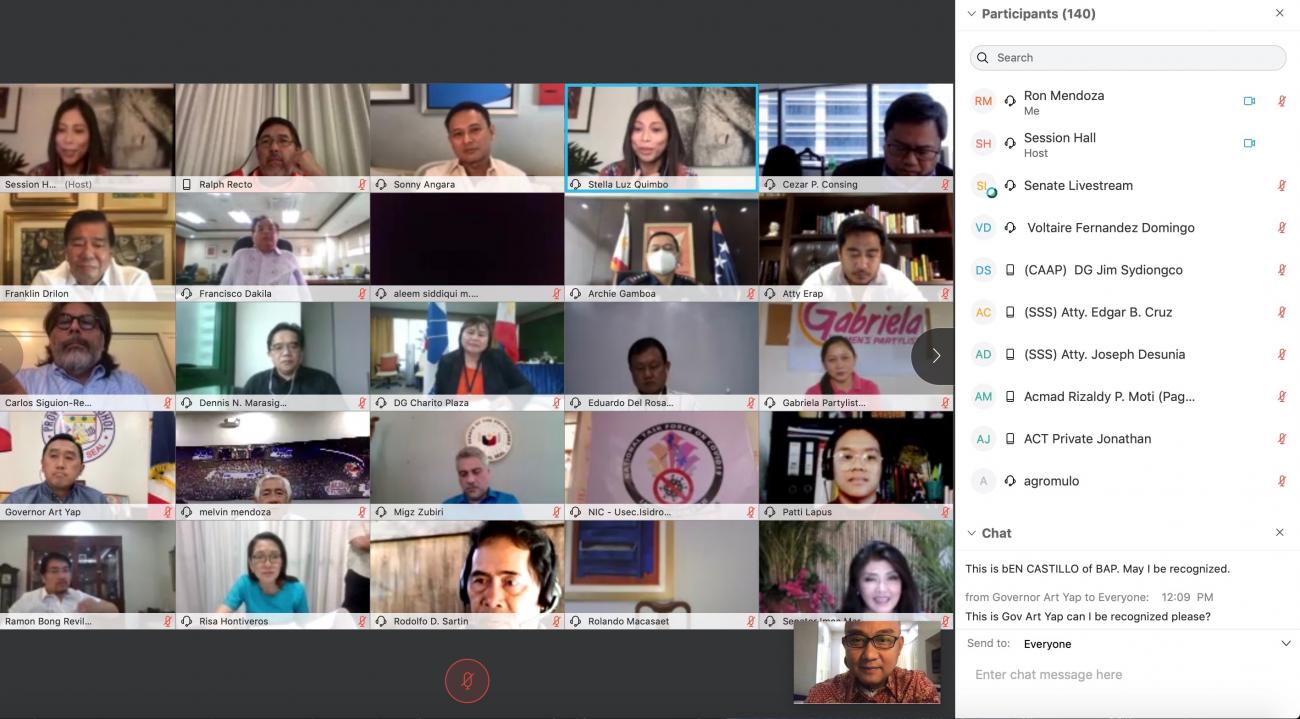
Last May 29, 2020, Ateneo School of Government Dean Ronald U. Mendoza delivered a statement on the Economic Stimulus Packages at the Senate Public Hearing organized by the Senate Committee on Finance chaired by Sen. Sonny Angara and the Senate Committee on Economic Affairs chaired by Sen. Imee Marcos, 29 May 2020, 10:30 a.m. at the Senate Session Hall, 2nd Floor, Senate of the Philippines via CISCO WEBEX Teleconferencing.
Below is the full statement:
Promoting Inclusive Recovery from COVID-19
Ronald Umali Mendoza, PhD[1]
Dean, Ateneo de Manila University, School of Government
The COVID-19 pandemic has already created significant economic disruption and social costs in the Philippines. The lockdown alone is estimated to cost up to PhP24 billion a day in output losses.[2] The government estimates that at least 2 million Filipinos lost their jobs so far from the COVID-19 pandemic; but labor groups argue that the real figure is probably closer to 5 times this number. At least over 70,000 OFWs are expected to repatriate in the next month due to mass lay-offs in their host countries.[3] The expected contraction in remittances is 20% to 30% of US$35 billion (per annum remittances) which is roughly US$7-10 billion.[4] (For comparison the net FDI of the country in 2019 was US$7.6 billion.)
Due to the clear and present danger posed by COVID-19 and the heavily weakened economy in its wake, the main principles for crafting our stimulus plan should probably be: a) “first do no harm”; and b) focus on an inclusive recovery.
First do no harm.
TRAIN2/TRABAHO/CITIRA/CREATE -- new wineskins for old wine, i.e. fiscal incentives reform (notably for foreign investors) and corporate income tax cuts. On paper these are sound reforms, and in a world not racked in crisis, and if done right, it might help boost the country’s competitiveness. Many of us economists actually once supported them. But in practice and once implemented under this administration, many of our economic reforms hit into the stark reality of weak state capability to execute policy. And also quite a bit of bad timing.
For instance, economic reformists ended up implementing TRAIN1 during a period of high fuel prices; and they implemented rice tariffication shortly before droughts struck some of our main rice suppliers in Asia (followed promptly by COVID-19). And now reformists are seeking to implement fiscal incentives reform after a hugely unsuccessful effort to win the support of our existing foreign investors AND during a period of economic fragility.
I share the views of fellow Dean Monching Clarete of UP School of Economics who states that: “The world is likely now to be at the start of a more complicated global economic crisis, the duration of which cannot be cut short by some financing or economic stimulus, but by the knowledge gained by humanity, with the help of the world’s scientists and health experts, in containing the virus. CITIRA introduces another dimension of uncertainty to our exporters. Let us put this off for now and let the authorities like the PEZA and the other investment promotion agencies monitor the deteriorating situation and assist our country’s exporters save jobs.”[5]
Another Dean of UPSE, Dr Raul Fabella notes that CITIRA can only be considered a stimulus if there is profit to be made. “With a looming U-shaped recovery, private businesses will almost surely operate in the red instead of in the black in the next few years. If so, the corporate tax liability will surely go from 30 percent of nothing to 25 percent of nothing, meaning a stimulus boost of nothing! Furthermore, when businesses are facing a depressed utilization rate of capital, the canonical response is ‘wait’—no new capital investment going forward.” He further noted that “The massive multiplier argument parlayed by the DOF for CREATE seems dreamy in a free-falling economy.”[6]
Meanwhile, there are deep governance issues linked to the incentives granting powers embedded in TRAIN2/TRABAHO/CITIRA/CREATE, and we cannot rush discussion of that specially now in an environment when some regulatory institutions appear to be weak (e.g. witness the recent experiences of PhilWeb, Manila Water, and ABS-CBN). What trust and credibility is available now to tackle the sensitive topic of incentives given the present dispensation?
There also does not seem to be a major budget reform nor bureaucratic reform agenda to support the implementation of yet another complex reform. Corruption indicators and competitiveness metrics have actually deteriorated in recent years. We were once 52nd out of 144 countries in competitiveness in 2015, and by 2019 we slid down to 64th.[7] In terms of corruption, the 2019 indicator shows we scored 34, which landed us in the 113th spot – a decline of 18 notches from its previous rank at 95th in 2015.[8] Perhaps unsurprisingly, net FDI in the country fell in 2019, the lowest it has been since 2015.[9]
Furthermore, Harvard Kennedy School scholars recently concluded a novel study of state capability measured in terms of bureaucratic and institutional performance indicators. This study showed the Philippines is 83rd out of 193 countries in the world in terms of state capacity to execute policies. And that’s the good news. The bad news is we are sliding over time, based on indicators of the last decade.[10]
In the face of these challenges, budgets for training and bureaucratic capacity enhancement are likely (if not already) facing the axe under the present crisis. And until just a few months back, there was even talk of repealing rice tariffication because of poor execution. Those challenges are still there--only this time eclipsed by a global pandemic.
Address the COVID-19 pandemic first.
The Philippine State’s capability to execute is weak, and yet the government workplate is already full due to the COVID-19 pandemic and the impending economic slowdown. Incidentally, COVID-19 response is not exactly a showcase of successful policy execution. Testing targets have been missed; crisis communications have been confusing and divisive; and social safety nets have been delayed and error-prone, even as the lockdown has been extended – now among the longest of any country facing COVID-19. The latter implies the country will pay a very high socio-economic cost for controlling the disease---something which is not even clear yet due to the deficit in testing information.
Let's not rush TRAIN2/TRABAHO/CITIRA/CREATE and make an effort to get it done better compared to TRAIN1 and rice tariffication. Let’s also be honest with what we’re trying to do, rather than re-package what is essentially an important but still potentially painful reform. Too many Filipino families are still reeling from the combined effects of poorly executed reform policies in 2018 and 2019, and high-uncertainty and socio-economic disruption arising from the COVID-19 crisis. Pushing more tax reforms at this stage, seems like hubris.
With so little time left, and given the monster (i.e. COVID-19) staring us in the face right now, the de facto reform legacy of this administration could be the Universal Health Care (UHC Law) and social protection (4Ps Law) which can use further boosting and strengthening during the COVID-19 pandemic.
“Build back better” for a health-anchored inclusive recovery.
There now appears to be growing recognition that countries cannot simply go “back to normal” because what had become “normal” was part of what exacerbated the crisis in the first place. Issues here include insufficient and non-inclusive healthcare and social protection, combined with a growing level off inequality that, in part, reflected itself in densely populated urban slums vulnerable to contagion, as well as easily impacted heavily by quarantines and lockdowns. The case of the Philippines highlighted how the deep divides between the healthcare-haves and have-nots, and the technology-haves and have-nots (for online education and work-from-home vs “no work no pay” daily wage earning) made the crisis trade-offs noted earlier even more acute.
Access to healthcare needs to be universal, in order to minimize the possibility of weak health-seeking behavior among poor and low income communities, which could open risks for contagion. Presently around 50% of health financing in the Philippines is drawn from out-of-pocket expenditures. And so even as health insurance is available for indigents, and poor and low income households, uptake is weak given the high out-of-pocket costs which continue to deter them from seeking healthcare.
A strong healthcare system and social protection system underpinning the recovery and providing a credible assurance of coverage for all citizens should they need it, will also be critical in backstopping the psychology of recovery. Simply put, without these systems, recovery will likely be timid and uncertain, if many consumers and investors continue to fear a relapse due to a lack of trust in crisis response capabilities, notably the health sector.
Crises offer important windows for deep re-thinking and systems reform. Drawing on international good practices in COVID-19 response, the Philippines’ healthcare system can be further strengthened through important innovations and reforms. Emerging lessons from the COVID-19 experience suggest that stronger and more inclusive systems for healthcare and social protection build upon and also reflect the level of social cohesion in countries. It is unsurprising that those same countries tend to have a deep well of social capital and public trust in crisis responses of the State, in turn making it much more effective in crisis response. +AMDG
[1] Comments on the Economic Stimulus Packages at the Senate Public Hearing organized by the Senate Committee on Finance chaired by Sen. Sonny Angara and the Senate Committee on Economic Affairs chaired by Sen. Imee Marcos, 29 May 2020, 10:30 a.m. at the Senate Session Hall, 2nd Floor, Senate of the Philippines via CISCO WEBEX Teleconferencing. Please send any questions and comments on this document to: ronmendoza@post.harvard.edu.
[2] See https://www.msn.com/en-ph/money/markets/45-day-lockdown-cost-philippines-p11t/ar-BB14sDGH?li=BBr8Mkn.
[3] See https://www.bangkokpost.com/world/1916244/covid-to-cost-71-700-overseas-filipino-workers-their-jobs.
[4] See https://www.philstar.com/business/2020/03/10/1999658/fdi-inflows-drop-four-year-low-2019?fbclid=IwAR1_KqRMkYpYk98LhVCTIonu4582n3SELbxAUDu-PDeUs4xLbY45AqKmydQ.
[5] See https://www.bworldonline.com/postpone-citira-due-to-the-coronavirus/.
[6] See https://business.inquirer.net/298342/create-may-do-more-harm-than-good-says-economist.
[7] The Global Competitiveness Report 2015 and 2019, World Economic Forum, http://www3.weforum.org/docs/WEF_TheGlobalCompetitivenessReport2019.pdf
[8] Corruption Perceptions Index 2015 and 2019, Transparency International, transparency.org/en/cpi/2015/results/phl. The index uses a scale of zero to 100, where zero is “highly corrupt” and 100 is “very clean.”
[9] https://www.philstar.com/business/2020/03/10/1999658/fdi-inflows-drop-four-year-low-2019
[10] Government effectiveness - Country rankings, 2008-2018, The World Bank,
https://govdata360.worldbank.org/indicators/h580f9aa5?country=PHL&indica....