Energy Policy Series Examines the Attributes of Electricity Poor Communities in the PH
24 Feb 2021
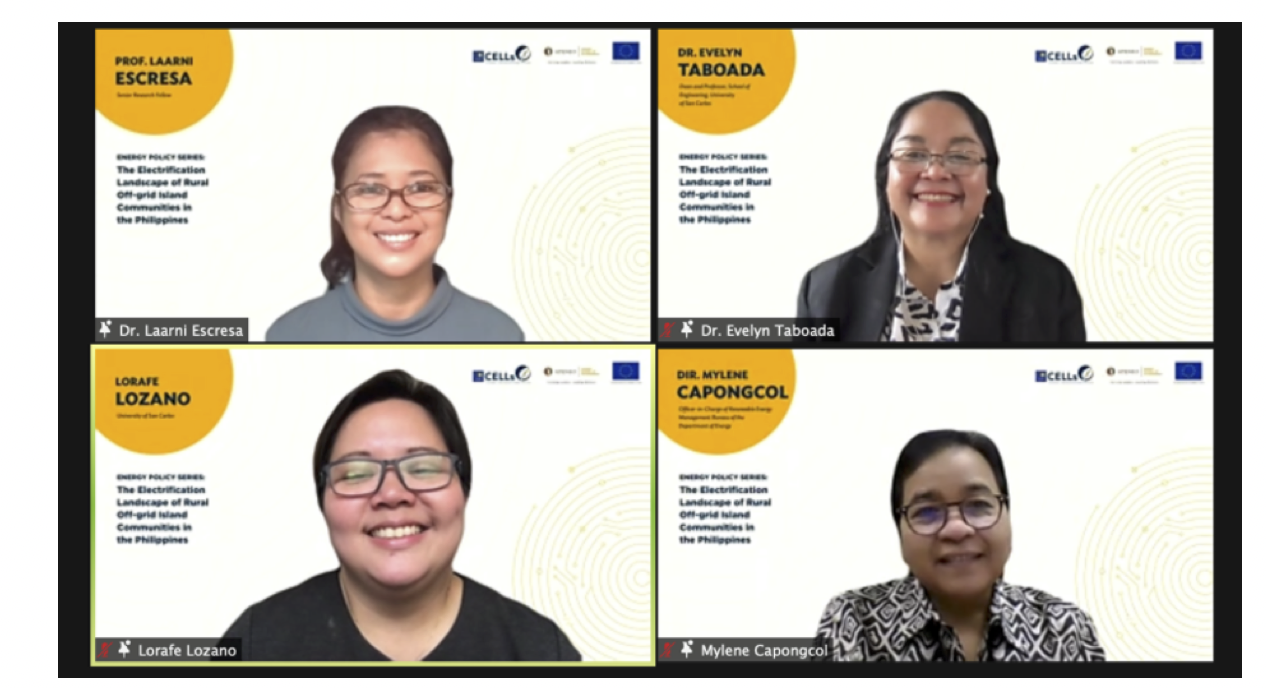
The Ateneo School of Government, through the Access to Sustainable Energy Programme-Clean Energy Living Laboratories (ASEP CELLs), and with the funding support from the European Union, held its very first virtual Energy Policy Series (EPS) for 2021 last 19 February.
The study entitled, “Demystifying the Authentic Attributes of Electricity-Poor Populations: The Electrification Landscape of Rural Off-Grid Island Communities in the Philippines” was presented by Professor Lorafe Lozano, and Dean Evelyn Taboada, Ph.D. from the School of Engineering at the University of San Carlos. Dean Taboada serves as the Project lead of the EU-ASEP Visayas CELL, while Professor Lozano is also a part of the faculty research team working on the project. Completing the list of the panelists include Director Mylene Capongcol, the Officer-in-charge of the Renewable Energy Management Bureau at the Department Energy as the reactor, while Dr. Laarni Escresa, ASEP CELLs Senior Research Fellow moderated the open forum.
In presenting their paper, Professor Lozano and Dean Taboada challenged the conventional notion that the Multidimensional Energy Poverty Index is the appropriate tool in assessing community electrification in the Philippines. To this end, Dean Taboada and Professor Lozano proposed the Household Electricity Poverty Matrix as an alternative model, claiming it as a more pragmatic approach to examining energy poverty in the country. The authors suggested that the binary approach of measuring electricity deprivation could be improved further by assigning tier levels. This argument is explored through an empirical study of three islands—Gilutongan, Pangan-an, and Cobrador—that depicts the multidimensionality of electricity poverty in off-grid areas in the country. The findings of the study conclude that electrical energy poverty goes far beyond the mere ‘absence’ of electricity access. More than just using the concept of ‘access’ surrounding electricity, policymakers must undertake a holistic approach towards electrification that considers the socio-economic development dimension among communities.
For her comments on the study, Director Capongcol emphasized the current efforts of the Department of Energy to connect missionary areas in the country primarily through the Electric Power Industry Reform Act (EPIRA) or the RA 9136. Director Capongcol also shed light on the role of the private sector in bringing electricity access to off-grid areas. However, she noted that it is important to balance the private sectors’ interests with the target communities. Bridging this gap requires an active engagement between the Local Government Units with the private sector and the target communities to maximize the socio-economic benefits of electrification.
The open forum moderated by Dr. Escresa touched on a variety of topics. The panelists tackled questions that further explored the accuracy of the six attributes for household electricity; the veracity of the tier level assignments; the relevance of the study’s key findings on electrification concerning renewable energy; and the policy implications of the study on EPIRA. Overall, the first installment of the EPS for 2021 was a success, drawing a hundred participants from various backgrounds and industries. The audience feedback from the post-event survey highlighted the lively and diverse yet complementary perspectives elicited from the speakers based on their unique expertise.
The Energy Policy Series or EPS is a public virtual forum that enjoins key stakeholders from the domestic and international energy sector to dissect relevant critical issues that center on energy access, renewable energy, and energy efficiency. It features cutting-edge research from the ASEP CELLs that contributes to pragmatic and impactful energy policymaking in the Philippines and beyond.
The full peer-reviewed article of Professor Lozano and Dean Taboada can be accessed through this link: https://bit.ly/3s217AG.
A recording of the webinar is also available through the ASOG Facebook page.