[Tinig] How Safe Should the Ateneo de Manila Be?
01 Oct 2021 | Luis Carmelo M. Julian, MA

That afternoon in October 2019 is still fresh in my memory—the day that, once again, the issue of sexual harassment on campus was at the center of attention. When I proceeded to my classes later that day, I decided to suspend that day’s lesson and allowed my students to openly speak their minds about the issue. The session was heavy, to say the very least. A bitter mix of confusion, indignation, and discouragement permeated the air; it was so thick you could cut it with a knife. And I had to confess to my students that I did not have all the answers to their questions. I was just as clueless as they were about how the university administration was handling the issue at the time. But one thing that my students and I were certain about was that this issue had gone unchecked for far too long, and that change was needed. “Our school is not safe.” This lament reverberated across the campus and on various social media platforms. Naturally, this called for some necessary reflection about whether or not our beloved university was indeed a “safe space.”
But the notion of “safe spaces” has proven to be a matter of contention in many universities abroad, especially in the West, because of its seemingly arbitrary parameters. On the one hand, proponents of safe spaces believe that they aim to uphold and defend the well-being of students as they go about their lives in the university—surely a good and necessary idea. On the other hand, critics point out the overreach that the enforcement of such spaces will bring about when it comes to matters of free speech. I have been observing university culture in North America in the last five years, and indeed, the fears of the critics have become real. Safe spaces have gone far beyond matters of personal well-being and have now encroached on the domain of ideas, much to the chagrin of members of these educational institutions. We hear stories of rigid speech codes, shout-downs, cancellation of speakers, and rabid calls for the resignation of administrators, faculty, and student leaders. It is a sad state of affairs that aggravates the climate of fear and division already at play globally.
Let’s get one thing straight. We want the university to be safe. But in what sense? Social psychologist Jonathan Haidt makes the distinction between physical safety and emotional safety. He says that universities must be physically safe, that is, no member of the academic community should ever be harassed or become a victim of any kind of violence, especially based on their identity. But he goes on to say that it is not good for individuals and institutions to foster emotional safety. This refers to being shielded from all sorts of emotional disturbances that may “trigger” one to be uncomfortable. This is not limited to words that directly harm another (a reasonable limitation), but those that could be construed as indirectly harmful and prejudicial, which are often called microaggressions. Of course, we want people to be mindful of their biases, but it is not helpful if we breed a culture where we pillory others for every little misspoken word regardless of the speaker’s intent. It cannot be forgotten that part of our long-standing legal and moral tradition is to learn how to judge intent, and not just actions alone. While we indeed desire that our students be both attuned to issues of social justice and compassionate toward the suffering, we would like them to be critical too, since these qualities are not at odds with each other. This is why it is no insignificant matter that in the pastoral cycle used in Catholic social teaching, “judge” comes before “act.”
We must not shield our students from uncomfortable ideas. Rather, they should learn how to engage these ideas critically. The role of the professor is to facilitate this engagement in an environment where the students will not feel threatened from expressing opinions freely. It is incumbent upon the university as a whole to allow for this free exchange of ideas to take place. Those who have unpopular ideas (for instance, an unpopular political stance) should not be de-platformed or silenced just because they hold these ideas per se. But we precisely need to allow these ideas to flow freely so we can easily distinguish the wheat from the weeds. After all, if their ideas are truly wrong, how else can their wrongness be demonstrated if we do not shine the light of serious academic scrutiny over them?
However, I am not at all suggesting that all ideas are correct and acceptable (God forbid that I as a faculty member of the School of Humanities believe this!). Of course, free speech is not absolute—speech that directly incites hate and violence has no place in any civilized society. In light of recent issues pertaining to Martial Law, I join those who say that this issue is not merely a matter of differing political views, but one that involves moral values that are not up for debate. But given the parameters, we must understand that not everything that is disagreeable is violent and immoral. I envision a campus with people who have various ideas, some of which may clash, but all of which are expressed in the spirit of serious dialogue. We will be in a sorry state if we create an echo chamber on campus out of an inordinate need for “safety.” Thankfully, as far as I can see, today’s Ateneans are generally concerned with matters of social justice with a critical eye. Most, if not all, dislike cancel culture. They still believe in the value of healthy debate and listening to various perspectives. I hope it remains this way. But it will not be so unless we clarify the parameters of safety that the university must have.
Going back to my original question: should universities be safe spaces? I would say yes unequivocally if what we mean is that is a place where sexual violence and identity-based discrimination are unacceptable. Personal safety should one be of our givens and we certainly need fair, effective, transparent and empathic institutional systems to ensure that. But once we get those systems in place (with continual fine-tuning, of course), the university can be a place where no one needs to worry anymore that they will be a victim of any form of violence. In so doing, the university will then be a lot freer to pursue its original mandate: to go into the risky business of truth-seeking and truth-telling.
Tinig is a monthly opinion and analysis series from the School of Humanities. The views expressed in this piece are those of the author and do not necessarily represent the views of School of Humanities or the Ateneo de Manila University.
Recent News
You may also like these articles
Protecting Creativity: AIPO and Rizal Library Host Copyright Awareness Session for the Ateneo Community
On March 18, 2026, the Ateneo Intellectual Property Office (AIPO), in collaboration with the Rizal Library, successfully conducted a Copyright Awareness Session held on the
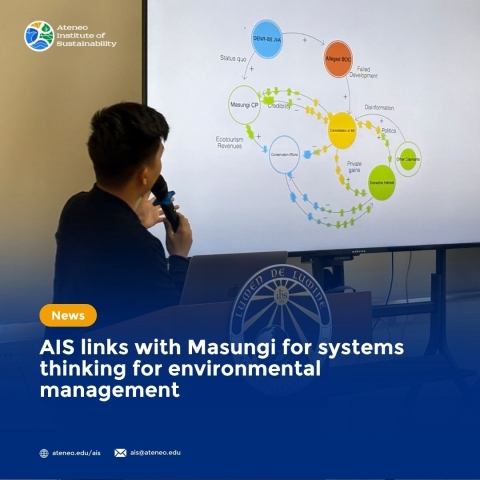
AIS links with Masungi for systems thinking for environmental management
Last 23-24 March 2026, the Ateneo Institute of Sustainability (AIS) , which manages the My Climate Risk – Ateneo de Manila University Regional Hub
Contingency Measures in Higher Education in the Face of a Worldwide Energy Crisis (HE Memo#Y4.16)
In response to the energy crisis caused by escalating tensions in West Asia, Ateneo Higher Education will implement the following class and operational adjustments.
Basic Education Class Schedules March – June 2026 (OVPBE memo)
In alignment with DepEd Memorandum No. 018, s. 2026, and our own commitment to Cura Personalis, we are refining our operations for the remainder of the school year to ensure that we finish strong, safe, and sustainable.
URH residency application for Intersession SY 2026-2027 now open
Hey, Blue Eagles! Big news — URH INTERSESSION RESIDENCY SY 2026-2027 is NOW OPEN! Apply now to live where the vibes are unmatched! What’s in

Class Arrangements for Thursday and Friday, 26-27 March 2026 (HE Advisory)
In view of the announcement of a nationwide transportation strike on 26-27 March, undergraduate and graduate classes of the Schools of Education and Learning Design