[Tinig] Spaces for the Social and the Political in Beauty Pageants
01 Nov 2021 | Dr. Stephanie Ann Y. Puen
I’ve heard it said—both jokingly and seriously—that the Philippines enjoys three Bs: basketball, boxing, and beauty pageants.[1]
The third B—beauty pageants—is a guilty pleasure of mine. I started getting into it in 2010, when the Philippines, represented by Venus Raj, began placing in the Miss Universe pageants again. I am still a fan today. I especially enjoy watching the evening gown and Q&A segments, where I get blown away by the elegance and eloquence of many of the women on stage. I also frequent many groups and discussion pages on pageants, and am familiar with some of the history behind our country’s love of and participation in beauty pageants, especially as a so-called “Miss Universe” country (vis-à-vis other countries where Miss World, another beauty pageant, is more popular).
As someone who does work in feminist theology, I often get asked how I reconcile this guilty pleasure with my work: Aren’t beauty pageants demeaning to and objectifying of women? Look at the way they glorify a certain body shape and how they stereotype and pressure women!

These critiques of beauty pageants should not be ignored. My hope is that more body shapes, skin tones, and faces and hairstyles are represented at pageants. Swimsuits can also be swapped with athletic wear. These changes will diversify the definition of beauty and emphasize health and fitness rather than one’s having an hourglass figure.[2]
Some of those changes have begun. Witness Emma Loney, Miss Earth Wisconsin 2020, H’Hen Niê, Miss Universe Vietnam 2018, and Zozibini Tunzi, Miss Universe South Africa 2019 and eventual Miss Universe 2019. In her closing statement competing at Miss Universe 2019, Tunzi emphasized that she “grew up in a world where a woman . . . with [her] kind of skin and [her] kind of hair—was never considered beautiful” and that she wanted children to see her as a beauty queen and see “their faces reflected in hers” and that they, too, could be beautiful.[3] In our own local Miss Universe Philippines pageant in 2020, Skelly Ivy Florida, representing Biliran, and We’am Ahmed, representing Davao, demonstrated a beauty that differed from what had often been seen. This year, Rouseanne Marie Bernos, representing San Juan City, reached the top sixteen even though she did not possess the beauty or figure of the traditional beauty queen.
What I find especially fascinating is that beauty pageants have also become spaces for possible deeper awareness of or even discourse on social issues. For example, questions of identity have always found their way into the beauty pageant scene; when the Philippines had a winning streak between 2013 and 2016, placing in each of the big four pageants (i.e., Miss Universe, Miss World, Miss International, and Miss Earth), fans from other countries raised the accusation that the Philippines won or placed well when it was represented by “halfies” (e.g., Megan Young, Miss World Philippines and eventual Miss World 2013, Pia Wurtzbach, Miss Universe Philippines 2015 and eventual Miss Universe 2015, and our latest titleholder Catriona Gray, Miss Universe Philippines 2018 and eventual Miss Universe 2018). And so debates began circulating on whether or not these women were truly “Filipino” and what it meant to be a Filipino. Last September 30, 2021, when the Miss Universe Philippines organization crowned Beatrice Luigi Gomez, the first openly queer woman to represent our country at Miss Universe, fans began discussing as to whether or not the country had truly began to be more accepting of the LGBTQ+ community, or whether the victory was another example of LGBTQ+ being accepted as long as they fit a particular mold (in this case, as entertainers).[4]
Even geopolitics has also become a question raised in beauty pageant circles, as certain pageants restrict which territories may be represented. Taiwan, for example, is represented at the Miss International pageant and it used to be represented at Miss Earth, but not at Miss Universe. Will allowing Taiwan to be represented upset China even if the Taiwanese representative’s sash reads “Chinese Taipei”?
Pageant questions are another space for engagement (though to be honest, thirty seconds are not exactly enough for candidates to nuance her position!). Pia Wurtzbach’s response to the question during her stint at Miss Universe 2015 drew a lot of reactions, but also it made people more aware of and start thinking about whether or not the country should continue having some form of military presence from the United States.[5] Miss Intercontinental Philippines 2021 Cinderella Obeňita’s answer to Michael Cinco’s question on the importance of luxury items for women in a depressed economy also created a buzz. She replied that she wanted to be a woman who would “comfort the afflicted, and afflict the comfortable.” That answer impressed people and touched on the issue of social justice and caring for the vulnerable, especially at this time.[6]
As a fan, I appreciate the willingness of the beauty pageant community to engage in these kinds of questions, questions regarding social issues and questions of identity. There are other questions that I don’t mention in this piece, but my hope is that engagement with such questions also make beauty pageant organizations reflect on the kind of platform they have. It can be both entertainment and a force for social good rather than for the objectification of women. Miss Universe and Miss International reflected this shift towards finding winners who are not only models of physical beauty but also advocates of a particular social issue; Miss World requires of the winner a Beauty with a Purpose project, which it funds; Miss Earth focuses on winners who will concretely further their environmental advocacy.
Pageants are not as superficial as they are perceived to be—and while there are times when fights over the issues raised can get toxic, still the thoughts from fellow Filipino pageant fans or even pageant fans abroad can be very thought provoking and insightful on these issues, developing engagement with and awareness of relevant social issues.
Tinig is a monthly opinion and analysis series from the School of Humanities. The views expressed in this piece are those of the author and do not necessarily represent the views of School of Humanities or the Ateneo de Manila University.
[1] Sherwin Cy, “Three B’s of the Philippines,” Ikot.ph, July 22, 2021. https://www.ikot.ph/three-bs-of-the-philippines/.
[2] Joanna Walters, “Miss Teen USA Beauty Pageant Replaces Swimsuit Portion with Athletic Wear,’” The Guardian, June 30, 2016, https://www.theguardian.com/fashion/2016/jun/29/miss-teen-beauty-pageant....
[3] Isabella Gomez Sarmiento, “Miss Universe 2019 Is Young, Gifted, and an Outspoken Believer in ‘Black Girl Magic,’” NPR, December 9, 2019, https://www.npr.org/sections/goatsandsoda/2019/12/09/786312377/miss-univ....
[4] Amanda T. Lago, “Who is Beatrice Luigi Gomez, Miss Universe Philippines 2021?” Rappler, September 30, 2021, https://www.rappler.com/entertainment/pageants/things-to-know-beatrice-l....
[5] Vernise Tantuco, “Watch: Pia Wurtzbach Defense Answer on US Military Presence in PH,” Rappler, January 24, 2016, https://www.rappler.com/entertainment/pageants/pia-wurtzbach-defends-ans....
[6] Ysa Abad, “Who is Cinderella Faye Obeňita, Binibining Pilipinas Intercontinental 2021?” Rappler, July 16, 2021, https://www.rappler.com/entertainment/pageants/things-to-know-cinderella....
Recent News
You may also like these articles
Protecting Creativity: AIPO and Rizal Library Host Copyright Awareness Session for the Ateneo Community
On March 18, 2026, the Ateneo Intellectual Property Office (AIPO), in collaboration with the Rizal Library, successfully conducted a Copyright Awareness Session held on the
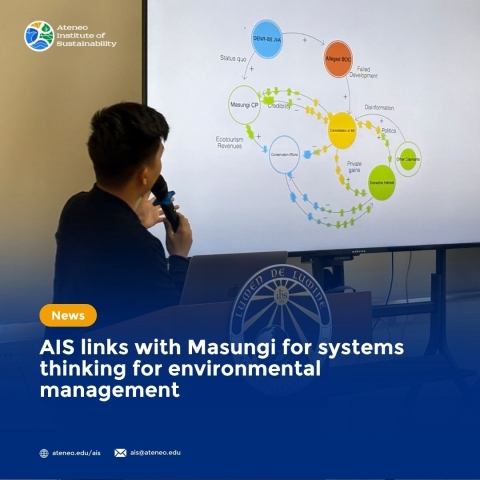
AIS links with Masungi for systems thinking for environmental management
Last 23-24 March 2026, the Ateneo Institute of Sustainability (AIS) , which manages the My Climate Risk – Ateneo de Manila University Regional Hub
Contingency Measures in Higher Education in the Face of a Worldwide Energy Crisis (HE Memo#Y4.16)
In response to the energy crisis caused by escalating tensions in West Asia, Ateneo Higher Education will implement the following class and operational adjustments.
Basic Education Class Schedules March – June 2026 (OVPBE memo)
In alignment with DepEd Memorandum No. 018, s. 2026, and our own commitment to Cura Personalis, we are refining our operations for the remainder of the school year to ensure that we finish strong, safe, and sustainable.
URH residency application for Intersession SY 2026-2027 now open
Hey, Blue Eagles! Big news — URH INTERSESSION RESIDENCY SY 2026-2027 is NOW OPEN! Apply now to live where the vibes are unmatched! What’s in
Scribbles of discontent: Graffiti and banyulatin as works of literature
The law often dismisses graffiti as “destruction,” “anarchy,” or even as mere “dirt.” But new research from Ateneo de Manila University’s Filipino Department reveals what