[Tinig] It’s the Common Good
01 Apr 2022 | Levy L. Lanaria
This is unprecedented in our nation’s contemporary political history: direct participation of many Catholic priests and canonically recognized religious in the conflictive world of partisan politics. The number appears to be increasing. At no point in recent memory have both groups boldly come out of their comfort zones to publicly endorse one presidential candidate. Many citizens, including Catholics, whose candidate, incidentally, is not being endorsed are the most vocal critics of the priests and religious “meddling” in politics.

Invoking the Church-State separation provision in the 1987 Philippine Constitution they accuse the Catholic Church, without making a distinction between the institution and its individual church leaders or individual members of religious orders, of political interference. Yet even if the distinction is made, Article II, section 6 of the Constitution does not prohibit any religion from actively participating in the political affairs of the nation. The non-establishment of religion and the freedom of religion clauses in the constitutional provision actually favor the religion. It is the state that stands to be accused of constitutional transgression if it shows partiality for one religion over the others, or if it curtails the freedom of religious body to preach, to worship and practice according to its tradition.
The unabashedly political acts of the clergy and the religious can be justified on civil grounds: they are citizens of the state. But the political men of cloth justify their active involvement more by their moral language. A self-exiled priest whose life has been threatened for his relentless criticism of the government’s violent campaign against the drug menace, a campaign that for the most part targets the poor is an example: “In choosing our leaders, let us support the true servant leaders. . . . Let us avoid and reject those who are selfish and corrupt – who just want to gain wealth, power and glory. It is a moral choice – a choice between good and evil, between those who bring light amidst darkness and those who wish to perpetuate darkness.”
What appears to drive people like him is the fear of historical revisionism being sold nowadays in the public market of the social media. Add to this (a) the morally reprehensible extra-judicial killings of suspected drug users and addicts most of whom are poor, and (b) of red-tagged activists, and the immoral proliferation and sharing of fake news and deceptions, and one can understand why the clergy and the religious as moral teachers are shedding whatever inhibitions they have. The platforms in the virtual world being exploited to the hilt by falsehood peddlers offers as well a wide space for the clergy and the religious guided by the Catholic social tradition to make their voices heard and to help in the education of the Church members in particular and of the citizens in general.
A religious brother from Mindanao who, himself, was a victim of martial law and who in “normal” times would have preferred his spiritual brothers and sisters not to endorse openly has this to say: “Desperate times demand desperate measures. If we are not so desperate, I too, believe it would have been best for us church people NOT to name NAMES during an election. But given the trends (if we believe that the surveys do have some indication what the results will be) we are not just in DESPERATE TIMES, but absolutely VERY DESPERATE times. Can you imagine Imelda returning to Malacaňang and what would that make of us as a people?” The Catholic brother who has a PhD in Philippine Studies is known for his advocacy work with the lumads in Mindanao. A prolific writer, he is a multi-awarded author of books.
A priest-theologian who partly ministers to the poor families is no less forthright and daring: “Anyone who was an enabler of Marcos or Duterte does not deserve my vote. ‘Thou shalt not kill’ is an absolute command. No Christian will be able to justify the suffering and pain extrajudicial killings inflict on their families.” The pastor partly ministers to the families left behind by the summary executions of suspected drug users and addicts, and he, is at present, a visiting professor of St. John’s University in New York.
Tama na, sobra na.
What the Church people above are suggesting is that the common good is absolutely at stake in the coming May 2022 elections. The principle which, according to the late Pope John XXIII, “embraces the sum total of all those conditions of social life which enable individuals, families, and organizations to achieve complete and effective fulfillment” (Mater et Magistra #24) requires a national leadership that is not tainted by corruption, has a deep respect for human rights and rule of law, and is armed with the weapon of truth. (One gets a fair idea of what each candidate stands for by scrutinizing his/her track record of public service).
The Church’s 1983 Code of Canon Law has a provision which offers room for the priests to play an active role in politics if it is a question of protecting “the rights of the Church” or promoting “the common good” (canon 287, n. 2) according to the “judgement of competent ecclesiastical authority.” To be sure the state is not a threat to the rights of the Church so this is not an issue. It is the “promotion of the common good” that must be uppermost in the minds of the concerned priests and religious. This is the hope as well of our Catholic bishops that “all of us consider the common good as foremost concern” (CBCP, “The Truth Will Set You Free (John 8:32), February 2022). This is the politics of the common good, as Pope Francis simply puts it.
If many clerics and religious sincerely find in one presidential candidate the relative embodiment of the values and principles that conform and respond to the imperative of the common good in the context of our “absolutely VERY DESPERATE times,” then their public endorsement is not only not uncalled for but is morally necessary. As to the qualifying phrase “in the judgement of the competent ecclesiastical authority,” does not CBCP’s “The Truth Will Set You Free (John 8:32)” suffice as an expression of the hierarchy’s judgement to warrant the church people’s active (or “proactive” as emphasized by the CBCP president) involvement in politics which was preceded by their faith-informed discernment?
Tinig is a monthly opinion and analysis series from the School of Humanities. The views expressed in this piece are those of the author and do not necessarily represent the views of School of Humanities or the Ateneo de Manila University.
Recent News
You may also like these articles
[Hot Off the Press] Arkipelago
New book from the Ateneo Press Arkipelago provides a fascinating and fantastical twist on Philippine politics and history Our country is an archipelago of stories
Protecting Creativity: AIPO and Rizal Library Host Copyright Awareness Session for the Ateneo Community
On March 18, 2026, the Ateneo Intellectual Property Office (AIPO), in collaboration with the Rizal Library, successfully conducted a Copyright Awareness Session held on the
Holy Week 2026 Holidays (Memo # UHR2526-038)
Memo # UHR2526-038 31 March 2026 TO: All Employees FROM: [Sgd] Maria Victoria T Cortez, PhD Vice President for University Human Resources SUBJECT: Holy Week
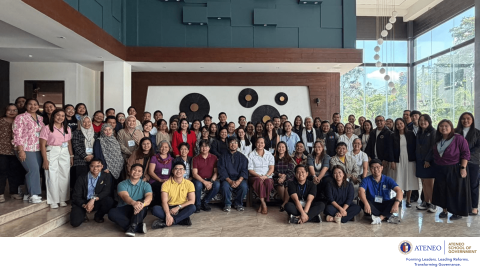
ASOG’s Tobacco Control initiatives spotlighted in DOH National Technical Working Group for Tobacco Prevention and Control
On March 10 to 12, 2026, the Ateneo School of Government (ASOG), through its research and public policy unit, the Ateneo Policy Center, participated in
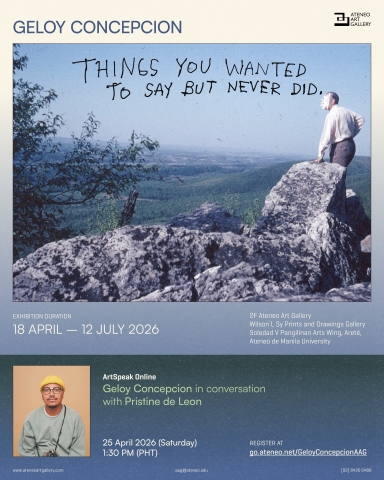
Things You Wanted to Say But Never Did: Geloy Concepcion’s six-year project makes Its exhibition debut at the Ateneo Art Gallery
Geloy Concepcion’s Things You Wanted To Say But Never Did comes to the Ateneo Art Gallery this 18 April 2026. After receiving almost 300,000 messages

[Hot Off the Press] Love If I'm Pretty
New YA Release from the Ateneo Press Love If I’m Pretty tackles the nuances of growing up through complex characters and straightforward prose What do