[Tinig] Where is the Voice of God? A Post-Elections Reflection on Vox Populi Vox Dei and Our Deafness
08 Jun 2022 | Bernadine Lanot
The day after the elections, I posted an announcement to my students, ending it, as I had always done these past two years whenever a crisis came up, with the words “You will never be alone.” A student messaged me and said he was in tears after reading it. “Salamat po sa pakikiisa.” It was not just empathy that I was feeling, however, for I too felt our collective disorientation and grief so deeply, as though someone I loved had met a life-threatening accident and was on the verge of death—a stark contrast to gleeful voices celebrating the results, saying, “Vox Populi Vox Dei.”
But I was certain that God as revealed by Jesus Christ would not want us to elect unrepentant thieves and liars into office .
History tells us that entire groups of people and crowds can make wrong collective decisions: structural racism and discrimination happening everywhere in the world, state killings, millions cheering on dictators who mastered the art of propaganda, in countries beyond the Philippines. There are people making wrong, collective decisions even in the narratives of the Bible: worshipping the golden calf, choosing Barabbas over Jesus . . . The list of wrong collective decisions that we human beings do could go on and on. And that is not God’s doing. That is of human choosing. A crowd’s collective decision based on a campaign run on disinformation, historical distortion, manipulation, plunder, and ill-gotten wealth can never be the “voice of God.”
If the voice of God is not in the voice of the majority, where is it, then, and how do we move forward? I felt lost. I spent the week of May 9 praying Psalm 10: “Why, Lord, do you stand far off? Why do you hide yourself in times of trouble . . . ?”
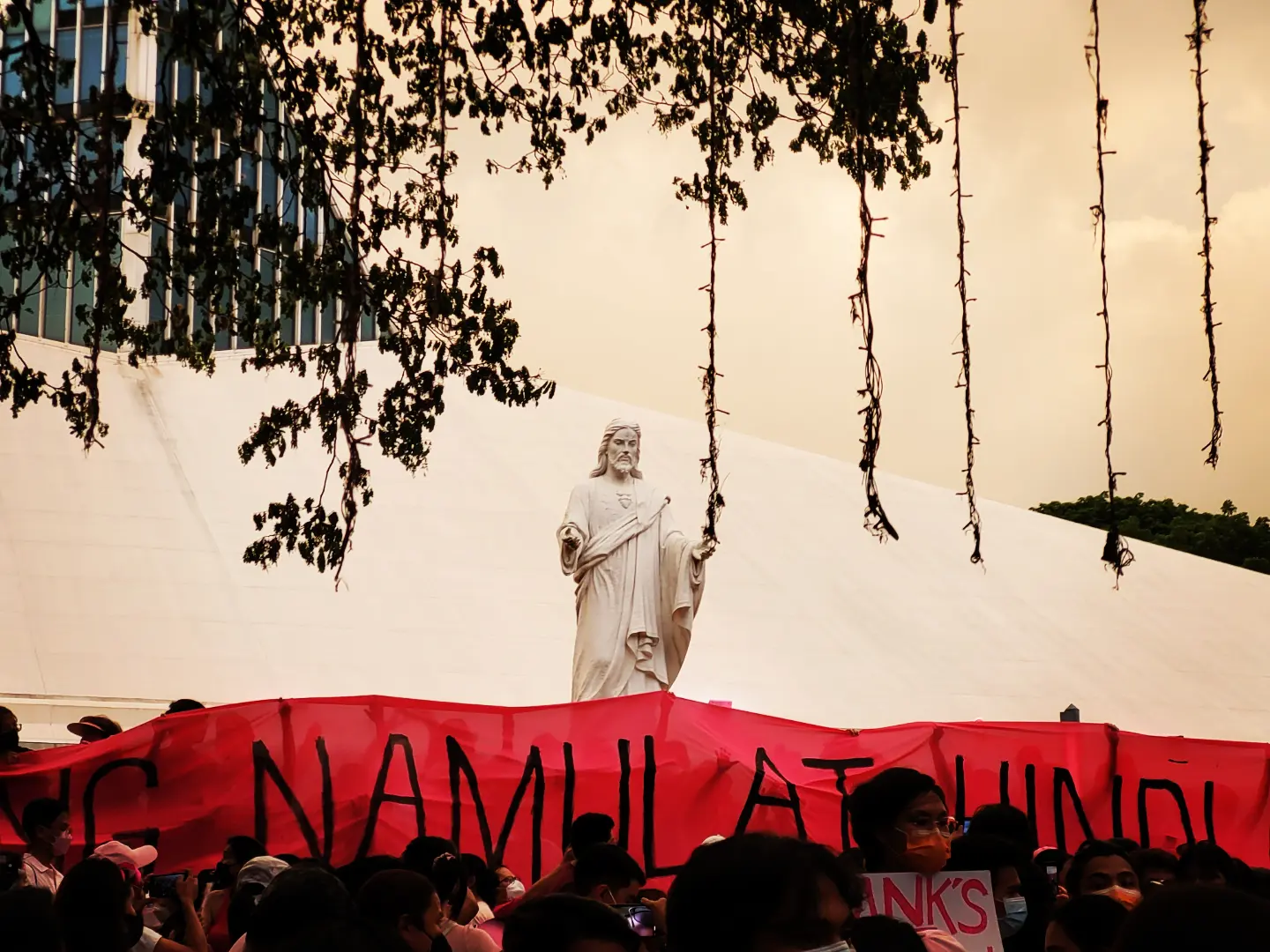
The Thanksgiving Rally on Bellarmine Field felt like the closure and the beginning that I needed. At some point in front of the Sacred Heart at the Church of the Gesu, some people raised a banner that bore the words: “Ang namulat, ‘di na muling pipikit.” How moving it was to see those words borne by a crowd the size of which I had never seen on campus, while the Sacred Heart stood with us all. Were those words our own vow? Our own desperate plea to the highest heavens? Or a message from our God, a promise that He will give us sight and sustain us?
Those words could be many things, but after that, I began to hear echoes of God’s voice again. God’s voice cut through my consciousness like the anguished wail of a mother when I listened again to accounts of the violated, mangled bodies of victims of Martial Law and extrajudicial killings. God’s voice rang out in peaceful and nonviolent protests that sought to safeguard our democracy, demanding justice for disenfranchised voters and accountability from our duty-bearers. There was God’s voice too in the still idealistic but plaintive voice of a student, writing in her last paper of the semester, “I have been driven to despair, but I will not give up on our country.”
And I began to believe again that God can speak through us too. In this not-so-golden era of disinformation, those with the eyes to see are commanded to be prophets, to speak the truth. I believe that this is our civic and Christian duty—to ensure that our democracy is built on truth, for without truth, the voice of the people cannot be the voice of God. This is part of our evangelization.
But it is not as simple as raising our own voices as the “true” voice of God. In our context, prophets cannot proceed with the arrogance of believing that they possess moral ascendancy and a superior grasp of unfolding events. They would only be a shadow, a caricature, of the prophets that we are called to be. For at the heart of every true prophet is the longing of God’s own heart—a preferential option for the poor—which at present includes those vulnerable to disinformation, with no privilege, means, or space to seek the truth.
Following still the call of the 2nd Plenary Council of the Philippines, how can we relate to the poor as our equals? How can we practice “preferential reliance on the poor in the work of evangelization”? (PCP II, no. 132)
While we are sure of our historical truth in an era of disinformation, we must learn how to speak it. Th e prophetic work cannot be done within bubbles of privilege. In discussing information and ideas among ourselves, in countless publications, conferences, fora, classrooms, and org events, many of us do not yet know how to connect with the poor. We know we need to use our privilege and position to inform and educate. But what if our privilege is the very thing that makes us so inarticulate in the language of the people, a language that is spoken not just with words but also with bodies, orientations, and lifestyles? Do we even understand what the people truly long for? How do they want to be spoken to? What connects with them?
Only they can tell us, and paradoxically, giving up our power and privilege may be just what is needed to help bridge the existing divide. Because, aside from our muteness, we also don’t know how to listen. The masses do not ask us for enlightenment; they ask us to listen, and perhaps right now prophets must listen more than they speak out.
It is hard to love radically when we feel so betrayed—and easier to rail against everyone else. But listening is an act of radical love and great courage. Listening could expose our own collective failures because something certainly led to this situation. How have we collectively failed the nation, not just these past elections, but over the last decades? How do we locate ourselves in these structures? How have we been complacent or complicit? The poor often complain, “Andito lang naman kayo tuwing eleksyon.” So have we truly, consistently, been radical in our love?
The clearest way forward is to be where the poor are, in the way of Leni Robredo whom we hoped would be our president. The Angat Buhay NGO, which will be launched next month, is built on this very mission. There is no other way to proceed than to do the work on the ground, not for those less privileged but with them. We cannot love from a distance or show up just to solve problems. We have heard it time and again: what is needed is an ongoing, sustained, personal relationship with the poor, for they demand to be seen.
This engagement is not optional, but crucial to our survival as a democratic nation—for we cannot fight disinformation if the poor do not trust or know us. Only through this vulnerability, this mutual sharing of radical love, can we hope to break down the systemic barriers of disinformation and lies.
Then maybe we will realize that there in the stories of the poor the voice of God can be heard too.
Tinig is a monthly opinion and analysis series from the School of Humanities. The views expressed in this piece are those of the author and do not necessarily represent the views of School of Humanities or the Ateneo de Manila University.
Recent News
You may also like these articles

[Hot Off the Press] Arkipelago
New book from the Ateneo Press Arkipelago provides a fascinating and fantastical twist on Philippine politics and history Our country is an archipelago of stories
Protecting Creativity: AIPO and Rizal Library Host Copyright Awareness Session for the Ateneo Community
On March 18, 2026, the Ateneo Intellectual Property Office (AIPO), in collaboration with the Rizal Library, successfully conducted a Copyright Awareness Session held on the
Holy Week 2026 Holidays (Memo # UHR2526-038)
Memo # UHR2526-038 31 March 2026 TO: All Employees FROM: [Sgd] Maria Victoria T Cortez, PhD Vice President for University Human Resources SUBJECT: Holy Week
ASOG’s Tobacco Control initiatives spotlighted in DOH National Technical Working Group for Tobacco Prevention and Control
On March 10 to 12, 2026, the Ateneo School of Government (ASOG), through its research and public policy unit, the Ateneo Policy Center, participated in
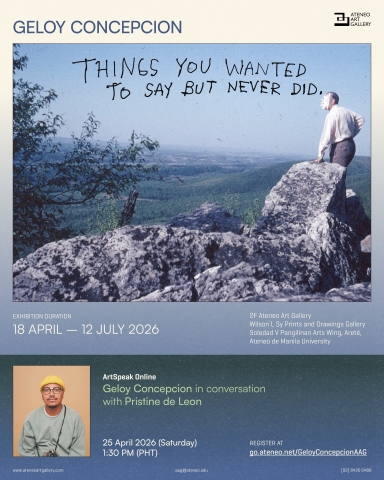
Things You Wanted to Say But Never Did: Geloy Concepcion’s six-year project makes Its exhibition debut at the Ateneo Art Gallery
Geloy Concepcion’s Things You Wanted To Say But Never Did comes to the Ateneo Art Gallery this 18 April 2026. After receiving almost 300,000 messages

[Hot Off the Press] Love If I'm Pretty
New YA Release from the Ateneo Press Love If I’m Pretty tackles the nuances of growing up through complex characters and straightforward prose What do