Graduate Level Academic Policies for SY 2025-2026 (OAVPGE Memo)
01 Aug 2025 | Office of the Assistant Vice President for Graduate Education


Graduate education in Ateneo de Manila continues to stand as a powerful catalyst - refining minds through collaboration, deepening expertise with empathy, and empowering students to be change agents in our society. In support of this mission, we are committed to advance diverse teaching and learning experiences along with transformative opportunities for research and service. This includes embracing the advancements in technology to innovate how we teach, learn, and serve.
This School Year, we are reminded of our most important role - as mentors - to our graduate students who come from diverse backgrounds, many of whom are first generation graduate students from far-flung communities. In order to support them in their academic journey, I would like to highlight key academic policies from the Graduate Student Handbook and Faculty Manual for your guidance:
I. Teaching and Learning
A. Learning Hours and Class Attendance (Graduate Student Handbook, p. 30)
In order to provide our students with learning opportunities that are in-depth, experiential, and collaborative across spaces, we are reminded of the following:
1. Learning hours refer to the total time a student devotes to fulfilling the learning outcomes of the course. This is roughly equivalent to at least twice the number of contact hours per course.
2. There is a need to assign a minimum number of onsite contact hours per credit unit not only to fulfill residential program regulatory requirements but most importantly to maximize in-person collaborative learning experience.
3. Students are expected to attend at least 80% of the total contact hours per course. A grade of W will be given to those who are unable to do so.
For every 1 credit unit:
Note: In-person contact hours may be subject to change depending on changes in CHED regulatory requirements.
We want to emphasize that effective instructional methods—whether onsite classes, small group work, supervised fieldwork, online activities, live broadcasts, or independent research—are crafted to empower students in reaching their course’s learning outcomes. We trust our course instructors and coordinators to thoughtfully develop instructional materials, activities, and assessments aligned with the course’s goals and pedagogical philosophy. Let’s embrace the technology at our fingertips to enrich and elevate our onsite sessions, making learning a vibrant and engaging journey. We continue to encourage everyone to use available technologies to support and enhance onsite sessions, not only for online work.
B. Course Syllabus
- Graduate Students
- Students must be officially enrolled in a course to access the course syllabus and the online Learning Management System (LMS), participate in onsite and online class activities, submit papers, take exams, and receive grades at the end of the semester or term. If there are any special circumstances that prevent a student from completing registration, they should immediately see the University Registrar. (Graduate Student Handbook, p. 23)
- Students shall be provided with a copy of the course syllabus at the beginning of every semester. (Magna Carta of Graduate Students' Rights - Graduate Student Handbook, pp 142-143)
- Instructors
- Faculty members are expected to upload their class syllabi on AISIS before the start of each term. (2019 Faculty Manual, p 38)
- Only course descriptions, PLOs, and CLOs approved by the Curriculum Committee and on file with the Office of the AVP for Graduate Education and the Office of the University Registrar must be used. Changes in the course details should go through a course revision proposal.
- All class syllabi should be uploaded to AISIS on or before the deadline set in the Academic Calendar released by the Office of the University Registrar.
- For activities and deadlines that may impact class schedules and activities (e.g., load revision schedule, deadlines for academic processes, national and school holidays, etc.), instructors may refer to the Academic Calendar released by the Office of the University Registrar.
- Include GenAI Use Policy in the syllabus, based on the Guidelines on the Responsible Use of Generative Artificial Intelligence (GenAI) in Higher Education.
- Procedures and details on preparing and uploading a course syllabus in AISIS are available at this link.
C. Student Performance
- Computation of Student's Grade (Graduate Student Handbook, p. 34)
In outcomes-based education, the final grade reflects how well the student has achieved the course’s expected learning outcomes. Hence, it is based on a variety of assessments as indicated in the syllabus. Except in the case of a W grade (Withdrawal without Permission), attendance does not form part of the students’ grade for the course. Refer to 2.7.4.1 Grading System for Graduate-Level Courses, pages 33-34 of the Graduate Student Handbook for more information.
- Completion of an Incomplete Mark (Graduate Student Handbook, pp 35-36)
- A student may be given a temporary grade of INC in extraordinary circumstances when some requirements of a course (except the final examination) have not been met.
- Students who receive a grade of “INC” are required to complete the requirements within the deadline set by the instructor or at least one month before the end of the one-year grace period if the instructor sets no deadline.
- Students with an “INC” in a course that is a prerequisite to a succeeding course will not be allowed to register for the succeeding course.
- If the requirement is not completed at least one month before the end of the one-year grace period or by the deadline set by the instructor, the grade will be automatically changed to an F (Failed). Refer to the Academic Calendar for the deadline for completion of incomplete marks for each term.
D. Beadle (2019 Faculty Manual, pp 38-39)
Faculty members must assign a student as class beadle for each class. The class beadle reports:
- the attendance of a faculty member on AISIS
- major changes in the course requirements and course grading system or other matters to the Department Chair/Program Director or School Dean if these concerns are not sufficiently resolved by the instructor. The revisions to the syllabus after the start of an academic term require the agreement of the students and the approval of the Department Chair/Program Director.
E. Learning Management System (Graduate Student Handbook, pp 171-172)
Canvas is the main Learning Management System of the university. All officially enrolled students will automatically be given access to their courses in Canvas. As an online platform, the LMS allows teachers to create and deliver content and monitor the learning progress of the students. It also facilitates efficient communication between learners and teachers as they navigate through the course materials and assessments vis-a-vis articulated learning goals together during the semester. Hence, it is highly encouraged that we use Canvas more strategically - whether in tracking students’ progress, delivering formative assessments or in integrating social learning experiences.
II. Comprehensive Examinations
The comprehensive exam is generally a two-part examination that aims to test the student’s knowledge, competency, and/or expertise in their field of study. It typically covers all core or foundation courses and may include some pre-identified major and specialized courses. Students may take the Comprehensive Examinations after completion of certain courses as prescribed in the program’s curriculum and CHED Memorandum Order (CMO) and/or prior to the commencement of their thesis/dissertation/capstone project. (Graduate Student Handbook, p 37)
The Comprehensive exam grade must be submitted and posted in AISIS within the deadline set in the Academic Calendar for each term.
We have unwavering confidence that departments and programs are uniquely positioned to choose and implement the most effective methods for delivering their respective comprehensive exams. We encourage departments and programs to review their internal protocols, embracing feedback from stakeholders, all aimed at upholding the integrity and authenticity of the Comprehensive Exam as a vital program-level assessment.
III. Final Academic Requirements
Thesis, Dissertation, and Capstone Project (Graduate Student Handbook, p 39)
- The aim of the thesis is to reflect the student’s mastery of a relevant specialized area of their discipline. It also demonstrates the student’s ability to critically engage the topic through the conduct of a scientifically and ethically sound research process.
- A dissertation’s aim is to contribute new knowledge, theory, or practice in the student’s field or discipline. It demonstrates the student’s ability to produce an original body of work by using previous research as a guide.
- The capstone project is an investigative project, action-based research, or an integrative paper on a social problem that culminates in the opportunity to exhibit new knowledge or the implementation of a project, presentation, or performance. This encourages students to apply what they have learned to real-world issues or problems.
Research is a cornerstone of graduate degree programs, driving innovation and knowledge. Over the years, we have made significant strides by updating our policies, establishing clear guidelines, and automating key processes. We’ve embraced technology such as Zoom and Canvas to create a more inclusive and efficient experience for both mentors and mentees. We will continue this journey, ensuring technology is used in meaningful ways—not just for facilitating Thesis, Dissertation, and Capstone Project advising and presentations, but also to foster lifelong learning skills and build professional relationships. More information on Thesis, Dissertation, and Capstone Project, including grading systems, rubrics, publication requirements, and additional resources, is available in the Graduate Research Mentoring Framework GSite.
In our commitment to fostering a vibrant academic community, we will uphold a degree of decentralization in the governance of our graduate programs, while ensuring that schedules for final course assessments, comprehensive exams, oral defenses, and other important academic and research-related activities adhere to the deadlines in the Academic Calendar for school year of the Office of the University Registrar. These must be indicated in the course syllabus and uploaded in the AISIS and Canvas course shells provided for each course so students can make the necessary preparations early.
To end, cura personalis is indeed a challenging endeavor, and we extend our gratitude to the Department Chairs, Program Directors, and Graduate Program Coordinators for their unwavering dedication to guiding the achievement of our graduate degree programs’ learning outcomes. As we approach a new school year, we embrace the political, environmental, and social unpredictability ahead, finding strength and humility in our shared journey. We are committed to delivering transformative graduate programs across diverse disciplines and environments. Let us remain steadfast in our mission to cultivate transformative knowledge, empower change leaders, and build resilient and equitable communities within our university and society.
Recent News
You may also like these articles

[Hot Off the Press] Arkipelago
New book from the Ateneo Press Arkipelago provides a fascinating and fantastical twist on Philippine politics and history Our country is an archipelago of stories
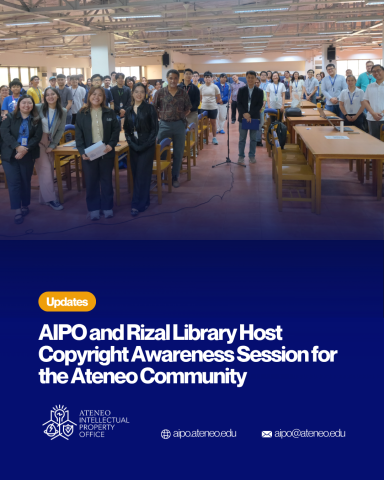
Protecting Creativity: AIPO and Rizal Library Host Copyright Awareness Session for the Ateneo Community
On March 18, 2026, the Ateneo Intellectual Property Office (AIPO), in collaboration with the Rizal Library, successfully conducted a Copyright Awareness Session held on the
Holy Week 2026 Holidays (Memo # UHR2526-038)
Memo # UHR2526-038 31 March 2026 TO: All Employees FROM: [Sgd] Maria Victoria T Cortez, PhD Vice President for University Human Resources SUBJECT: Holy Week
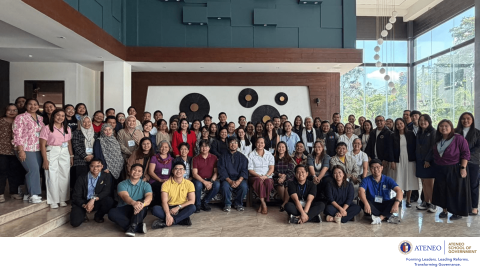
ASOG’s Tobacco Control initiatives spotlighted in DOH National Technical Working Group for Tobacco Prevention and Control
On March 10 to 12, 2026, the Ateneo School of Government (ASOG), through its research and public policy unit, the Ateneo Policy Center, participated in

Things You Wanted to Say But Never Did: Geloy Concepcion’s six-year project makes Its exhibition debut at the Ateneo Art Gallery
Geloy Concepcion’s Things You Wanted To Say But Never Did comes to the Ateneo Art Gallery this 18 April 2026. After receiving almost 300,000 messages

[Hot Off the Press] Love If I'm Pretty
New YA Release from the Ateneo Press Love If I’m Pretty tackles the nuances of growing up through complex characters and straightforward prose What do