On the Weariness of Time: El Niño in the Philippines
28 Nov 2022 | Published in eTropic: Electronic Journal of Studies in the Tropics, 20(2) (2021), 209–220. https://doi.org/10.25120/etropic.20.2.2021.3819.


Christian Jil R Benitez
Department of Filipino, Ateneo de Manila University
cbenitez@ateneo.edu
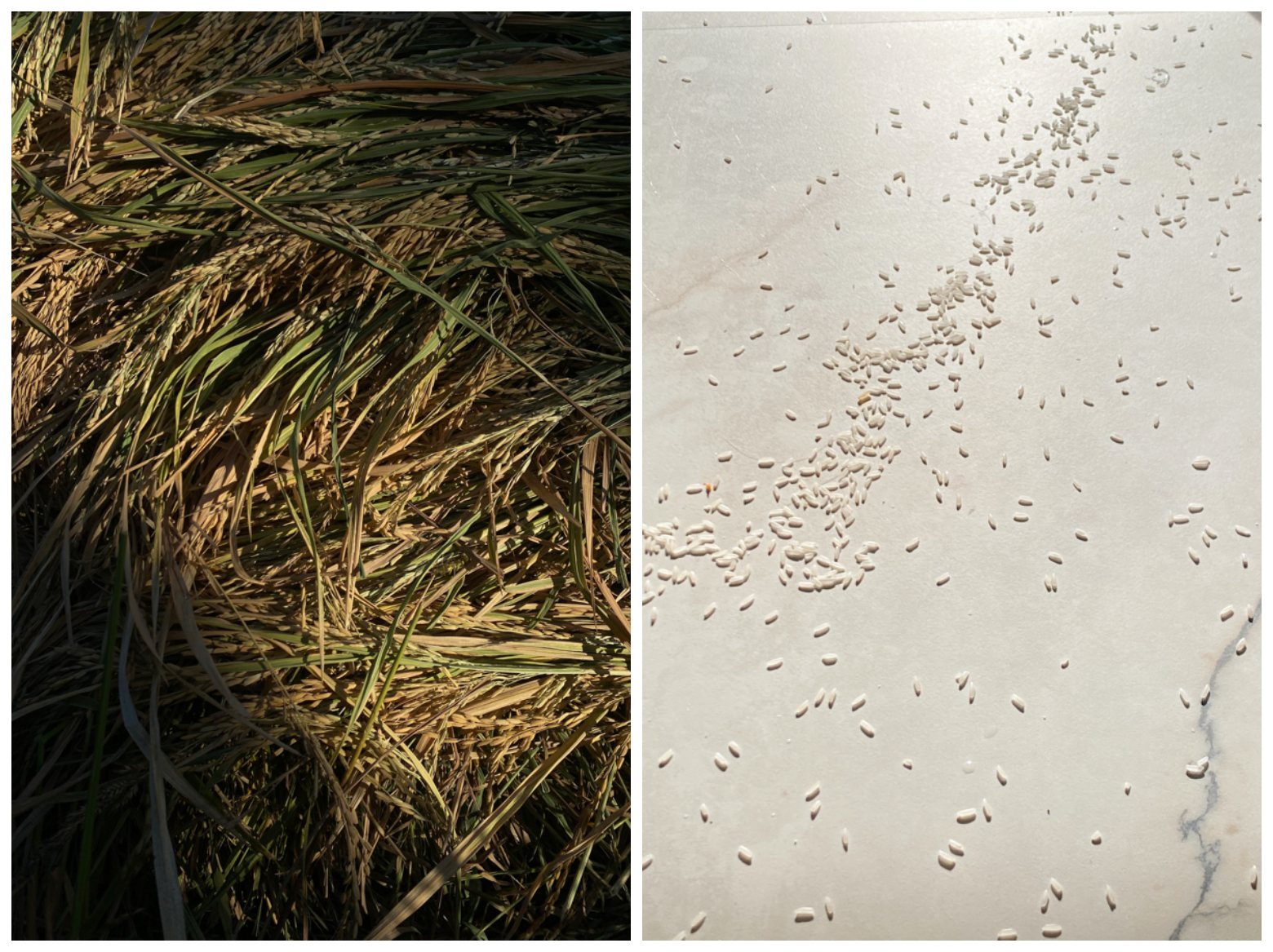
A part of a larger work that aspires to rethink time particularly as panahon and thus in Philippine terms, this essay takes its cue from the Filipino poet Jose F. Lacaba’s work titled “Ang Kapaguran ng Panahon” (“The Weariness of Time”). A poem that has been often valued for its being among the first Bagay poems published in 1965, alongside the works of Rolando Tolentino and Bienvenido Lumbera, “Kapaguran” is especially read here in relation to another seemingly unconnected context that took place more than 50 years after the initial publication of the poem: the 2015 El Niño phenomenon in the Philippines, which has left the agricultural sector of the country to suffer millions of damages.
Because of the grave impact of the El Niño drought to the country that year, many farmers were compelled to voice out and insist their urgent concerns. For despite the preparatory efforts of the government to attenuate the impact of drought, such as commencing cloud seeing operations and distributing seeds of a rice variant that can withstand water depletion, these did not necessarily translate to a successful adaptation of the country to the extreme turns of the tropical climate: as it has often been the case, farmers were left to their own devices to confront and live through the harsh circumstances. And particularly for the farmers and their supporters in Kidapawan City, Cotabato Province, in Mindanao, who have gathered in 2016 to express their needs to the government, this determination to simply survive led to a most violent culmination: as the local police dispersed the crowd to supposedly alleviate the traffic jam in the city, over 150 people were injured, including the three from the protestors’ side who were killed.
Through reading Lacaba’s work in light of this ecological crisis and the brutal encounters it has triggered in the country, the essay demonstrates a critical practice that deliberately coincides seemingly disparate events, if only to show how time specifically manifests in the context of the Philippines. And true to Lacaba’s poem, what emerges from this instance of reading is an sense of time that is worn down—panahong pagod—as embodied by the simple fact that a poem that has been written in 1960s still holds true today, as if no time has happened between then and now. In other words, what the questionable “universality” of Lacaba’s poem reveals is how the system largely remains the same with regards to how farmers are still left on their own to acclimate themselves and their livelihood to droughts and other climate extremes.
More than pointing to the typical imagination of time as (exotically) cyclical or circular in non-Eurowestern worlds such as the Philippines, this “weariness of time” must be recognized then as, in reality, a prohibition of time from unfolding its possibilities—a restriction that is repeatedly constructed, imposed, and self-replicated upon temporality itself through the coordination of various political infrastructures. As such, the “weariness of time” can be understood as the failure of imagining other possibilities of time, or of merely imagining time as irrefutably and irreversibly attrit, due to deliberate impeding of its potential to emerge differently. Thus, from here, it only becomes an imperative to discern time in alternative ways, which means, among other things, to assert that there still remains plenty of possibilities for things, and, at the same time, to acknowledge that such possibilities are inevitably and intimately entangled with each other. It is only from and through insisting such insights that criticality, as the most timely of virtues, can be finally put into practice—an embodiment that the essay ultimately aspires to have demonstrated in its temporally comparative approach.

About the Author
Christian Jil Benitez is a poet and scholar from the Philippines. He earned his AB-MA in Filipino Literature from the Department of Filipino, Ateneo de Manila University, where he currently teaches literature and rhetoric. He is currently pursuing his PhD in comparative literature at Chulalongkorn University. His critical and creative works in both English and Filipino primarily move around the Philippine notion of time, namely panahon, intuited through the rubrics of the tropical, the poetic, and the new material. His first book, Isang Dalumat ng Panahon (2022), is published by the Ateneo de Manila University Press.
View the original journal article in the Archium: Ateneo Institutional Repository.
Get Isang Dalumat ng Panahon from Ateneo University Press.
Explore more of the author's work on Ateneo Institutional Repository and Ateneo Experts Gallery.
Recent News
You may also like these articles
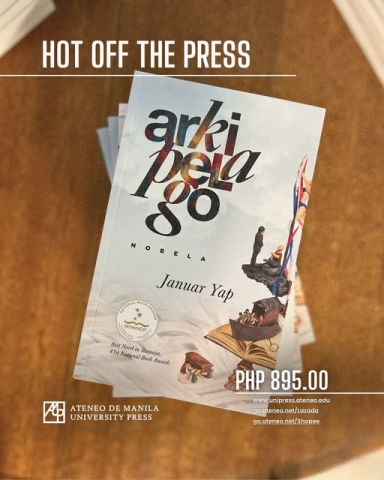
[Hot Off the Press] Arkipelago
New book from the Ateneo Press Arkipelago provides a fascinating and fantastical twist on Philippine politics and history Our country is an archipelago of stories
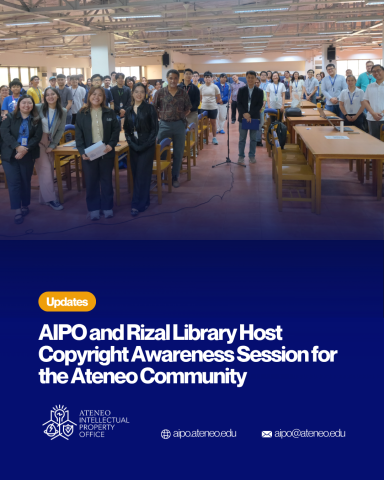
Protecting Creativity: AIPO and Rizal Library Host Copyright Awareness Session for the Ateneo Community
On March 18, 2026, the Ateneo Intellectual Property Office (AIPO), in collaboration with the Rizal Library, successfully conducted a Copyright Awareness Session held on the
Holy Week 2026 Holidays (Memo # UHR2526-038)
Memo # UHR2526-038 31 March 2026 TO: All Employees FROM: [Sgd] Maria Victoria T Cortez, PhD Vice President for University Human Resources SUBJECT: Holy Week
ASOG’s Tobacco Control initiatives spotlighted in DOH National Technical Working Group for Tobacco Prevention and Control
On March 10 to 12, 2026, the Ateneo School of Government (ASOG), through its research and public policy unit, the Ateneo Policy Center, participated in
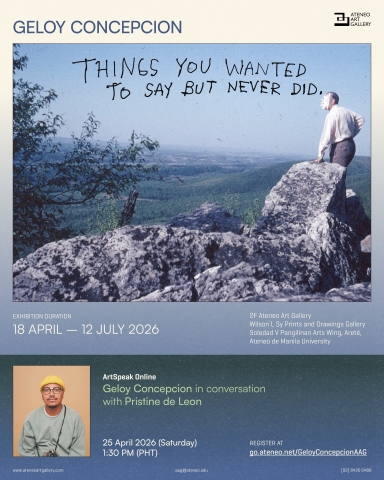
Things You Wanted to Say But Never Did: Geloy Concepcion’s six-year project makes Its exhibition debut at the Ateneo Art Gallery
Geloy Concepcion’s Things You Wanted To Say But Never Did comes to the Ateneo Art Gallery this 18 April 2026. After receiving almost 300,000 messages

[Hot Off the Press] Love If I'm Pretty
New YA Release from the Ateneo Press Love If I’m Pretty tackles the nuances of growing up through complex characters and straightforward prose What do