DigiPhiLit: The importance of digital humanities, distance learning, and studying Philippine literature in Spanish
31 Aug 2023 | Alliya Kyla Garcia



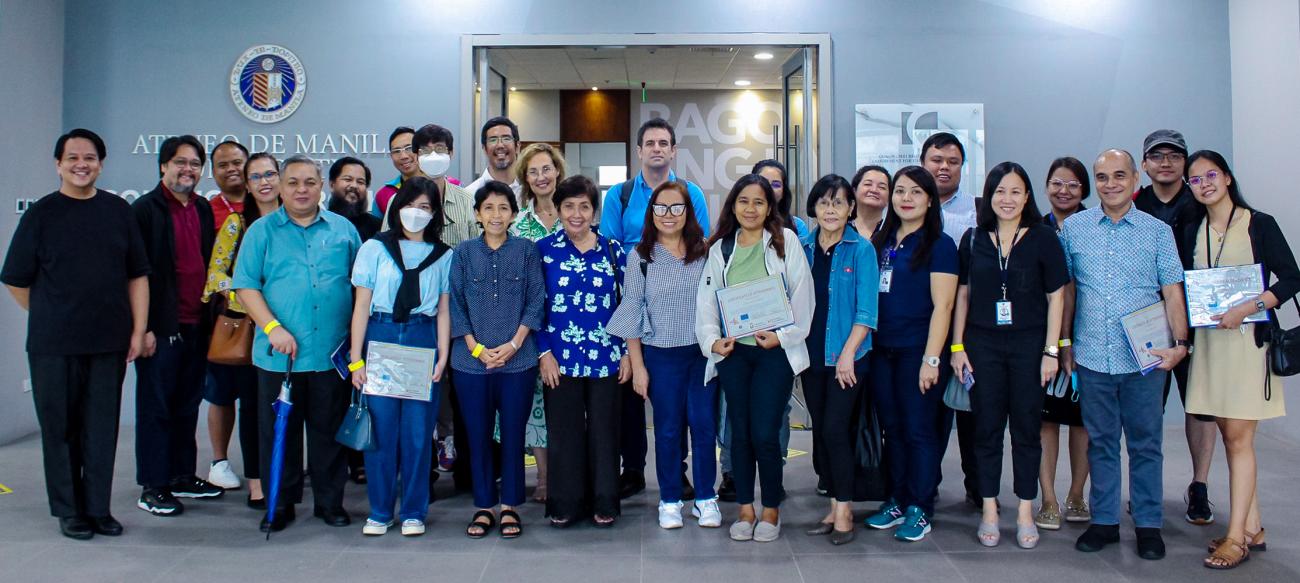
Last 27 July, the School of Humanities at Ateneo de Manila University, in coordination with the Gokongwei Brothers School of Education and Learning Design (GBSEALD), hosted a workshop entitled Old Wine, New Skin: Digital Humanities, Distance Learning, & Philippine Literature in Spanish. The event, held at the JJ Atencio Lighthouse, was organized by Ateneo de Manila University, Universidad Rey Juan Carlos, and Université Paris Nanterre.
The workshop brought together professors and students from the field of Philippine literature to discuss one of the outputs of the DigiPhiLit Project: A Massive Open Online Course (MOOC) that “aims to introduce Philippine Literature in Spanish that everyone could enjoy,” according to one of the esteemed speakers, Professor Jorge Mojarro Romero.
The Importance of Studying Philippine Literature in Spanish
Professor Jorge Mojarro Romero, Philippine colonial literature professor from the University of Santo Tomas, was the first speaker at the workshop. His talk focused on the parallel development of Latin American and Philippine literature. He mentioned that while these two are the same in terms of context, the difference between them is that Latin American literature has a vast collection of resources and has been studied by many people while Philippine colonial literature does not currently have as many resources for readers and scholars. Professor Mojarro then stated that there are fewer than ten researchers in the field, and that none of them are Filipino.
When he was invited to contribute to the DigiPhiLit project by adding his research to the content of the MOOC, Professor Mojarro said that he found the project to be interesting. “[The] contribution is small,” he stated, but what made it fascinating for him was the research and the ability to “go into one area that no one has gone into.”
The second workshop speaker was Professor Emmanuelle Sinardet, a professor of Latin American studies from Université Paris Nanterre. She discussed Philippine national identity as having been built by national imaginaries seen in literature and art. In her talk, she explained that the higher volume of literature produced by the second generation of ilustrados after 1898 caused the Alma Filipina to emerge. She quoted political scientist Benedict Anderson, saying that “the nation is always conceived in language” because “literature is a space where you can talk about your national project by using symbols in an indirect way.”
The reason why Professor Sinardet contributed to the DigiPhiLit project was because she saw how the traditional approach of doing research was not useful enough if people wanted to understand how national imaginaries worked. For her, there was a need for an open database not only to help people understand these kinds of literature but also for them to realize that there is a need to look at literature in an interdisciplinary manner to interpret the way it is coded.
DigiPhiLit and the Future of Digital Humanities and Distance Learning
The MOOC aims to resolve three issues when it comes to researching and teaching Philippine Literature in Spanish. First, the lack of specialized teachers aims to be resolved by how the module is created for distance learning. Second, the difficulty in accessing literary works can now be addressed through the digitization of bodies of research. Third, the difficulty in accessing information and reading keys will be resolved by the creation of materials for study. These texts will then be translated from Spanish to English and then to Filipino for those who are not sufficiently proficient in the Spanish language.
Professors Jorge Mojarro and Emmanuelle Sinardet gave participants a glimpse of the DigiPhiLit MOOC during the second part of the workshop. They showed the structure of the online course: an introductory video explaining what the specific module is about, the modules (5 lessons) which are color-coded and presented with bright animation, an exercise, and then the sources. These modules have been designed by students from Universidad Rey Juan Carlos, and are structured to be interactive and easy to go through for both professors and students.
With Philippine Literature in Spanish now being more accessible to students and teachers alike through the DigiPhiLit MOOC, Professor Mojarro advises fellow professors to use this resource as something to complement their students’ learning. “The professor can develop the topic based on the MOOC and then expand [from there],” he stated. Professor Sinardet offered similar advice to professors by saying that they should follow the structure of the MOOC and let it become a “guide [reading material] for the students.”
The creation of this MOOC, which is just a part of the DigiPhiLit project, sets a positive tone for the future of digital humanities and distance learning.
Recent News
You may also like these articles
Protecting Creativity: AIPO and Rizal Library Host Copyright Awareness Session for the Ateneo Community
On March 18, 2026, the Ateneo Intellectual Property Office (AIPO), in collaboration with the Rizal Library, successfully conducted a Copyright Awareness Session held on the
AIS links with Masungi for systems thinking for environmental management
Last 23-24 March 2026, the Ateneo Institute of Sustainability (AIS) , which manages the My Climate Risk – Ateneo de Manila University Regional Hub
Contingency Measures in Higher Education in the Face of a Worldwide Energy Crisis (HE Memo#Y4.16)
In response to the energy crisis caused by escalating tensions in West Asia, Ateneo Higher Education will implement the following class and operational adjustments.
Basic Education Class Schedules March – June 2026 (OVPBE memo)
In alignment with DepEd Memorandum No. 018, s. 2026, and our own commitment to Cura Personalis, we are refining our operations for the remainder of the school year to ensure that we finish strong, safe, and sustainable.
URH residency application for Intersession SY 2026-2027 now open
Hey, Blue Eagles! Big news — URH INTERSESSION RESIDENCY SY 2026-2027 is NOW OPEN! Apply now to live where the vibes are unmatched! What’s in

Class Arrangements for Thursday and Friday, 26-27 March 2026 (HE Advisory)
In view of the announcement of a nationwide transportation strike on 26-27 March, undergraduate and graduate classes of the Schools of Education and Learning Design