[Ateneo Press Review Crew] Memories of My Maestro: A Book Review on “A Dapitan Schoolboy”
31 Mar 2025 | Christine Marie Lim Magpile



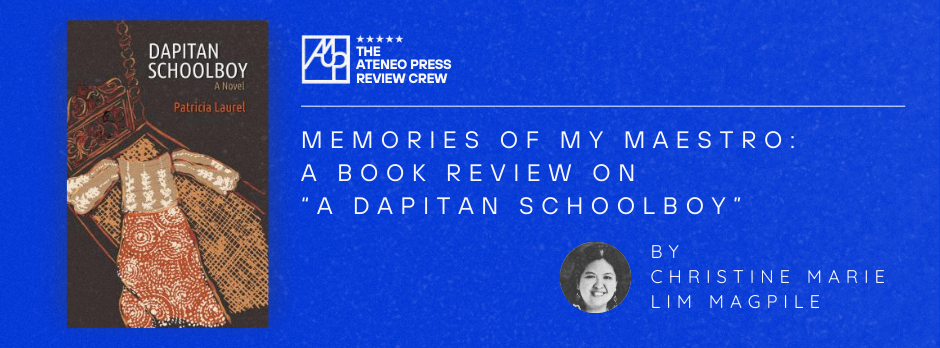
Through the eyes of young Jose (Joselito) Aseniero, we are granted an intimate and humanizing glimpse into the life of Jose Rizal during his exile in Dapitan. The book's central theme is personal transformation through education and mentorship. Dapitan Schoolboy portrays Jose Rizal as an educator with an enduring impact. Jose Aseniero's journey from an uninspired boy to a diligent young lad is a testament to the inspiration of Jose Rizal's teachings to his students in Dapitan.
Initially, Jose Aseniero was chosen to be Rizal's assistant, but the role expanded to include Fernando Eguia, Mateo Edjawan, and Romulo Hamak. These boys were tasked with gathering materials for projects, such as shells, stone pebbles, and rattan strips for constructing a relief map of Mindanao. As Rizal's students, they assisted patients at the clinic. They participated in nature studies like collecting specimens of flowers. They also learned English. Rizal established a school in Talisay, offering a new approach to education, and he took his students on expeditions. The book illustrates how Rizal's commitment to nurturing young minds fosters a sense of purpose and engagement, highlighting education's potential to spark change.
Despite the constraints of his exile, Rizal's commitment to education extends beyond the classroom as he undertakes various infrastructure projects, medical services, and education initiatives to uplift the community of Dapitan. The novel also narrates Jose Rizal's relationship with his family when they visited him in Dapitan and during his execution as well as its aftermath, which offered a humanizing perspective on Jose Rizal aside from the hero enshrined in historical narratives. The presence of his sisters, their support, and dedication to preserving his legacy, adds another layer of depth to Rizal's story.
The author uses detailed descriptions to paint a picture of the scenes and people, such as describing the physical appearance of Joselito and Dr. Rizal. The book has an engaging storytelling style because the narrator (Joselito) shares personal anecdotes and memories, drawing the readers into his experiences with Dr. Rizal. Additionally, the narrator expresses his feelings and reactions to the events unfolding around him, creating an emotional connection with the readers.
Contemporary women authors like Patricia Laurel offer unique perspectives shaped by their lived experiences. Reading works from women authors broadens understanding of social issues as stories written by women authors foster empathy and promote inclusivity. Through her novel, the author was able to show the pivotal role of Jose Rizal's sisters in his life. His sisters, Maria, Narcissa, and Trinidad accompanied their mother, Doña Teodora in Dapitan.
They helped manage his household, clinic, and school. They provided emotional support and companionship, alleviating his loneliness and isolation during exile. With the help of Joselito, Narcissa searched for Rizal's body after his execution and located his unmarked grave, ensuring he received proper recognition. Doña Trinidad Rizal was the last surviving sister of Dr. Jose Rizal. Doña Trinidad took care of Josephine's belongings after her death, and years later, she entrusted them to Joselito, knowing he would treasure them.
After Rizal's execution, his sisters were instrumental in preserving his memory and writings. Trinidad played a crucial role in safeguarding his final poem, "Mi Ultimo Adios," which he hid in a lantern. She kept alive the memories of her brother, as seen in her visit to Dapitan many years later.
The novel also narrates the development of friendship between Rizal and Commandant Ricardo Carnicero, which demonstrates how friendship can cross political lines and provide mutual support. Unfortunately, the book also revealed that Rizal was betrayed by people like Florencio Namanan, sent to Dapitan to spy on Rizal and report his work to authorities. Dapitan Schoolboy is relevant to current socio-political issues in the Philippines because it touches on themes that continue to resonate in the nation's identity and governance.
Rizal’s love for his country could encourage modern-day Filipinos to act in the best interest of their country. Rizal's character, as depicted in the book, exemplifies moral courage and the importance of standing up for one's beliefs, even in the face of adversity. The historical backdrop of colonization in the book provides context for understanding the Philippines' ongoing struggle for genuine independence and self-determination.
The novel's vivid depiction of Rizal's daily life while in Dapitan, his interactions with his students, and the profound effects of his mentorship create a reading experience that is both intellectually stimulating and emotionally resonant. It encourages readers to reflect on how history continues to shape its present while considering their role in shaping the future. Dapitan Schoolboy not only honors the memory of Jose Rizal but also challenges its readers to contribute to building a more just and equitable society.
You can get your copy in paperback: Website | Shopee and Lazada

Christine Marie Lim Magpile is a teacher, book editor, textbook author, and creative writer. She has a BS Education – History (cum laude) from the University of Santo Tomas, Manila and currently finishing her MA in Araling Pilipino (Philippine Studies) from the University of the Philippines, Diliman. She is a fellow of several national writers’ workshops in the Philippines such as the Iligan National Writers Workshop (2024), DLSU Young Screenwriters Workshop (2023), LIRA Poetry Workshop (2023 and 2007), La Salle Kritika National Workshop on Art and Cultural Criticism (2019), 6th Angono Writers’ Summer Workshop (2018), and the UST National Writers’ Workshop (2008).
Recent News
You may also like these articles
[Hot Off the Press] Arkipelago
New book from the Ateneo Press Arkipelago provides a fascinating and fantastical twist on Philippine politics and history Our country is an archipelago of stories
Protecting Creativity: AIPO and Rizal Library Host Copyright Awareness Session for the Ateneo Community
On March 18, 2026, the Ateneo Intellectual Property Office (AIPO), in collaboration with the Rizal Library, successfully conducted a Copyright Awareness Session held on the
Things You Wanted to Say But Never Did: Geloy Concepcion’s six-year project makes Its exhibition debut at the Ateneo Art Gallery
Geloy Concepcion’s Things You Wanted To Say But Never Did comes to the Ateneo Art Gallery this 18 April 2026. After receiving almost 300,000 messages
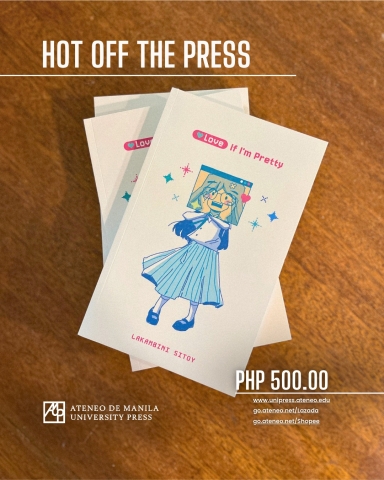
[Hot Off the Press] Love If I'm Pretty
New YA Release from the Ateneo Press Love If I’m Pretty tackles the nuances of growing up through complex characters and straightforward prose What do
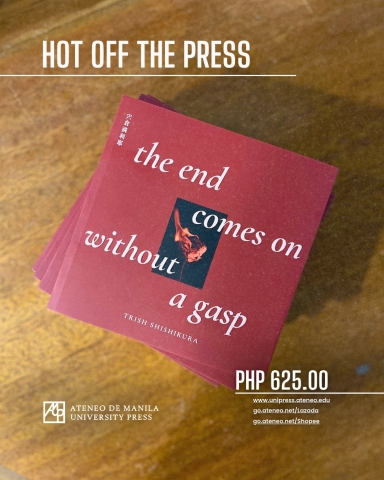
[Hot Off the Press] the end comes on without a gasp
the end comes on without a gasp: Trish Shishikura’s debut poetry collection arrives from Ateneo de Manila University Press (Bughaw) Ateneo de Manila University Press
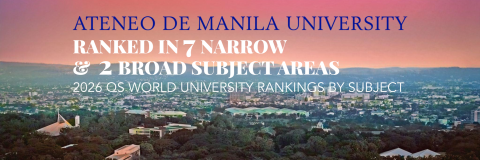
QS Subject Rankings 2026: Ateneo in top 100 for theology; ranked in 7 subject areas
Ateneo de Manila University is among the top institutions in seven subject areas, and among the top 100 for theological and religious studies, according to