[Ateneo Press Review Crew] Seeing the Woman in Dumdum’s “Moving with Moonrise”
31 Mar 2025 | Des Suarez

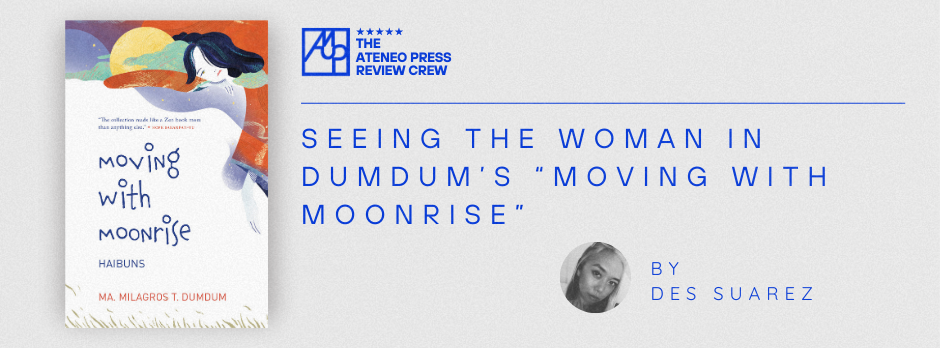
I happened to read Ma. Milagros T. Dumdum’s haibun collection Moving with Moonrise while traveling. It’s a thin book, easy to carry, and a great companion during transit or while passing the time at airports and terminals. Fittingly, the first thing you learn upon opening this book is that the haibun was born in the travel diary of Matsuo Basho, who coupled prosaic descriptions of his travels with a poem containing three lines of 5-7-5 syllables respectively: the haiku.
It is easy to be intimidated by the haibun because it is, quite literally, foreign to us, but in Moving with Moonrise, the strangeness of the form is quickly eased by the familiar images that Dumdum evokes with it. Her personal reflections are rooted in domestic life, in quiet memories, and in familiar spaces which altogether amount to the interior life of a woman who is a daughter, wife, mother, and poet. The fact that it is artfully articulated is an added delight.
Throughout the book, a feeling of transience overcame me because of Dumdum’s ability to capture things that were here in one moment and gone the next, like a leaf drifting before it hits the ground (Haibun 31), or the silence that precedes the first cockrow of the morning (Haibun 3). Many of the haibuns returned to her girlhood in Ormoc, Leyte, which she described so sensually that it seemed like she was tapping into an instinct that time might have otherwise buried. For instance, in the concluding haiku of Haibun 38:
Dark muscovado–
The taste of thick molasses
A child’s moist smell
The haibuns are not arranged chronologically but follow the natural rhythm of memory. It’s like a shoebox of photographs taken over the years and across different stages of her life. She is a schoolgirl in Haibun 2, a grandmother to a feverish three-year-old in Haibun 27, and a young girl again in Haibun 53, doing her first piano recital. Other roles that she plays as a daughter, wife, poet, pilgrim, and many others overlap in the same way, reflecting the intricacy of a woman’s identity.
I found myself taking photographs of some of the haibuns to share with a few of my female friends, especially the existential Haibun 19, which listed activities that she did with friends and family as a child in Leyte, where I also grew up. I swear the haiku that she concluded with was something that I experienced as a child, too.
Looking down the well–
Water, dark and bottomless
I can’t see my face
It was interesting to find that what felt nostalgic to one woman was painful to another, and what seemed ordinary to one carried deep meaning for someone else. While some themes felt universal, our interpretations weren’t—reminding me that womanhood is not a singular experience but a tapestry of distinct lives.
Now is a good time to mention that the haiku originated from the renga, a collaborative form of poetry where multiple “writers” or participants added their own line to the piece. Though deeply personal, I don’t think that Moving with Moonrise is meant to exist in isolation. Any writer, even a poet, still writes to be read, to spark connection, and to invite others into a conversation.
I think that the value of this book is that it shows us how slowing down, noticing small details, and having the patience to listen closely to things that might otherwise be drowned out by all the noise leads to a deeper understanding of the world. Cultivating this level of attention isn’t just useful for making sense of ourselves, but also for understanding the lives of those around us—especially those on the margins whose interior worlds are just as rich and important as our own.
In Moving with Moonrise, Dumdum reveals the depth of her own interior life as a multifaceted woman. Her haibuns show that a woman’s identity is a collection of lived experiences that inform each other and resonate over time.
Some women marry, some don’t; some become mothers, others never do; some are born into womanhood, while others, like transgender women, claim it for themselves—we all redefine the meaning of womanhood in our own way, yet there are still people who think of it as something rigid. Just as Dumdum reclaims her own story through her haibuns, every woman deserves the space to exist on her own terms, to be seen as she is, and to shape her own meaning.
You can get your copy in paperback: Website | Shopee and Lazada

Des Suarez is an MA Literature student at the University of San Carlos. She graduated cum laude with a BA in Mass Communication from the University of Philippines Cebu in 2019. Outside of her studies, she runs the subreddit and book club r/Cebooklub for a small community of readers in Cebu City.
Recent News
You may also like these articles

[Hot Off the Press] Arkipelago
New book from the Ateneo Press Arkipelago provides a fascinating and fantastical twist on Philippine politics and history Our country is an archipelago of stories
Protecting Creativity: AIPO and Rizal Library Host Copyright Awareness Session for the Ateneo Community
On March 18, 2026, the Ateneo Intellectual Property Office (AIPO), in collaboration with the Rizal Library, successfully conducted a Copyright Awareness Session held on the
Things You Wanted to Say But Never Did: Geloy Concepcion’s six-year project makes Its exhibition debut at the Ateneo Art Gallery
Geloy Concepcion’s Things You Wanted To Say But Never Did comes to the Ateneo Art Gallery this 18 April 2026. After receiving almost 300,000 messages
[Hot Off the Press] Love If I'm Pretty
New YA Release from the Ateneo Press Love If I’m Pretty tackles the nuances of growing up through complex characters and straightforward prose What do
[Hot Off the Press] the end comes on without a gasp
the end comes on without a gasp: Trish Shishikura’s debut poetry collection arrives from Ateneo de Manila University Press (Bughaw) Ateneo de Manila University Press

QS Subject Rankings 2026: Ateneo in top 100 for theology; ranked in 7 subject areas
Ateneo de Manila University is among the top institutions in seven subject areas, and among the top 100 for theological and religious studies, according to