[Ateneo Press Review Crew] The Marcos Years, the Movement, and the Women Who Endured Both
08 Apr 2025 | Arienne Therese Guinto




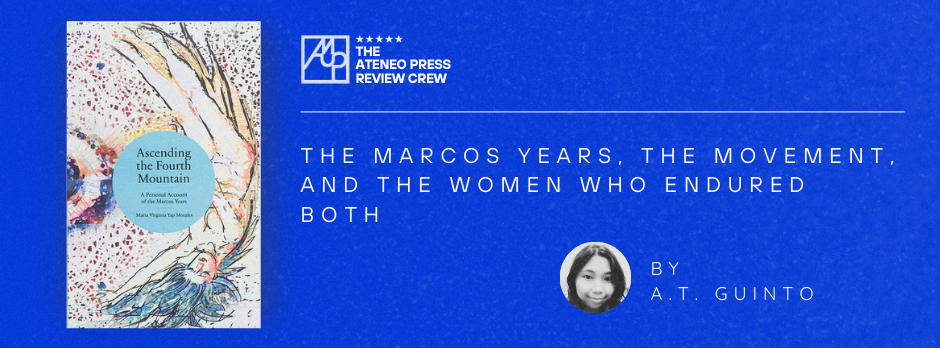
Maria Virginia Yap Morales’ Ascending the Fourth Mountain is not just a memoir; it is a reckoning. At a time when historical revisionism aggressively reshapes public memory—when the children of the dictator Morales resisted are once again in power—this book stands as both testimony and warning. But Morales does not merely revisit the past to reaffirm what we already know about Martial Law. She interrogates the very structures of power: state repression, movement dynamics, and the ways in which revolutions, despite their calls for liberation, can replicate the inequalities they seek to dismantle. Hers is a narrative that resists reductionism, instead dissecting the layered realities of struggle, both against dictatorship and within the movement itself.
Morales recounts her journey as an activist during the Marcos dictatorship, where she took part in the underground resistance against state repression. The book offers a deeply personal yet politically sharp examination of how women actively participated in the struggle, not only against the dictatorship but also against the patriarchal structures that persisted even within the movement. More than just a historical account, the book explores the emotional and ideological weight of commitment to a cause. Morales reflects on the sacrifices demanded by revolutionary work and the psychological toll it exacts on those who dedicate their lives to resistance. She also sheds light on her role in shaping the Malayang Kilusan ng Bagong Kababaihan (MAKIBAKA), one of the earliest militant feminist organizations in the Philippines, and how its formation was shaped by the broader political upheavals of the time.
Reading this book felt eerily familiar. As someone engaged in research and activism, I often encounter the same contradictions Morales lays bare—the tension between conviction and doubt, the exhaustion of pushing forward despite knowing how deeply entrenched the structures we fight against remain. The book operates as both testimony and analysis, situating individual experiences within broader structural realities. Morales does not merely recount events; she critically examines them. She exposes not only the brutality of the Marcos regime but also the internal fractures of the movement that sought to overthrow it. In an era when political discourse flattens history into a morality play of heroes and villains, Morales refuses simplification. She highlights ideological rifts, personal sacrifices, and unresolved questions that linger long after a dictatorship falls. In doing so, she reminds us that revolutions are not free from contradiction, and that true engagement with history requires confronting both victories and limitations.
One of the book’s most compelling interventions is its feminist lens. In the wake of Martial Law, much of the literature on resistance has focused on state violence and triumphs, often overlooking the hierarchies within the movement itself. Morales forces us to ask: Why did a struggle against oppression uphold structures of patriarchy? Why did the movement’s rhetoric of liberation not always translate to the liberation of its women? Her reflections on these contradictions remain deeply relevant, as the fight for women’s rights continues to be waged both within social movements and against reactionary forces. Morales reminds us that political struggles cannot afford selective critiques—a movement’s integrity is measured not only by what it fights against but also by what it refuses to replicate.
A defining strength of the book is its refusal to frame struggle as a simplistic arc of triumph or suffering. Morales portrays revolution as a continuous, deeply personal process marked by fractures, disillusionments, and painful reckonings. Reading her account, I was reminded of conversations with fellow organizers about how commitment to a cause does not erase exhaustion, and how the weight of struggle is unevenly carried, especially by women.
Rather than writing from a detached perspective, Morales brings us into the deeply personal stakes of resistance—where ideological commitment is inseparable from personal loss and betrayal. Her honesty is crucial today, when activism is often dismissed as futile or reduced to performative displays online. At times, she acknowledges exhaustion, but never surrender. Instead, she insists on the necessity of struggle, of questioning, of remembering—not passively, but as an act of defiance and accountability. Her work affirms that political engagement is neither easy nor pure; it demands deep commitment, intellectual rigor, and the courage to confront one’s own contradictions.
The structure of the book mirrors the fragmented nature of memory, making it an intellectually engaging but sometimes challenging read. Morales does not adhere to strict chronology; she allows her recollections to unfold in layers, shaped by both time and shifting political landscapes. This narrative choice strengthens one of the book’s central arguments: history is not simply a linear sequence of events but a contested space where meaning is constantly renegotiated. In an era of disinformation, where the past is deliberately rewritten to serve those in power, Morales' approach reminds us that historical memory is an active struggle. We are not merely remembering the Marcos years—we are fighting over what they mean in the present.
What makes Ascending the Fourth Mountain an urgent text is not just its role in countering historical distortion, but its deeper insistence that history itself is never static. The persistent revisionism surrounding Martial Law, the silencing of critical voices, and the continued criminalization of activists all reaffirm its relevance. But beyond serving as a corrective to historical revisionism, Morales’ work challenges us to critically engage with resistance itself—not as a static moment in history, but as an evolving struggle fraught with contradictions.
The book does not simply demand that we remember; it compels us to interrogate the narratives we accept, the gaps we overlook, and the unresolved tensions that still shape our political landscape. If the Marcos years continue to haunt the present, it is because the structures that enabled them were never fully dismantled. Morales’ book does not just expose this reality—it forces us to confront our own role in shaping what comes next.
Hence, it is not enough to remember Martial Law as an era of violence; we must also remember the aspirations that fueled resistance and the internal contradictions that shaped its course. More importantly, we must ask: What lessons have we truly learned? This book serves as both a warning and a guide, not just for those looking back, but for those who continue the struggle in different forms today.
You can get your copy in paperback: Website | Shopee and Lazada

Arienne Therese Guinto is a people's researcher at the Institute for Nationalist Studies, with a background in Human Ecology. She critically engages with public policy, disaster resilience, feminist thought, grassroots organizing, and nationalist movements, emphasizing the intersections of power, resistance, and social transformation. In her capacity as a reviewer, she seeks to interrogate dominant narratives, foreground marginalized perspectives, and contribute to a more critical and emancipatory discourse in literature and scholarship.
Recent News
You may also like these articles

[Hot Off the Press] Arkipelago
New book from the Ateneo Press Arkipelago provides a fascinating and fantastical twist on Philippine politics and history Our country is an archipelago of stories
Protecting Creativity: AIPO and Rizal Library Host Copyright Awareness Session for the Ateneo Community
On March 18, 2026, the Ateneo Intellectual Property Office (AIPO), in collaboration with the Rizal Library, successfully conducted a Copyright Awareness Session held on the
Holy Week 2026 Holidays (Memo # UHR2526-038)
Memo # UHR2526-038 31 March 2026 TO: All Employees FROM: [Sgd] Maria Victoria T Cortez, PhD Vice President for University Human Resources SUBJECT: Holy Week
ASOG’s Tobacco Control initiatives spotlighted in DOH National Technical Working Group for Tobacco Prevention and Control
On March 10 to 12, 2026, the Ateneo School of Government (ASOG), through its research and public policy unit, the Ateneo Policy Center, participated in
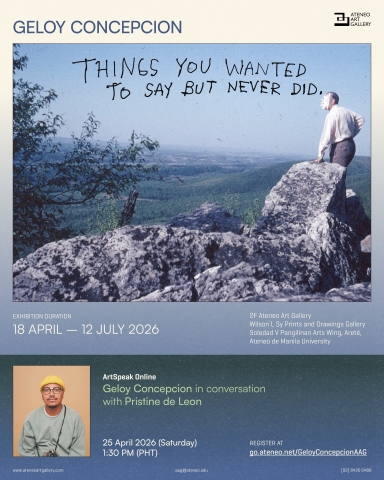
Things You Wanted to Say But Never Did: Geloy Concepcion’s six-year project makes Its exhibition debut at the Ateneo Art Gallery
Geloy Concepcion’s Things You Wanted To Say But Never Did comes to the Ateneo Art Gallery this 18 April 2026. After receiving almost 300,000 messages

[Hot Off the Press] Love If I'm Pretty
New YA Release from the Ateneo Press Love If I’m Pretty tackles the nuances of growing up through complex characters and straightforward prose What do