Applied AI for micro-retailers: An industry–academe–government initiative
09 Dec 2025








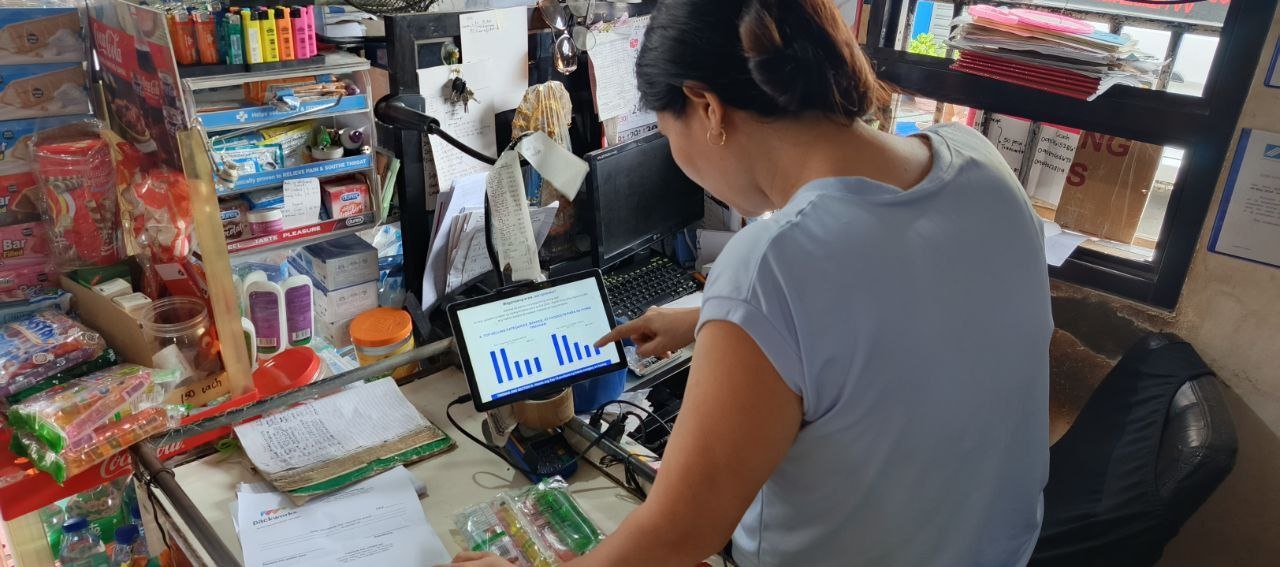
A micro-retailer examines store performance charts on a tablet, using insights from Packworks’ AI-supported reporting tool to guide daily business decisions. Photo courtesy of Packworks.
How Packworks, Ateneo BUILD, and DOST worked together to bring data-driven tools to sari-sari stores
Across many Philippine neighborhoods, sari-sari stores remain central to daily life. These small shops offer essential goods and often operate with narrow margins, relying on experience and routine rather than structured data to guide decisions. Their challenges are familiar, yet their role in local economies is significant.
Packworks, a Philippine startup, set out to support these micro-retailers through digital tools that help track sales and inventory. As more store owners used the platform, Packworks accumulated a growing dataset of retail activity from across the country. This opened the door to exploring how analytics and artificial intelligence could help small retailers understand demand, manage stock more efficiently, and improve business performance.
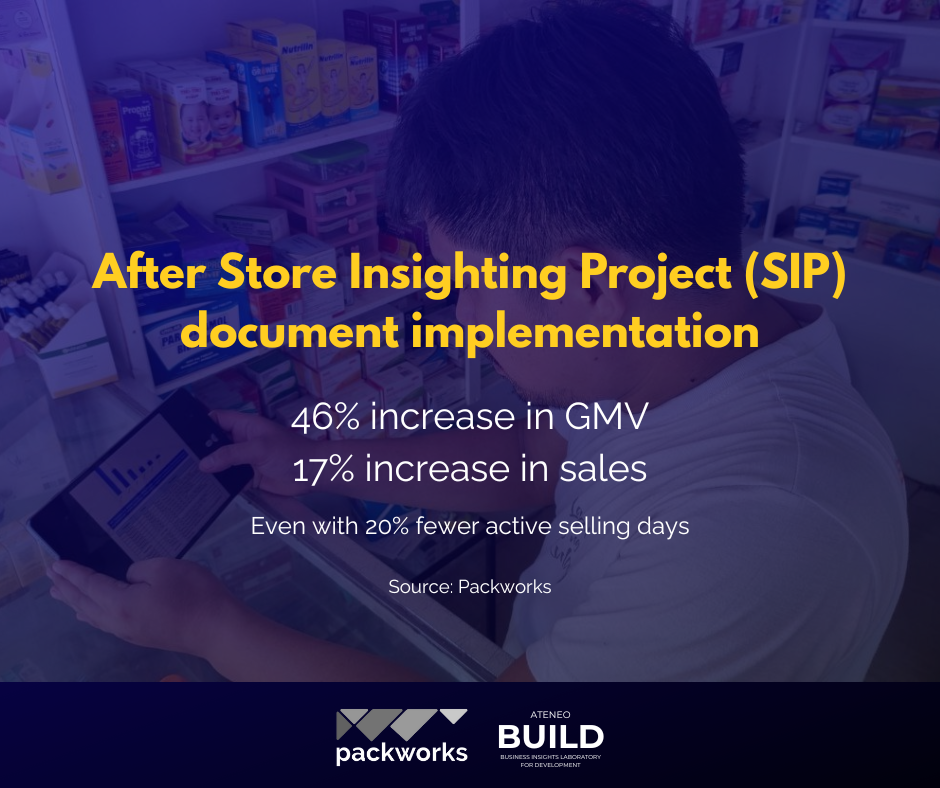
A recent analysis of more than 300 stores showed encouraging results. Stores that reviewed the Packworks Store Insighting Project report recorded increases in daily gross merchandise value and overall sales, even as some operated fewer selling days during the same period. The findings suggest that accessible, data-driven guidance can help small retailers make more informed decisions.
Packworks’ AI-driven tools were developed with support from the Department of Science and Technology (DOST) – Philippine Council for Industry, Energy and Emerging Technology Research and Development (PCIEERD) Startup Grant Fund (SGF) Program, which backed the company’s efforts to bring advanced analytics to the country’s micro-retail sector. The grant supported the development of Packworks’ precision marketing and insight-generation models, which later informed the Store Insighting Project.
Ateneo’s role in enabling applied AI
Behind these insights was early work undertaken with Ateneo’s Business Insights Laboratory for Development (BUILD), housed under the John Gokongwei School of Management (JGSOM). BUILD worked with Packworks to develop the data warehouse and business intelligence systems that organized the company’s growing dataset. These systems supported the AI models developed through the DOST-funded initiative.
Packworks Chief Data Officer Andres Montiel noted the value of this collaboration. “Even at this early stage of adoption, we’ve recorded increased sales and enhanced operational efficiency from stores by using the AI tools we’ve developed with support from DOST and through our collaborations with STT-GDC and Ateneo BUILD,” he said.
Montiel added that store owners are beginning to see how data-driven insights can guide their day-to-day decisions. “As stores learn to leverage the recommendations from the AI-driven insights they can access through SIP, micro-retailers can make smarter decisions that translate into higher sales and more efficient operations.”
He also recognized BUILD’s contribution. “The data platform that Ateneo BUILD developed helped us organize and prepare the information needed for our AI models. Their work allowed us to scale our analytics more effectively across our network of sari-sari stores.”
Packworks’ partnerships and shared infrastructure
Packworks’ AI initiatives further developed through a partnership with ST Telemedia Global Data Centers (STT GDC). Through the STT GDC AI Synergy Lab, the company gained access to computing resources needed to train and run more advanced models. BUILD’s earlier data engineering work provided a reliable base for these efforts, ensuring that Packworks could maximize the value of the infrastructure available to them.
BUILD’s evolving engagements
Packworks represents one part of BUILD’s broader trajectory as a laboratory working on applied data systems in collaboration with industry and civic partners.
Co-Develop, a global fund that supports countries and institutions in adopting digital public infrastructure through research, technical assistance, and capacity building, partnered with BUILD to establish the Technical Resource Lab (TRL), an initiative aimed at encouraging the use of standards-based DPI in the Philippines. The TRL introduces organizations to components such as digital identity, verifiable credentials, and interoperable data exchange, and helps stakeholders consider how these systems could strengthen public service delivery.
BUILD also convenes Breathe Metro Manila, a collaboration that brings together private firms, civic groups, and researchers to expand access to air quality data across the region. Through this initiative, BUILD works with Clarity Movement, a provider of low-cost networked air-quality sensors, and partners with scientific and health institutions such as the Manila Observatory and the Ateneo School of Medicine and Public Health Center for Research and Innovation (ACRI) to develop data resources and support public understanding of environmental conditions.
These efforts have progressed in ways aligned with BUILD’s initial purpose to explore how data systems and applied analytics can be used in collaboration with partners addressing practical challenges.
A model for industry–academe–government collaboration
The work involving Packworks, BUILD, and the DOST reflects a convergence of industry insight, academic data expertise, and government support for technological development. The partnership shows how shared investment in data systems and applied AI can lead to tools that benefit microenterprises at scale. It also demonstrates how public funding, private innovation, and academic research can reinforce one another in emerging areas of digital transformation.
Continuing work and broader implications
Packworks continues to refine its AI tools, providing store-level insights that help sari-sari owners monitor inventory, identify trends, and adjust operations. BUILD’s early involvement contributed to the data environment that supports this ongoing work.
For Ateneo, the collaboration illustrates how universities can contribute to applied AI and data engineering efforts that connect academic expertise with industry needs and government priorities. The work between Packworks, BUILD, and DOST offers one model for how such partnerships can support more inclusive approaches to digital transformation in the Philippines.
Recent News
You may also like these articles
Protecting Creativity: AIPO and Rizal Library Host Copyright Awareness Session for the Ateneo Community
On March 18, 2026, the Ateneo Intellectual Property Office (AIPO), in collaboration with the Rizal Library, successfully conducted a Copyright Awareness Session held on the
Class and work arrangements for March 30-April 1, 2026 (Memo No. AGSB-DO-2526-043)
AGSB-DO-2526-043 28 March 2026 TO: AGSB Community FROM: (sgd.) Jowett Cecilio F. Magsaysay, MBA, PhD Dean SUBJECT: Class and work arrangements for March 30-April 1
BIR and Ateneo sign MOU for academic cooperation and research collaboration
The Bureau of Internal Revenue (BIR) and Ateneo de Manila University recently signed a memorandum of understanding (MOU) for academic cooperation and research collaboration. The
Class and work arrangements for March 26-27, 2026 (Memo No. AGSB-DO-2526-042)
AGSB-DO-2526-042 25 March 2026 TO: AGSB Community FROM: (sgd.) Jowett Cecilio F. Magsaysay, MBA, PhD Dean SUBJECT: Class and work arrangements for March 26-27, 2026

QS Subject Rankings 2026: Ateneo in top 100 for theology; ranked in 7 subject areas
Ateneo de Manila University is among the top institutions in seven subject areas, and among the top 100 for theological and religious studies, according to
New study from JGSOM proposes framework to address sudden market liquidity collapses
Ateneo de Manila Assistant Professor Emmanuel Richard B Madarang of the John Gokongwei School of Management (JGSOM) presented his research paper “Mitigating Liquidity Black Holes