Klim@Musika
12 Mar 2026 | Dhea Nicole Amante, Lorenzo Miguel Gutierrez, and Nathan Luis Jordan



For most Filipinos, music is inseparable from daily existence. Music playlists accompany Filipinos in their commutes be it through walks, jeepneys, trains, or their private vehicles. From the early morning hours to late-night karaoke sessions, from barrio fiestas to protest marches, music is how emotions are articulated, how stories are passed down, and how identity is continually negotiated. To understand Filipino culture is, in many ways, to listen closely to its music.
Scholars have observed that Filipino musicality is grounded in expressiveness and adaptability rather than rigid technical form. Molina (2025) describes a Filipino vocal habitus shaped by history, language, and environment, one that privileges sincerity, emotional openness, and fluidity. This is why singing thrives not only on professional stages but in informal, communal spaces where voices rise collectively more than individually.
However, these musical expressions depend heavily on accessible spaces. Singing happens outdoors, in open courts and streets—anywhere Filipinos can freely belt out those notes! However, as climate conditions shift, the spaces that once nurtured Filipino musical expression become harder to inhabit.

The Filipino voice, music, and environment
The climate crisis thus threatens not only biodiversity, but a dimension of bio-cultural diversity – the continuity of musical knowledge passed down through generations.
As climate change intensifies, it increasingly intrudes upon the Filipino soundscape. Rising temperatures and worsening heatwaves strain the very spaces that nurture Filipino musical expression, discouraging outdoor karaokes, rehearsals, performances, limiting the places where communities can form. The climate crisis is no longer a distant environmental issue; it is increasingly embedded in the rhythms of Filipino musical life.
This close relationship between music and the environment is not new. Traditional Philippine music, in particular, evolved in direct dialogue with the natural world. As Santos (1998) explains, indigenous instruments are crafted from materials such as bamboo, wood, shells, and animal skins, resources deeply tied to local ecosystems. Music accompanied agricultural cycles, rituals, and communal labor, making sound inseparable from land and climate. Climate change now disrupts this relationship as ecological degradation affects the availability and durability of materials. Bamboo cracks under drought, wood warps with extreme humidity, and coastal degradation threatens shell-based instruments. For indigenous communities that sustain these traditions, environmental stress translates directly into cultural vulnerability. The climate crisis thus threatens not only biodiversity, but a dimension of bio-cultural diversity – the continuity of musical knowledge passed down through generations.
While climate change places indigenous musical traditions at the greatest risk, its impact is not confined to rural communities. The contemporary Filipino music industry must also grapple with climate change across modern digital platforms, large-scale international concerts, and within the lyrics and themes that articulate Filipinos’ lived experiences.
The dissonance between music and climate
Prior to the rise of the digital age where access to media and information have been democratized, music was shared and produced in mass through physical formats such as vinyl records and CDs. In the Philippines and even other countries, nostalgia has revived popularity for these physical formats in the midst of digital streaming platforms. However, the increasing appreciation of vinyl records and compact discs (CDs) does not come without environmental drawbacks.
Vinyl records are made of polyvinyl chloride (PVC), which is synthesized from different petrochemical compounds in an extensive line of industrial processes. In short, however, the synthesis of PVC for producing vinyl records demands a great amount of energy that is mainly derived from fossil fuel sources. According to research from Keele University, with modern records containing 135 grams of PVC on average, the production of one vinyl record is equivalent to 0.5 kilograms of carbon dioxide (CO2) emissions (George and McKay, 2019). A single vinyl record also contains about 120 grams of plastic, and its synthesis produces an estimated 2.2 kilograms of greenhouse gas (GHG) emissions that collectively contribute to rising global temperatures (Egeland-Jensen, 2021; Brennan co2& Devine, 2019). Due to its chemical composition, vinyl records also biodegrade very slowly, and variations in environmental conditions in landfills can influence the leaching of toxic compounds into nearby soils or waters (George and McKay, 2019; Hasnan, 2019). As such, the production of vinyl records can pose environmental challenges in addressing climate change and pollution across different dimensions.
With the advent of CDs and its promise of durability and portability, the environmental cost of delivering on the demand for music has decreased. George and McKay (2019) explain that whereas the synthesis of vinyl required great amounts of energy and involved toxic byproducts, the use of layered aluminum and polycarbonate in producing CDs translated into less energy and material resource consumption in the industrial process. Since CDs are still made from synthetic plastics, its production still carries an environmental cost towards GHG emissions, albeit contributing only about 172 grams of equivalent GHG emissions per CD (Egeland-Jensen, 2021; Brennan & Devine, 2019) (compared to the 2.7 CO2e from producing vinyl). Through the inception and spread of the CD then, it could be said that the music industry has developed a way of delivering music to audiences with a much lower carbon footprint than with the use of vinyl records. However, the blend of mixed materials in CDs makes it more difficult to recycle and segregate in terms of individual material components; its relatively higher durability also makes it more resistant to degradation in landfills thus posing a greater risk to increased solid waste pollution.
Moving past the era of physical media, digital platforms have enabled access to music far beyond what physical formats have achieved. Streaming services such as Spotify and YouTube have democratized access to music, allowing Filipino artists from different regions and backgrounds to reach wider audiences, and simultaneously allowing people to discover new generations of artists and songs. The booming popularity of digital streaming platforms has then sparked discussions on not only its accessibility and reach, but also its potential to mitigate the environmental costs of delivering music through older, physical formats.
Although digital access to music does not rely anymore on records or discs made of synthetic plastics, streaming platforms nonetheless carry with them another form of environmental burden. Digital music consumption relies on data centers and network infrastructure whose carbon footprint depends on the electricity systems that power them. George and McKay (2019) generalize that one of the impacts most attributable to individual streaming stems from the energy required to retrieve stored information from data centers and transmit them via WiFi to personal electronic devices. Since streaming services are readily available (“24/7”), these data centers require a heavy and consistent supply of energy, mostly derived from fossil fuel-based generation (Hasnan, 2019); local freshwater resources are also heavily utilized to supply the cooling systems that continuously maintain data centers (Yañez-Barnuevo, 2025). It is worth noting, however, that the immediate individual carbon footprint attributable to streaming is lesser than with the case of vinyl records and CDs. One hour of streaming music through digital platforms has an estimated CO2 emission equivalent of only 55 grams (11% that of the equivalent emissions for vinyl records), which is considerably lower than that of one vinyl record or one CD (Peirson-Hagger & Swindells, 2021). However, even with a lower carbon footprint per “unit”, digital consumption can generate a much greater amount of CO2 and GHG emissions due to the massive subscription/user base and the number of times songs can be streamed and replayed.
While major streaming platforms operate through global data centers, streaming in the Philippines still depends on domestic network infrastructure and end-user electricity use, linking digital music consumption to a largely fossil-fuel-based energy system (Masanet et al., 2020; Kamiya, 2020). In the Philippines, around 79% of electricity generation relied on fossil fuels (Setyawati et al., 2025).
While the transition away from physical media may reduce plastic waste, it also relocates emissions to less visible infrastructures that power digital life. Beyond headphones and playlists, Original Pinoy Music or OPM comes fully alive in shared spaces. Live performances remain central to Filipino musical culture–through concerts, school fairs, fiestas, and gigs–yet these gatherings also intensify the carbon footprint of the music industry.
Apart from the environmental cost of directly listening to music, carbon emissions generated by travel to concert venues are also significant considerations. Audience travel accounts for the largest share of emissions in live events, often exceeding those from staging and production combined (Badiali et al., 2022). In the Philippines, limited public transportation infrastructure forces many audiences to rely on private vehicles, increasing fuel consumption and congestion-related emissions. Event waste from plastic cups to tarpaulin signage further adds to the environmental burden. While some large-scale concert venues within Metro Manila, such as the Mall of Asia Arena and Araneta Coliseum, are accessible by trains and buses, others located outside the city, like the Philippine Arena, lack direct mass transit links, often pushing audiences to use shuttles, buses, or even private vehicles. This makes audience mobility the dominant source of emissions for live music events, mirroring patterns observed in large-scale international concerts (Badiali et al., 2022).
Climate change further compounds these challenges. Heavy typhoons cancel shows, floods damage venues, and heatwaves endanger performers and audiences alike, making outdoor concerts increasingly risky. Heat and poor air quality strain vocal performance and reduce singers' endurance, while extreme temperature fluctuations can warp or crack instruments, affecting tuning and sound quality (Hall, 2022). The climate crisis thus threatens not only the sustainability of live music, but also the communal spaces where Filipino musical culture takes shape. At the same time, the music industry itself, through physical media production, digital streaming infrastructure, and carbon-intensive live events, actively contributes to the very environmental conditions that now constrain it. This dissonance reveals a reciprocal relationship where climate change reshapes how music is produced, performed, and experienced; but the industry’s own practices continue to feed, no matter how small a contribution, into the climate crisis it must increasingly contend with.
When climate changes the rhythm
Music carries language, memory, and emotion, and when climate change threatens the systems that support it, it threatens cultural continuity itself.
OPM has long served as a cultural mirror. It expresses shared Filipino experiences through a familiar language, emotional storytelling, and themes rooted in everyday life (Shaw, 2023). Love, resilience, migration, and hope recur not by accident, but because they resonate deeply with collective realities.
As the climate emergency worsens and its impacts more strongly felt, OPM increasingly reflects these current realities. Contemporary Filipino songs, like "Anak ng Pasig" and "Paraiso", reference nature not merely as context, but as something fragile and contested. Language and imagery reflect ecological loss, uncertainty, and longing for balance, echoing how music has always responded to social realities (Sebio, 2023).
Creative adaptation in a climate-vulnerable culture
Despite these challenges, signs of awareness and adaptation are emerging within the music industry. On the global stage, the British band Coldplay has set an example of making concerts and music consumption more sustainable since the start of their Music of the Spheres world tour in 2022. By 2024, the band announced that they were able to reduce their touring carbon emissions by 59% compared to their previous world tour through several efforts, including travelling by train, implementing kinetic floor tiles that generate electricity from audience movement, and handing out recyclable LED wristbands to fans. Furthermore, the band has further contributed to reforestation efforts, by having a tree planted for every concert ticket sold through collaboration with nonprofit organization One Tree Planted (Keenan, 2024). Meanwhile in the Philippine music scene, artists explore locally produced merchandise, and small communities pilot low-energy or solar-powered performances (Kopp, 2024). While limited in scale, these initiatives signal an understanding that music and environment are deeply connected. Sustaining Filipino music, traditional and contemporary alike, requires recognizing culture as an essential component of climate resilience. Music carries language, memory, and emotion, and when climate change threatens the systems that support it, it threatens cultural continuity itself.
Filipino music has always adapted. It has survived colonization, censorship, migration, and technological change (Filipinas Heritage Library, n.d.). Climate change presents a new kind of challenge — one that reaches into the environmental and material foundations of music-making. To listen to Filipino music today is also to listen to a nation negotiating ecological uncertainty. The future of the Filipino soundscape depends not only on creativity and talent, but also on how society responds to the climate realities shaping everyday life.
References
Devine, K., & Brennan, M. (2019, April 8). Music streaming has a far worse carbon footprint than the heyday of records and CDs – new findings. The Conversation. https://theconversation.com/music-streaming-has-a-far-worse-carbon-foot…
Egeland-Jensen, S. (2021, December 1). Audio Advent 2021 Day 1: The carbon footprint of vinyl records, CDs and music streaming. Expressiveaudio.com. https://expressiveaudio.com/blogs/audio-advent/audio-advent-day-1-the-e…
George, S., & McKay, D. (2019, January 18). The environmental impact of music: Digital, records, CDs analysed. Keele University. https://www.keele.ac.uk/about/news/2019/january/music/environmental-imp…
Hasnan, L. (2019, October 30). The environmental impact of music. The ASEAN Post. https://theaseanpost.com/article/environmental-impact-music
How Sustainable Is The Music Industry? (2020, May 12). Sustainable & Social. https://sustainableandsocial.com/sustainable-music-industry-festivals/
Indigenous Philippine Music: Tradition and Transformation. (n.d.). Filipinas Heritage Library. https://www.filipinaslibrary.org.ph/himig/indigenous-philippine-music-t…
Kamiya, G. (2020, December 10). The carbon footprint of streaming video: fact-checking the headlines – Analysis. IEA. https://www.iea.org/commentaries/the-carbon-footprint-of-streaming-vide….
Keenan, C. (2024, June 4). It was all eco: Coldplay beats emissions target for world tour – via kinetic dancefloors and trains. The Guardian. https://www.theguardian.com/music/article/2024/jun/04/coldplay-world-to….
Martial Law and Music. (n.d.). Filipinas Heritage Library. https://www.filipinaslibrary.org.ph/himig/martial-law-and-music/
Molina, K. (2025). Defining a Filipino Vocal Habitus. Perspectives in the Arts and Humanities Asia, 15(1). https://archium.ateneo.edu/cgi/viewcontent.cgi?article=1363&context=paha
Peirson-Hagger, E., & Swindells, K. (2021, November 5). How environmentally damaging is music streaming? New Statesman. https://www.newstatesman.com/environment/2021/11/how-environmentally-da…
Santos, R. (1998). Pahiyas: A Philippine Harvest. In Smithsonian Folklife Festival (pp. 49-50). https://folklife-media.si.edu/docs/festival/program-book-articles/FESTB…
Sebio, A. (2023). Wika at Kultura ng OPM: Pagsusuri ng mga Awiting Pilipino Tungo sa Pag-Unawa sa Kultura ng Ika-21 Siglong Pilipino. E-Dawa, 3(2). https://ispsc.edu.ph/e-dawa-hoct7180
Setyawati, D., Nadhila, S., & Sucahyo, R. (2025, April 10). The Philippines: Power sector overview. Ember Energy. https://ember-energy.org/countries-and-regions/philippines-the/
Shaw, S. (2023, September 29). OPM and its importance to Filipino culture. Inquirer Opinion. https://opinion.inquirer.net/166691/opm-and-its-importance-to-filipino-…
The Environmental Sustainability of the Music Industries. (2020). In Cultural Industries and the Environmental Crisis, New Approaches for Policy (pp. 37-49). Springer Nature Switzerland. 10.1007/978-3-030-49384-4_4
Yañez-Barnuevo, M. (2025, June 25). Data Centers and Water Consumption | Article | EESI. Eesi.org. https://www.eesi.org/articles/view/data-centers-and-water-consumption
Recent News
You may also like these articles

[Hot Off the Press] Arkipelago
New book from the Ateneo Press Arkipelago provides a fascinating and fantastical twist on Philippine politics and history Our country is an archipelago of stories
Protecting Creativity: AIPO and Rizal Library Host Copyright Awareness Session for the Ateneo Community
On March 18, 2026, the Ateneo Intellectual Property Office (AIPO), in collaboration with the Rizal Library, successfully conducted a Copyright Awareness Session held on the

Holy Week 2026 Holidays (Memo # UHR2526-038)
Memo # UHR2526-038 31 March 2026 TO: All Employees FROM: [Sgd] Maria Victoria T Cortez, PhD Vice President for University Human Resources SUBJECT: Holy Week
ASOG’s Tobacco Control initiatives spotlighted in DOH National Technical Working Group for Tobacco Prevention and Control
On March 10 to 12, 2026, the Ateneo School of Government (ASOG), through its research and public policy unit, the Ateneo Policy Center, participated in
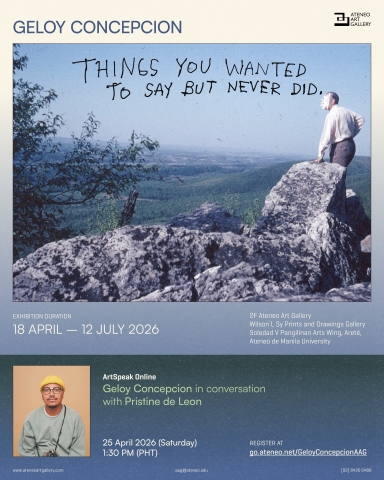
Things You Wanted to Say But Never Did: Geloy Concepcion’s six-year project makes Its exhibition debut at the Ateneo Art Gallery
Geloy Concepcion’s Things You Wanted To Say But Never Did comes to the Ateneo Art Gallery this 18 April 2026. After receiving almost 300,000 messages

[Hot Off the Press] Love If I'm Pretty
New YA Release from the Ateneo Press Love If I’m Pretty tackles the nuances of growing up through complex characters and straightforward prose What do