Memo on Ateneo Cat Management Program (ACCaP) (CSMO & SEEDS Memo)
05 Nov 2025 | Campus Safety and Mobility Office (CSMO) and Office of Social and Environmental Engagement for Development and Sustainability (SEEDS)

10 October 2025
MEMO TO:
The University Community
FROM:
[Sgd] Josephy F Almosera
Director, Campus Safety and Mobility Office
[Sgd] Leland Joseph R Dela Cruz PhD
Assistant Vice President for Social and Environmental Engagement for Development and Sustainability
RE:
Memo on Ateneo Cat Management Program (ACCaP)
On 20 May 2025, the Ateneo de Manila University renewed its Memorandum of Agreement with the Philippine Animal Welfare Society (PAWS) for the Ateneo Cat Management Program (ACCaP). The program management is led by the Campus Safety and Mobility Office (CSMO) assisted by the Office of the Assistant Vice President for Social and Environmental Engagement for Development and Sustainability (OAVP- SEEDS).
The ACCaP program contains several elements including the following:
- Trap-Neuter-Vaccinate-Return. Since July 2025, the University has been sending cats to PAWS for neutering and vaccination and these are returned to the school units after. We have already had 131 cats neutered. Cats that are neutered have notches on their ears. If you spot a cat with no notch on their ear, please take a picture of the cat and email the picture and the location where you saw the cat to csmo@ateneo.edu and seeds@ateneo.edu or you may drop by Room 102, MVP Building.
- Designated Feeders. The university will set up a system of designated feeders who have been given instructions on amount and frequency of feeding. The feeding stations will also be progressively located away from areas of heavy foot traffic. Security personnel know who the designated feeders are for each area. If you are not a designated feeder, you are not allowed to feed the cats.
Indiscriminate feeding of cats will result in cats who approach random humans for food and jump on dining tables. We also want to have designated feeding stations to keep heavy food traffic areas clean of cat waste. - No Taming Policy. Part of the Memorandum of Agreement with PAWS is that the university will adopt a “No Taming Policy”. This means that cats must not be touched and members of the community must not play with cats. Aside from considering the safety of the community, this policy is in place also for the safety of the cats. When cats are tamed, they may feel free to approach any human who in turn may react negatively and place the cats in harm’s way. According to PAWS, most cases of animal abuse begin that way.
- Aggressive and sick cats. Aggressive cats who act unprovoked will be turned over by CSMO to PAWS to check if they are sick and if they are sick, they will be treated. If you see a sick or aggressive cat, please take a picture of the cat and email the picture and the location of the cat to csmo@ateneo.edu and seeds@ateneo.edu or drop by Room 102, MVP Building. Also, please describe your observations about the cat (in case of illness) or describe the aggressive behavior.
- We would like to remind the community that there are guidelines for bringing pets on campus. We would also like to inform the community that leaving animals on campus is not only a school offense but is also considered a criminal offense. Cats, in particular, are very territorial so those left on campus will not find it easy to deal with the other cats. If you see anyone leaving animals on campus, kindly inform the nearest security personnel or email csmo@ateneo.edu and seeds@ateneo.edu.
The university guidelines and structures for cat management on campus are still evolving. Community pages will be set up for easier monitoring of cat whereabouts. We recognize that cats are valuable members of our community in more ways than one. The best way for us to take care of them is to follow the guidelines prescribed by the Philippine Animal Welfare Society. These guidelines are derived from their many years of experience with cat management. We would like to enjoin the population to follow these guidelines and other guidelines that may be released subsequently.
If you have any questions or suggestions, please feel free to email Mr Carl Kevin Manguera, CSMO Occupational Safety and Health (OSH) Head, who will be overseeing the program, through cmanguera@ateneo.edu and cc csmo@ateneo.edu and seeds@ateneo.edu.
Recent News
You may also like these articles

[Hot Off the Press] Arkipelago
New book from the Ateneo Press Arkipelago provides a fascinating and fantastical twist on Philippine politics and history Our country is an archipelago of stories
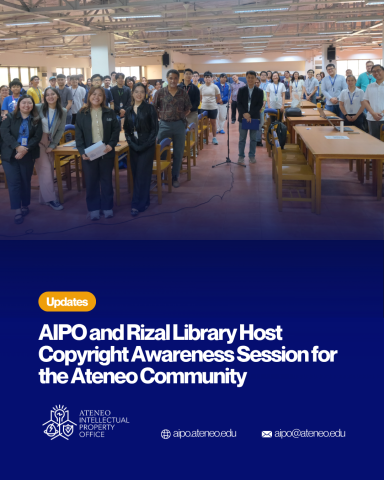
Protecting Creativity: AIPO and Rizal Library Host Copyright Awareness Session for the Ateneo Community
On March 18, 2026, the Ateneo Intellectual Property Office (AIPO), in collaboration with the Rizal Library, successfully conducted a Copyright Awareness Session held on the
Holy Week 2026 Holidays (Memo # UHR2526-038)
Memo # UHR2526-038 31 March 2026 TO: All Employees FROM: [Sgd] Maria Victoria T Cortez, PhD Vice President for University Human Resources SUBJECT: Holy Week
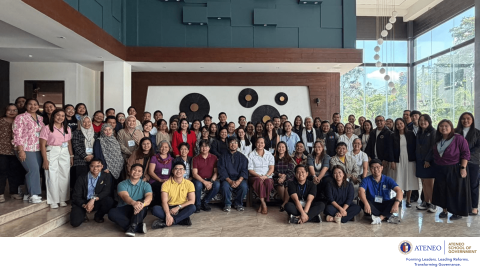
ASOG’s Tobacco Control initiatives spotlighted in DOH National Technical Working Group for Tobacco Prevention and Control
On March 10 to 12, 2026, the Ateneo School of Government (ASOG), through its research and public policy unit, the Ateneo Policy Center, participated in

Things You Wanted to Say But Never Did: Geloy Concepcion’s six-year project makes Its exhibition debut at the Ateneo Art Gallery
Geloy Concepcion’s Things You Wanted To Say But Never Did comes to the Ateneo Art Gallery this 18 April 2026. After receiving almost 300,000 messages

[Hot Off the Press] Love If I'm Pretty
New YA Release from the Ateneo Press Love If I’m Pretty tackles the nuances of growing up through complex characters and straightforward prose What do