Ensuring continuous teaching and learning amid disruptions (HE Memo#Y3.63)
20 Oct 2025 | Office of the Vice President for Higher Education







HE Memo#Y3.63
20 Oct 2025
TO:
The Higher Education Community
FROM:
[Sgd.] Maria Luz C Vilches, PhD
Vice President for Higher Education
SUBJECT:
ENSURING CONTINUOUS TEACHING AND LEARNING AMID DISRUPTIONS
I hope all’s well despite the many challenges that have caused disruptions to the schedules published in the Academic Calendar, as well as to many aspects of our lives, since the start of the semester.
Managing Expected Learning Outcomes
While disruptions are often beyond our control, as instructors and students, our course syllabus still remains to be within our control. It outlines the course expected learning outcomes that guide the instructor’s choice of input/lecture, assignments, or activities as well as help the students focus on what learning needs to be achieved in the course. Following the Outcomes-Based approach to education, the instructor’s input/lectures, reading assignments, and activities that students perform are strategies meant to help students develop knowledge, skills, and attitudes needed for them to achieve the expected learning outcomes that will measure their learning success in the course.
So, when there are disruptions that result in transitioning the class from one learning modality to another (e.g. from onsite to online), both instructor and students should be guided by the learning outcomes being targeted by the lesson at hand: the instructor gives the appropriate activity to the students and the students understand better the kind of output that is expected. Such an output from an online asynchronous class is not additional work. It is just part of learning accountability.
On Managing Teaching and Learning in Adverse Situations
During such circumstances, Higher Education makes decisions that reflect our desire to strike a balance in our response between the safety and welfare of our students and other members of the community as well as the need to ensure students’ continuous learning even in difficult conditions. We have both government policies and internal guidelines that guide our decisions.
Government Policies
There are various public policies that educational institutions are asked to adhere to when it comes to suspension or cancellation of classes (referring to both lecture and lab classes). Three policies that concern Higher Education are currently in place.
1. Executive Order 66 (2012): Section 2: Localized Cancellation or Suspension of Classes and Work in Government Offices
2. CHED Memo 15 (2012): Amendment to CMO 34, series of 2010 titled “Clarificatory Guidelines for the Suspension of Classes in Higher Education Institutions (HEIs) Due to Typhoons/Storms, Flooding, and Other Weather Disturbances”
3. Legal Education Board Memorandum Circular No. 013, Series of 2025 (On Flexibility in the Conduct of Classes During Government-Declared Suspensions) as supplemented by Legal Education Board Memorandum Circular No. 018, Series of 2025
In July 2025, Malacañang authorized the Department of the Interior and Local Government (DILG) to announce suspension of work and classes during inclement weather and disasters. (https://www.dilg.gov.ph/news/
Based on the essential features of these government policies and regulations, Ateneo de Manila Higher Education (HE) reiterates the following guidelines on class modality and arrangements during inclement weather and any other forms of disruptions that impact teaching and learning.
A. Response to any Government Announcement on Automatic Cancellation or Suspension of Classes
1. Automatic cancellation of classes (both onsite and online) when PAGASA raises the typhoon signal to number 3 or beyond. In an HE school’s satellite campus location (e.g., for AGSB) where the PAGASA announcement does not apply, classes will continue there as scheduled.
2. Automatic shift to the online teaching/learning mode when local governments declare localized suspension of classes due to typhoons, earthquakes, inordinate rainfall and flooding, dangerous air quality index levels, dangerous heat index levels, and other climate-related emergencies, based on their own disaster risk assessment that includes input from PAGASA, PHILVOCS, and the EMB-DENR. Schools located in the concerned city and/or municipality follow the local government directives.
3. Automatic suspension of onsite and online classes if the government directive expressly makes this specification. Note: When national or local governments plainly declare ‘suspension of classes,’ we generally interpret this to mean as suspension of onsite classes.[1]
4. In summary, see the table below:
| GOVERNMENT AGENCIES ANNOUNCEMENTS | RESPONSE FROM HIGHER EDUCATION |
| PAGASA raises the typhoon signal to number 3 or beyond | Automatic cancellation of classes (both onsite and online) in affected AdMU Higher Education campuses |
| National Government, DILG, or LGU suspend classes (without specifying the mode of teaching and learning) for other reasons than typhoon signal number 3 or beyond | Automatic shift to the online teaching/learning mode in affected AdMU HE campuses (see Reminders for Online Classes) |
| National Government, DILG, or LGU class suspends both onsite and online classes | Class suspension for both onsite and online classes in affected AdMU HE campuses |
Reminders for Online Classes
One of our hopes post-pandemic was that we would be more resilient to disruptions due to class suspensions owing to natural disasters, other climate-related disturbances (which are expected to increase in frequency), and political events (strikes, SONA, etc.). We leverage what we have learned from the pandemic, allowing us to draw from our post-pandemic wider repertoire of learning/teaching strategies that can help students achieve their expected learning outcomes in the course/lesson.
In online teaching/learning, the decision to go either synchronous or asynchronous depends on the expected learning outcomes of a particular class.
ASYNCHRONOUS CLASS
1. Well-designed asynchronous classes are as effective as synchronous or even in-person classes.
2. Asynchronous classes are expected to have an output to account for student learning vis-à-vis the expected learning outcomes of the class. Samples of output could be responses to a Discussion Board, an opinion write up on a reading assignment, a draft artistic design, a solution to a mathematical problem, a personal reflection write up in a philosophy, theology, or psychology class, writing a new ending of a story in a literature class, etc.
SYNCHRONOUS CLASS
1. If a class is on a synchronous mode but not everyone is present, the teacher should record the lecture and post it on Canvas so that students who are unable to attend the class can access the recording on their own. Recording synchronous lectures is a standard practice recommended by the Adaptive Design for Learning (ADL) program which a lot of our instructors have gone through.
2. Only during a class suspension, if necessary, the instructor and students may agree to have a make-up class afterwards within the semester subject to existing regulations (for undergraduate students, please refer to Academic Regulation III.6). Note: If a synchronous online class or asynchronous activity is held in place of an onsite class during normal conditions, there is no need to arrange for a make-up class.
A caveat: such decisions must always take into consideration the specific contexts of both students and instructor at the time.
1. The instructors’ class lists already include helpful student information that can facilitate communication.
2. The class beadles are also there to help with communication between the class and the instrctor.
3. We leave room for discernment so that we adequately take into consideration the student's or the instructor's situation on whatever the instructor decides to do judiciously, and with clearance of the plans from the Department Chair or Program Director.
a) In summary, please see the table below:
|
REMINDERS FOR ONLINE CLASSES synchronous or asynchronous, depending on class’ expected learning outcomes |
||
| ASYNCHRONOUS | Must be well-designed asynchronous classes | Output required of students for learning accountability |
| [18] [19] SYNCHORONOUS | Teacher’s lecture recording posted on Canvas for absent students’ easy access on their own. | Make-up class subject to existing regulations (for undergrads, Academic Regulation III.6) |
|
Such decisions must always take into consideration the specific contexts of both students and instructor at the time. ● Instructors’ class lists with student information to facilitate communication. ● Class beadles can help with communication between class and instructor. ● Instructor’s plan for the class, with clearance from Department Chair/Program Director |
||
What if government agencies don’t make any announcements during certain disruptions?
We can name some of these disruptions: inclement weather conditions, other weather disturbances (e.g., extreme heat condition, 42°C to 51°C), and environmental conditions not necessarily related to weather (e.g. transport strikes). The following table outlines the process of decision-making on the appropriate course of action.
| WHEN NO ANNOUNCEMENTS FROM GOVERNMENT AGENCIES DURING DISRUPTIONS | |
| Step 1 | A core group at the VPs level convene to gather data (e.g., from news bulletins, from AVP-HCW, from students via OSAS/AVP-ILEAF), consult various relevant sectors (e.g., PAGASA, the Manila Observatory, the deans), and analyze the situation to be able to arrive at the appropriate course of action. |
| Step 2 |
|
| Step 3 | UMCO designs the pubmat |
| Step 4 | UMCO disseminates the pubmat in University’s official media channels |
|
Timing of announcements on such decisions (whether class suspension or change of modality). ● Not later than 4:30 AM of the day in which the decision has to take effect ● Not later than 11:00 AM for decisions affecting afternoon and evening sessions |
|
Trust and Confidence
I trust in everyone’s cooperation and support. Ultimately, it is our desire to be spared from any untoward events that disrupt our lives. We continue to pray for protection and care.
[1] The Ateneo Law School follows this directive. Legal Education Board Memorandum Circular, No.018, Series of 2025:“SECTION 1. Onsite Class Suspensions. For purposes of this addendum, a government declaration suspending or cancelling classes shall be deemed to apply to onsite classes, unless the declaration explicitly states that the suspension covers both onsite and online/remote classes.”
Recent News
You may also like these articles

[Hot Off the Press] Arkipelago
New book from the Ateneo Press Arkipelago provides a fascinating and fantastical twist on Philippine politics and history Our country is an archipelago of stories
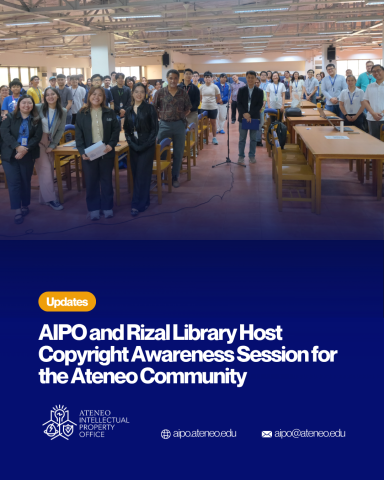
Protecting Creativity: AIPO and Rizal Library Host Copyright Awareness Session for the Ateneo Community
On March 18, 2026, the Ateneo Intellectual Property Office (AIPO), in collaboration with the Rizal Library, successfully conducted a Copyright Awareness Session held on the
Holy Week 2026 Holidays (Memo # UHR2526-038)
Memo # UHR2526-038 31 March 2026 TO: All Employees FROM: [Sgd] Maria Victoria T Cortez, PhD Vice President for University Human Resources SUBJECT: Holy Week

ASOG’s Tobacco Control initiatives spotlighted in DOH National Technical Working Group for Tobacco Prevention and Control
On March 10 to 12, 2026, the Ateneo School of Government (ASOG), through its research and public policy unit, the Ateneo Policy Center, participated in

Things You Wanted to Say But Never Did: Geloy Concepcion’s six-year project makes Its exhibition debut at the Ateneo Art Gallery
Geloy Concepcion’s Things You Wanted To Say But Never Did comes to the Ateneo Art Gallery this 18 April 2026. After receiving almost 300,000 messages

[Hot Off the Press] Love If I'm Pretty
New YA Release from the Ateneo Press Love If I’m Pretty tackles the nuances of growing up through complex characters and straightforward prose What do