Majority of Filipino youth respondents have “average skills” in identifying fake news
23 Nov 2021
Duterte supporters, more likely to believe fake news
QUEZON CITY – Majority or 52.5% of youth respondents only got six to eight correct answers or an average score of 6.9 in a 10-item fake news quiz, according to a study conducted by Boses, Opinyon, Siyasat, at Siyensya para sa Pilipinas (BOSES Pilipinas) released on Wednesday.
“Overall, we can conclude based on these figures that our students only have average skills in identifying fake news,” BOSES Pilipinas convenor Dr. Imelda Deinla said during an on-line press conference.
Aside from taking the fake news quiz, respondents were also asked to rate their level of confidence with their abilities in recognizing fake news items.
Majority or 63% of the respondents said they are somewhat confident in identifying fake news. However, the same set of respondents only scored an average of 6.9 on the 10-item fake news quiz. Only 23% said they are very confident and scored an average of 7.2. Thirteen percent said they are not very confident and scored an average of 6.5, while 1% said they are not confident at all and scored an average score of 5.7 (note: refer to the attached PVV Round 2 explainer for complete results).
“There is a big mismatch between the students’ perceived ability in identifying fake news from real news, and their actual performance in the face of fake news. This means, their confidence did not translate to their ability when they answered the quiz,” Dr. Deinla explained.
More than 20,000 students, who are eligible to vote in 2022, took part in the Pinoy Voters’ Vibe (PVV): Youth Edition surveys conducted from 23 August 2021 to 24 September 2021 through 25 partner colleges and universities across the country.
Dr. Deinla said that this was already the second round of PVV surveys. She explained that the results of the second round confirm the results of the first round, which showed very similar findings. The first round of PVV surveys were conducted from 17 May 2021 to 24 June 2021 and involved 7,744 respondents through 18 universities and colleges.
The PVV surveys featured a novel fake news quiz that is composed of Facebook posts containing shared photos with quotes supposedly attributed to selected Cabinet members of the current administration. The students were asked to classify the quote in the photo as true or false. BOSES Pilipinas used snowball sampling, a non-probability survey sampling technique.
Duterte supporters, more likely to believe fake news
Using the results from the first round of the PVV surveys, BOSES Pilipinas also analyzed the relationship between political polarization and the ability to recognize fake and real news.
Political polarization refers to a momentary division in support for two political elites. Last witnessed in the People Power movement between former Presidents Gloria Arroyo and Joseph Estrada, BOSES Pilipinas observed a wide divide in the current political landscape between Duterte and his allies, and opposition politicians led by Vice President Robredo
Results show that respondents who support President Rodrigo Duterte are more likely to believe in fake news and are less likely to believe in real news. On the other hand, respondents who support Vice President Leni Robredo are more likely to identify real news as real, and fake news as fake.
“This finding is not new. This behavior is likewise observed among the Republican supporters in the United States. It is possible that these ‘partisan’ tendencies to fall for misinformation is a product of the same disinformation networks (i.e. individuals or groups that spread fake news) that both Duterte and Republican supporters are exposed to or because of the possible impact of constant or high exposure to fake news being the new normal, thus to regard facts in a different way,” Deinla explained.
“We found in this research that those who have high exposure to fake news also have lower odds in identifying fake news,” the BOSES Pilipinas convenor pointed out.
In conducting the study, respondents were asked to rate their approval of government officials, including President Rodrigo Duterte and Vice President Leni Robredo. These approval ratings were used to determine and then calculate the degree of a respondent’s political polarization. Then, using Binomial Regression, BOSES Pilipinas correlated political polarization with the capability of youth in accurately recognizing fake news and real news (note: refer to the attached Working Paper for the complete methodology).
Respondents likely to vote, more likely to recognize real news
Using the results of the second round of PVV surveys, BOSES Pilipinas also observed the relationship between the respondents’ ability to detect real news and their likelihood to vote.
Results show that the 72% who said they will definitely vote in 2022 showed the highest ability in recognizing real news from fake news with an average score of 7 out of 10. Meanwhile, 1% or 215 respondents, who said they will not vote in 2022, only scored an average of 6.3 out of the 10-item fake news quiz. (note: refer to the attached PVV Round 2 explainer for complete results).
“This means that those who are politically engaged – especially those intent on voting, would actively seek a variety of good information, and are therefore more likely seeking real news. However, those who are good at detecting fake news are not necessarily the ones very keen on voting,” Dr. Deinla explained.
“This also means that seeing or seeking real news can stimulate political awareness and engagement. Detecting fake news by itself, has no effect on political engagement, unless this is accompanied by seeing real news,” she added.
BOSES Pilipinas will release a more in-depth analysis on these findings next year.
Higher trust in Facebook, more prone to fake news
The second round of PVV surveys also found that perceived trustworthiness of media platforms can also shape one’s ability to gauge the accuracy of news. Results show that respondents who trust Facebook more as a source of information have lower ability in identifying fake news.
According to the PVV survey, only 2% or 384 respondents find Facebook as a very trustworthy source of information. The same respondents only scored 5.7 out of the 10-item fake news quiz.
Meanwhile, 26% or 6,388 respondents who find Facebook as an untrustworthy source of information showed the highest ability in recognizing fake news from real news, with an average score of 7.2 out of 10. (note: refer to the attached PVV Round 2 explainer for complete results)
“Various studies show that respondents who trust mainstream media are less likely to believe in fake news and engage in conspiratorial thinking. They are predisposed to believe in “official” versions of an event compared to personal or exaggerated accounts online,” Dr. Deinla said.
“Meanwhile, trust in social media and Facebook are shown to impair one’s ability to detect misinformation. Users who are predisposed to believe information that mirrors their sentiments are more exposed to misinformation networks online,”
“The Philippine youth are now immersed in an environment, perhaps a culture, of fake news. If we want to create a better future for our youth – one who knows the truth, who can judge between right from wrong, who can trust institutions - then we will need a collective effort to overcome this information pandemic.” the BOSES Pilipinas convenor added.
BOSES Pilipinas launches online fake news quiz
In line with the efforts of BOSES Pilipinas to build an empowered and well-informed generation of Filipino voters, the survey firm launched its very own web application or online fake news quiz named, ‘What the Fake?!: Ang Fake News Challenge ng Bayan’.
What The Fake is the first university-based web application that aims to serve as a misinformation diagnostic tool among voting-age Filipinos, in preparation for the 2022 Elections.
“By voting-age Filipino citizens, ibig sabihin nito ay hindi lang limitado sa mga kabataan ang pwedeng sumagot ng web app na ito, kung hindi lahat ng mga kababayan natin na nasa tamang edad na para makaboto and at the same time, gustong suriin ang sarili nila kung gaano sila ka-vulnerable sa fake news,” Dr. Deinla explained.
“The very heart of What the Fake?! is to help others fight misinformation and disinformation and at the same time, to prepare them for the 2022 elections by testing if their judgment in identifying fake news from real news is impaired or not. Masasagutan ang What the Fake?! sa loob lang ng humigit-kumulang limang minuto!”
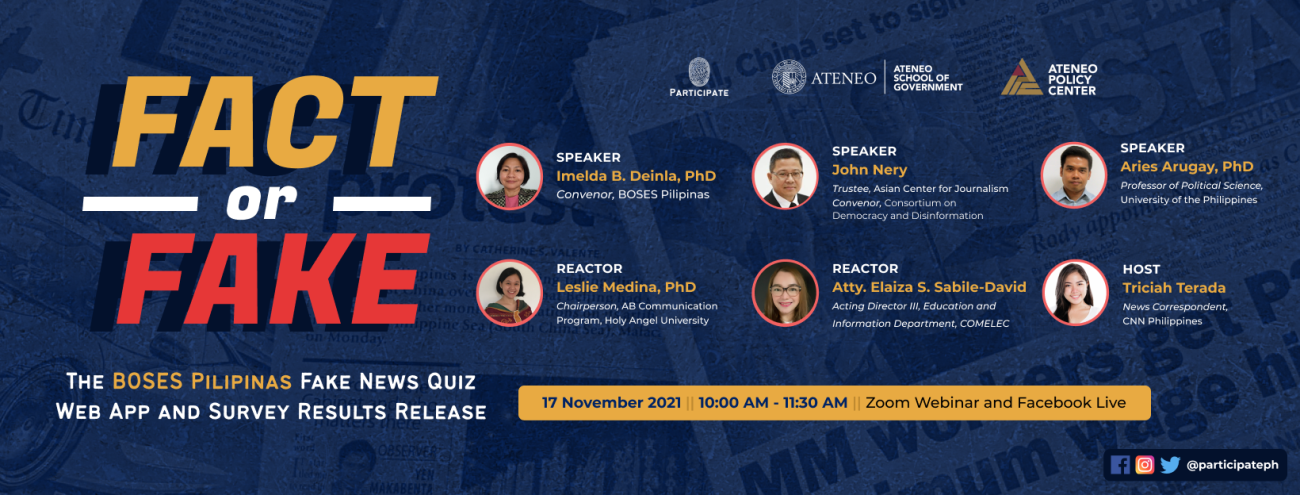
Take the ultimate Fake News Challenge now! You may access BOSES Pilipinas’ online fake news quiz through this link: www.inclusivedemocracy.ph/fakenewschallenge
Recent News
You may also like these articles
Protecting Creativity: AIPO and Rizal Library Host Copyright Awareness Session for the Ateneo Community
On March 18, 2026, the Ateneo Intellectual Property Office (AIPO), in collaboration with the Rizal Library, successfully conducted a Copyright Awareness Session held on the
Things You Wanted to Say But Never Did: Geloy Concepcion’s six-year project makes Its exhibition debut at the Ateneo Art Gallery
Geloy Concepcion’s Things You Wanted To Say But Never Did comes to the Ateneo Art Gallery this 18 April 2026. After receiving almost 300,000 messages

Call for Entries: 2026 Ateneo Art Awards - Purita Kalaw-Ledesma Prizes in Art Criticism
Co-presented with the Kalaw-Ledesma Foundation, Inc., the Ateneo Art Gallery is now accepting submissions for the 2026 Ateneo Art Awards Purita Kalaw-Ledesma Prizes in Art
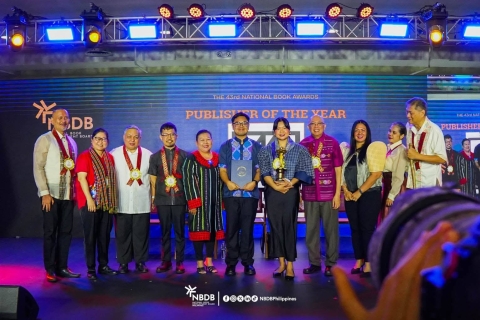
Ateneo University Press wins Publisher of the Year for 8th Consecutive Year
On 14 March 2026, the National Book Development Board along with the Filipino Critics Circle hosted the 43rd National Book Awards at the Philippine Book
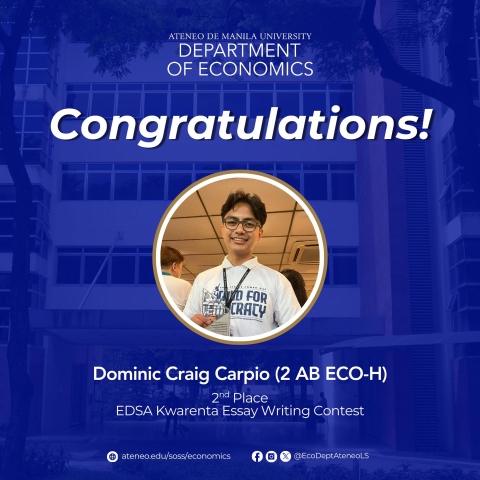
Congratulations to Dominic Craig Carpio (2 AB ECO-H) for placing 2nd in the EDSA Kwarenta Essay Writing Contest
The Department of Economics warmly congratulates Dominic Craig Carpio (2 AB ECO-H) for placing 2nd in the EDSA Kwarenta Essay Writing Contest. This achievement reflects
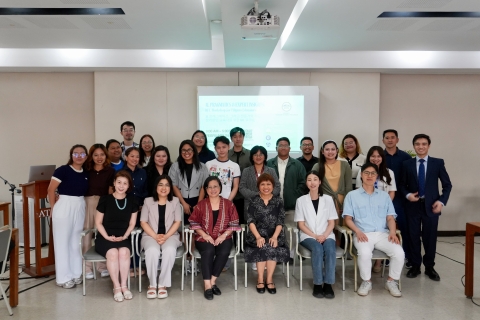
Ateneo Korean Studies Program Concludes KFL Workshop for Filipino Educators
The Ateneo Korean Studies Program, in partnership with the Global Leadership Development Institute, King Sejong Institute Quezon City 2, and the Dr. Rosita G. Leong