Fragmented realities and lost histories: Exploring women, revolution, and grief in Kaisa Aquino’s Isabela
24 Sep 2024



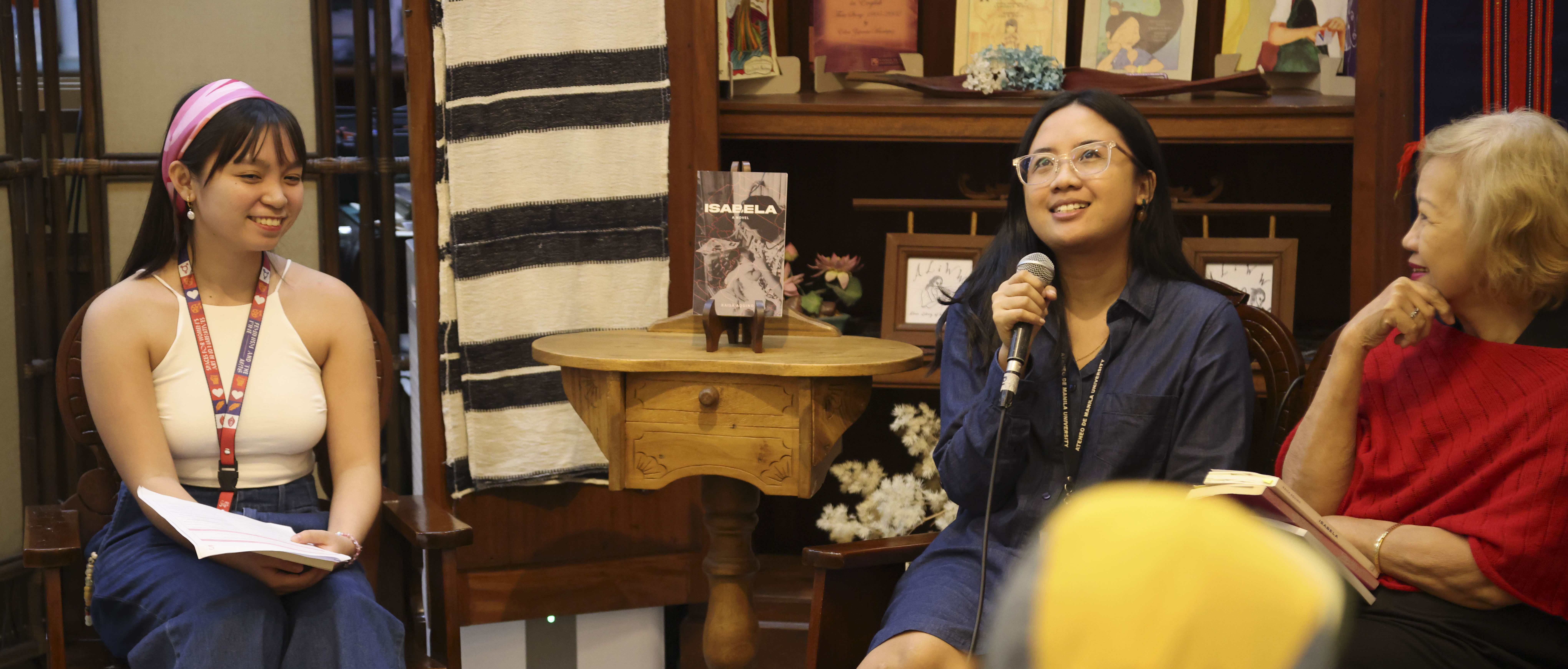
During a recent book talk hosted by the Ateneo Library of Women's Writings and the Department of Fine Arts, author Kaisa Aquino discussed her debut novel Isabela with Julia Hao of Spaces for Women’s Art and Narratives (SWAN), along with acclaimed writer Susan Lara. The conversation explored the novel’s origins, themes, and Aquino’s creative journey, shedding light on the deeply personal and political aspects of the book.
Kaisa Aquino and Susan Lara’s connection dates back to the 2019 Silliman Writer's Workshop, where Aquino first wrote the initial chapters of Isabela. At the workshop, Susan Lara served as her panelist, and during the book talk, she expressed how impressed she was by the growth of Aquino’s story since then. Aquino shared that many of the stories in Isabela were originally written from prompts given at the workshop, which she used to explore themes of women and social realism. The process of combining these prompts into a cohesive narrative eventually became part of her thesis which eventually became the novel. Kaisa, however, admitted that it was an arduous task, requiring careful consideration of “what works and what doesn’t.”
One of the standout aspects of Isabela, according to Susan Lara, is its prologue, which is written in the second-person point of view and follows the perspective of a wounded woman. This was read prior to the discussion, drawing the audience to the harrowing experience of a militant woman. Lara praised this narrative technique, which Aquino said was intended to fully immerse the reader in the protagonist’s experience. Kaisa also mentioned that her writing was inspired by Elaine Castillo’s America Is Not the Heart, particularly in how it centers on marginalized voices and complex social realities.
When Julia asked about the setting of Isabela, Aquino revealed that her primary motivation was to highlight her home province, Isabela, and its people. She wanted to bring attention to both the beauty and the struggles of the region, which she came to understand more deeply through the writing process. A key point of interest for Kaisa was the province’s revolutionary history, an area often overlooked in literature. Aquino explained that as someone adjacent to the revolutionary movement, she felt a personal responsibility to recover and reimagine the lost histories of the place she called home.
For Aquino, Isabela is more than just an activist work; it is a personal project that reflects her own experiences as a writer and scholar. During her time at the University of the Philippines, she was encouraged to take on the role of the fictionist—to reimagine the past and uncover forgotten stories. Susan Lara noted that even during the Silliman Workshop, Aquino already had a strong command of narrative, but she was particularly impressed by how the separate stories in Isabela are woven together into a unified whole.
Julia took note of the fragmentation of women’s stories in the novel, a notion Aquino affirmed. She explained that the fragmented nature of women’s lives should not be seen as distinct but as a reality that represents the complexity of women's lives. Aquino added that this fragmentedness reflects not only women’s desires but also the broader failures of the nation.
When discussing her characters, Aquino emphasized that while they are fictionalized, they are grounded in real experiences. Susan Lara noted that the characters seem drawn from real women, and Aquino agreed, saying that while her characters may not directly represent actual individuals, they reflect the shared experiences of many women.
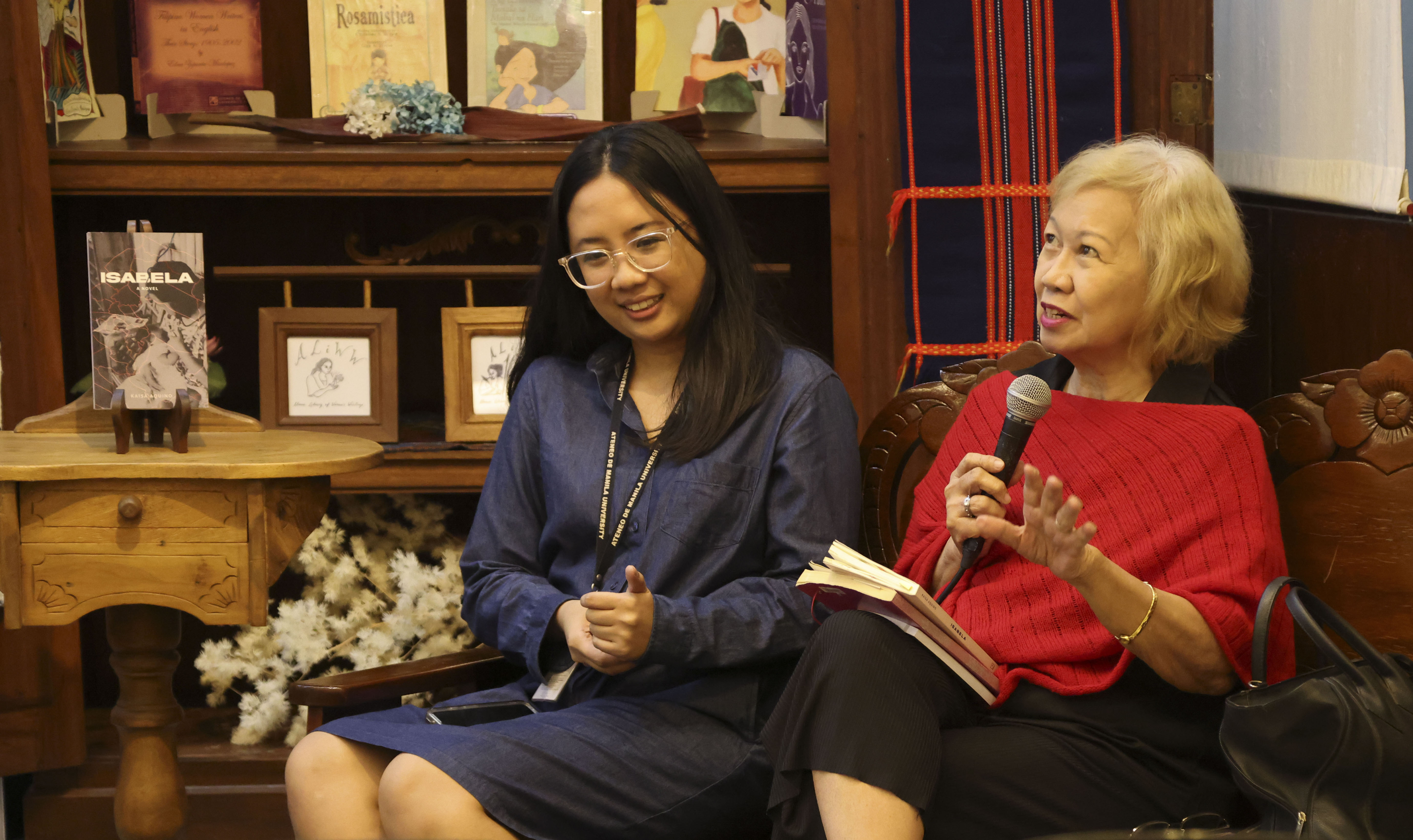
The theme of familial relationships, particularly between mothers and their children, plays a central role in Isabela. Aquino wanted to explore love stories within the revolutionary movement, focusing on militant women who were left behind and created new families. This exploration extended to different variations of family ties, with Aquino placing special emphasis on the bond between mothers and their children. Lara particularly enjoyed how Aquino portrayed the balance between animosity and tenderness in these relationships.
The conversation also touched on gender relations within the resistance movement. Aquino used characters like Jun and Caloy to depict the failings and successes of the movement. She and Lara emphasized the importance of portraying the intimacy and closeness that exists between people across different genders, capturing their struggles and relationships with authenticity.
Grief, another significant force in Aquino’s writing, was likened to ghosts that represent what has been lost. For Aquino, Isabela also symbolizes grief for a place, a longing to capture the parts of history and the landscape that people do not want to forget. The duality of grief and love was deeply embedded in the novel, with both emotions intertwined in her characters’ journeys.
As the talk concluded, both Aquino and Lara agreed that writing can indeed elicit change. For Aquino, Isabela is not just a reflection of history, but a means to provoke thought, uncover forgotten narratives, and inspire action—especially for women who continue to navigate fragmented realities in a world of incoherence.
Recent News
You may also like these articles

[Hot Off the Press] Arkipelago
New book from the Ateneo Press Arkipelago provides a fascinating and fantastical twist on Philippine politics and history Our country is an archipelago of stories
Protecting Creativity: AIPO and Rizal Library Host Copyright Awareness Session for the Ateneo Community
On March 18, 2026, the Ateneo Intellectual Property Office (AIPO), in collaboration with the Rizal Library, successfully conducted a Copyright Awareness Session held on the
Things You Wanted to Say But Never Did: Geloy Concepcion’s six-year project makes Its exhibition debut at the Ateneo Art Gallery
Geloy Concepcion’s Things You Wanted To Say But Never Did comes to the Ateneo Art Gallery this 18 April 2026. After receiving almost 300,000 messages
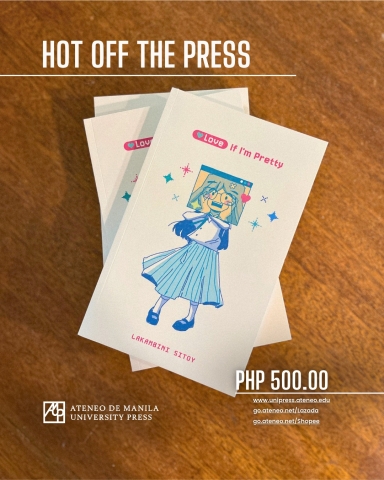
[Hot Off the Press] Love If I'm Pretty
New YA Release from the Ateneo Press Love If I’m Pretty tackles the nuances of growing up through complex characters and straightforward prose What do
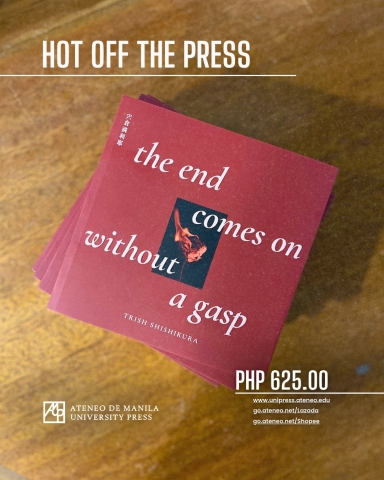
[Hot Off the Press] the end comes on without a gasp
the end comes on without a gasp: Trish Shishikura’s debut poetry collection arrives from Ateneo de Manila University Press (Bughaw) Ateneo de Manila University Press
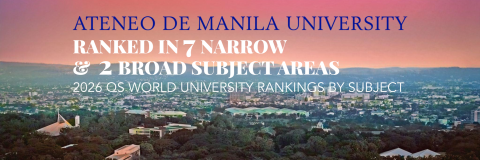
QS Subject Rankings 2026: Ateneo in top 100 for theology; ranked in 7 subject areas
Ateneo de Manila University is among the top institutions in seven subject areas, and among the top 100 for theological and religious studies, according to