Scientists warn vs ‘indirect’ effect of tropical cyclones during the monsoon season
14 Jul 2025





New research has found that tropical cyclones hundreds of kilometers away from the Philippines are often more responsible for heavy rainfall than those that hit the country directly during the annual “Habagat” or southwest monsoon season from July to September.

The findings undermine the widely-held public misconception that only tropical cyclones that directly hit the country pose serious flood risks: while the “direct” effect of tropical cyclones accounts for an average of 15.4 percent of rainfall during the Habagat season, its “indirect” effect contributes more than twice that amount. The remaining 51.5 percent comes from the monsoon itself, without tropical cyclone influence.
Torrential rain pulled in by distant tropical cyclones
An average of 33.1 percent of the rainfall during the southwest monsoon season is caused by tropical cyclones that do not make landfall but enhance the Habagat, pulling in large amounts of moisture from the surrounding seas and turning otherwise moderate monsoon rains into torrential downpours, according to the study.
The location where a tropical cyclone forms, called its “genesis point”, also impacts the amount of rainfall. It was found that tropical cyclones that form farther away from the Philippines tend to move northeast of Luzon and are thereby more likely to enhance the monsoon. In contrast, those that form closer to the country often take shorter, westward tracks and thus have a weaker effect on the southwest monsoon.
A striking example of this phenomenon occurred in July 2024, when Typhoon Gaemi (known locally as Super Typhoon Carina) stayed well away from the Philippine landmass but enhanced the southwest monsoon so much that Quezon City recorded nearly a full month’s worth of rain in just 24 hours. The resulting floods across Luzon killed 48 people and caused over 8 billion pesos in damage, despite the typhoon not making landfall.
Over half a century of research data
The researchers from Ateneo de Manila University; the Manila Observatory; the Philippine Atmospheric, Geophysical, and Astronomical Services Administration (PAGASA); and Japanese partner institutions analyzed 62 years of weather data from 1961 to 2022 and focused on rainfall patterns along the western coast of the Philippines during the peak southwest monsoon season from July to September.
In the four rainiest years on record—1962, 1972, 2012, and 2018—rainfall totals soared above 2,000 millimeters during the monsoon season. On average, the largest share of rainfall came from the indirect effects of tropical cyclones, with up to 41.5 percent of the total rainfall attributed to their monsoon-enhancing effects. These tropical cyclones never made landfall, yet ended up saturating Luzon and parts of Visayas with flood-inducing rains.
Call for improved tropical cyclone, monsoon monitoring
Moreover, by distinguishing between rainfall caused by the monsoon, as well as the direct, and indirect effects of tropical cyclones, the researchers hope to improve the way we anticipate extreme weather. Understanding these distinctions is crucial for local governments and disaster response agencies, especially as climate change increases the unpredictability of both tropical cyclones and seasonal rainfall.
The study highlights the need to monitor not only a tropical cyclone’s approach, but also its formation and interaction with the monsoon system. This knowledge is critically important to Filipinos in flood-prone regions, such as Metro Manila, Zambales, Ilocos, and Palawan.
SOURCE:
Bathan, A.A.L., et al. (2025). Influence of tropical cyclones, southwest monsoon, and tropical cyclone-enhanced southwest monsoon on rainfall variability over the western coast of the Philippines. Atmospheric Research, 326, 108273. https://doi.org/10.1016/j.atmosres.2025.108273
https://archium.ateneo.edu/manila-observatory/25/
For interview requests and other inquiries, please email media.research@ateneo.edu. Visit archium.ateneo.edu for more information about our latest research and innovations.
Recent News
You may also like these articles

[Hot Off the Press] Arkipelago
New book from the Ateneo Press Arkipelago provides a fascinating and fantastical twist on Philippine politics and history Our country is an archipelago of stories
Protecting Creativity: AIPO and Rizal Library Host Copyright Awareness Session for the Ateneo Community
On March 18, 2026, the Ateneo Intellectual Property Office (AIPO), in collaboration with the Rizal Library, successfully conducted a Copyright Awareness Session held on the
Holy Week 2026 Holidays (Memo # UHR2526-038)
Memo # UHR2526-038 31 March 2026 TO: All Employees FROM: [Sgd] Maria Victoria T Cortez, PhD Vice President for University Human Resources SUBJECT: Holy Week
ASOG’s Tobacco Control initiatives spotlighted in DOH National Technical Working Group for Tobacco Prevention and Control
On March 10 to 12, 2026, the Ateneo School of Government (ASOG), through its research and public policy unit, the Ateneo Policy Center, participated in
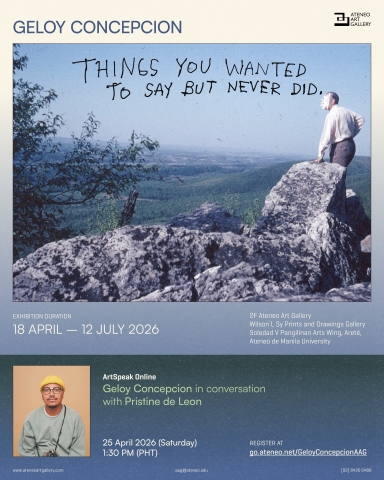
Things You Wanted to Say But Never Did: Geloy Concepcion’s six-year project makes Its exhibition debut at the Ateneo Art Gallery
Geloy Concepcion’s Things You Wanted To Say But Never Did comes to the Ateneo Art Gallery this 18 April 2026. After receiving almost 300,000 messages

[Hot Off the Press] Love If I'm Pretty
New YA Release from the Ateneo Press Love If I’m Pretty tackles the nuances of growing up through complex characters and straightforward prose What do