DISCO-HE Director Ralph Jacinto Quiblat highlights design thinking and futures thinking for innovation in higher education at International Summit in Brunei
17 Nov 2025




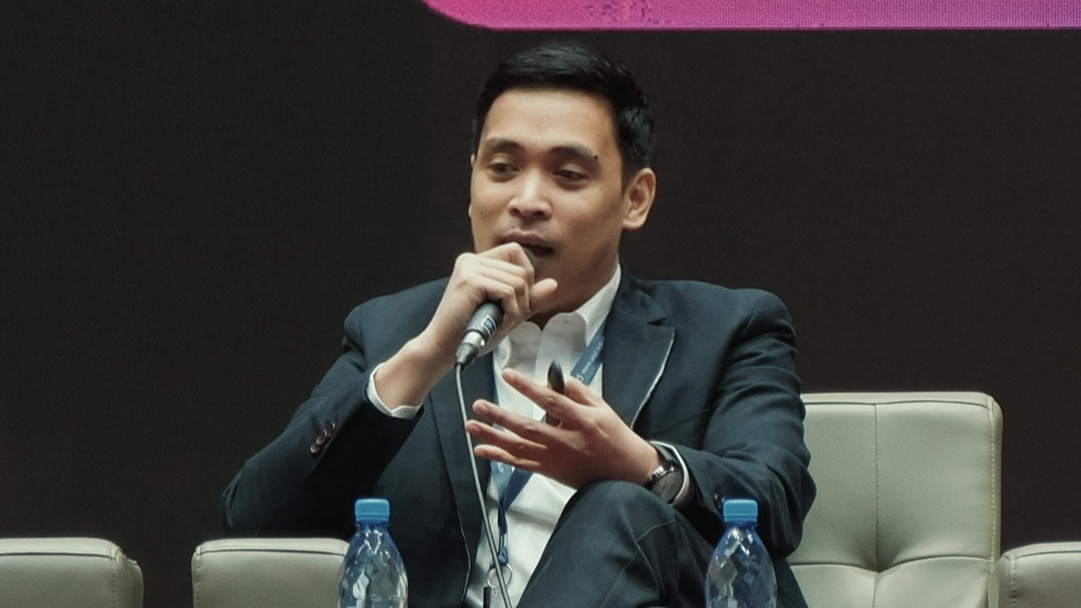
On 12 November 2025, Ralph Jacinto “Tats” Quiblat, Director for Design and Innovation for Strategic Content for Higher Education (DISCO-HE) at Ateneo de Manila University, presented key insights on design thinking, futures thinking, and innovation-driven entrepreneurship education at the International Higher Education Summit and Exhibition on Entrepreneurship, Innovation, and Commercialisation (IHEEIC) 2025. The event, held at Universiti Brunei Darussalam, was hosted by the Brunei Ministry of Education and Universiti Brunei Darussalam.
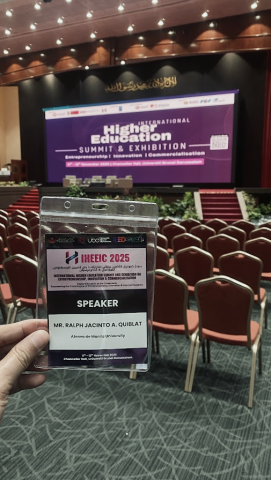
Quiblat spoke on Future-Oriented Entrepreneurship Education Models, joining international experts and higher education leaders committed to advancing global education innovation. His talk, Design and Futures Thinking in Entrepreneurship Education, examined how universities can better prepare students for rapidly evolving technological, environmental, and societal futures.
He emphasized that most entrepreneurship programs focus on opportunity recognition and business models. In an age of accelerating disruption, however, entrepreneurship education must start with possibility recognition. Students, he argued, should first learn to imagine new future contexts before creating solutions.
Quiblat explained how futures thinking helps learners identify weak signals and emerging trends in areas such as climate change, technology adoption, and social innovation. Through scenario building and strategic foresight tools, students can explore multiple possible futures. Design thinking then enables them to translate those insights into human-centered prototypes and innovative business models. Classroom methods including signal safaris, future canvases, and artifacts from the future help ensure that student ventures remain adaptable and relevant in different future scenarios.
Addressing ASEAN priorities, Quiblat shared how signals in green logistics, agritech, and AI-enabled food systems can become foundations for resilient entrepreneurship. These approaches encourage student founders to design solutions that thrive in both digital economies and community-focused environments.
He also emphasized that cross-disciplinary collaboration is crucial for education innovation. Quiblat encouraged universities to adopt Challenge Studios where engineering, business, design, and social sciences converge to address regional needs like food security and digital inclusion. He described this as trilingual fluency: thinking with scientific rigor, designing with empathy, and acting with social responsibility. This mindset, he said, produces innovative solutions that are technically sound and socially impactful.
Quiblat further noted that ethical entrepreneurship must become core to higher education. Alongside finance and operations, students should learn sustainability, empathy, and systems thinking. He challenges entrepreneurs with a key question: “If your idea doubles in size tomorrow, does the world get better or worse?” This encourages responsible scaling and mission-driven innovation.
In closing, Quiblat highlighted the vital relationship between innovation, values-driven leadership, and foresight education. Entrepreneurship propels change. Design and futures thinking provide direction. Values ensure that progress supports human wellbeing. He called on universities to guide learners toward futures shaped with wisdom and purpose, noting that “The challenge is not merely to move faster toward tomorrow, but to arrive there with wisdom and purpose.”
Quiblat’s participation at IHEEIC 2025 underscores Ateneo de Manila University’s growing leadership in ASEAN higher education innovation, human-centered futures thinking, and ethical entrepreneurship development. The summit reinforced the region’s shared commitment to preparing graduates who can anticipate change, navigate complexity, and build more inclusive and sustainable futures.
Recent News
You may also like these articles

[Hot Off the Press] Arkipelago
New book from the Ateneo Press Arkipelago provides a fascinating and fantastical twist on Philippine politics and history Our country is an archipelago of stories
Protecting Creativity: AIPO and Rizal Library Host Copyright Awareness Session for the Ateneo Community
On March 18, 2026, the Ateneo Intellectual Property Office (AIPO), in collaboration with the Rizal Library, successfully conducted a Copyright Awareness Session held on the
Holy Week 2026 Holidays (Memo # UHR2526-038)
Memo # UHR2526-038 31 March 2026 TO: All Employees FROM: [Sgd] Maria Victoria T Cortez, PhD Vice President for University Human Resources SUBJECT: Holy Week
ASOG’s Tobacco Control initiatives spotlighted in DOH National Technical Working Group for Tobacco Prevention and Control
On March 10 to 12, 2026, the Ateneo School of Government (ASOG), through its research and public policy unit, the Ateneo Policy Center, participated in

Things You Wanted to Say But Never Did: Geloy Concepcion’s six-year project makes Its exhibition debut at the Ateneo Art Gallery
Geloy Concepcion’s Things You Wanted To Say But Never Did comes to the Ateneo Art Gallery this 18 April 2026. After receiving almost 300,000 messages

[Hot Off the Press] Love If I'm Pretty
New YA Release from the Ateneo Press Love If I’m Pretty tackles the nuances of growing up through complex characters and straightforward prose What do