Eating more but growing less: Stagnant Philippine farms linked to widening rice gap
19 Nov 2025









As of 2022 alone, Filipinos were eating 2.3 million metric tons more rice than the country produced—an 18 percent shortfall that has locked the Philippines into deeper dependence on imported rice despite years of government programs to boost local harvests.
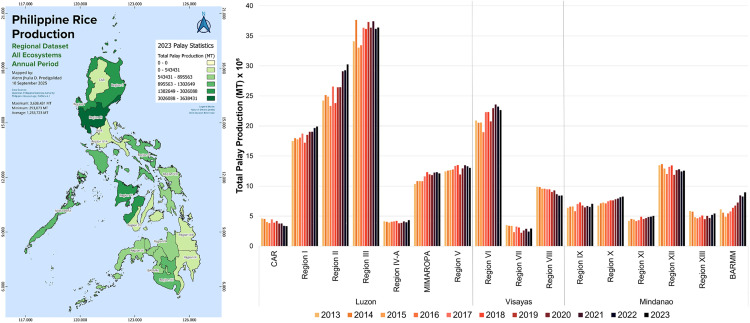
This widening gap is the focus of new research from Ateneo de Manila University’s John Gokongwei School of Management and Department of Environmental Science. They found that national rice output has been largely stagnant since 2017, based on data from the Philippine Statistics Authority (PSA).
In the ten years leading up to 2023, total production of palay (unmilled rice) grew just 9 percent, from 18.4 to 20.1 million metric tons, even as rice consumption and the population itself continued to rise. Rice farmland barely expanded, increasing by just 1 percent (from 4.7 to 4.8 million hectares), while average yields improved by only 7 percent, from 3.9 to 4.2 metric tons per hectare.
The myth of urbanization
Contrary to the common belief that urbanization encroaches on farmland and takes away farmland resources, the researchers did not find strong evidence that city expansion alone explains farmland stagnation. Instead, they point to a combination of limited farmland expansion, slow yield growth, climate shocks, and uneven public investment in rice areas as the main constraints on domestic production.
This is borne out by sharp regional contrasts that emerged from the data. On the one hand, from 2018 to 2023, the Cordillera Administrative Region (CAR) and Eastern Visayas (Region VIII) saw rice production decline by 15 percent and 11 percent, respectively, largely due to rice farmland loss; stagnant yields; repeated typhoons and droughts; and competition as farmers divert land use to other, more profitable crops.
And yet, on the other hand, the Bangsamoro Autonomous Region in Muslim Mindanao (BARMM) increased its rice output by 40 percent, while Cagayan Valley (Region II) and Ilocos (Region I) posted gains of 27 percent and 16 percent, respectively. These gains are linked to expanding irrigated areas, better yields, and support programs such as improved seed, farm mechanization, and targeted regional initiatives.
Moreover, seed programs to help ensure robust crops and mechanization aid towards improving rice harvesting and processing have helped boost yield, while infrastructure expansion and regional government policies have helped with farmland expansion. In the particular case of the BARMM, increased rice yields are linked to dedicated investments in rice infrastructure on top of peace dividends in the wake of improved political stability in the region.
Better infrastructure and support needed
Despite the establishment and subsequent extension until 2031 of the Rice Competitiveness Enhancement Fund (RCEF) under the Rice Tariffication Law (RA 11203), the authors note that national programs alone have not been enough to lift productivity in lagging regions.
The successes of the BARMM, Cagayan Valley, and Ilocos may provide insights toward boosting rice production in other regions; and the experiences from less successful regions may give lessons toward avoiding the same declines elsewhere. Closing the country’s growing rice deficit will require regionally tailored, climate-resilient strategies: stronger irrigation systems, better-targeted support services, and financial measures that lower farmers’ costs, according to the Ateneo researchers. The researchers expressed optimism that, with the right complement of policies and investments, local rice production can still grow and help narrow the country’s dependence on imported grain.
Henry A. Bartelet, Alenn Jhulia D. Prodigalidad, Janelle S. Dy, and Jan Gabriel N. Manzano published their paper, Understanding rice production stagnation in the Philippines: Regional evidence and development implications, in the open-access journal PLOS One.
SOURCE: https://archium.ateneo.edu/qmit-faculty-pubs/40/
For interview requests and other inquiries, please email media.research@ateneo.edu. Visit archium.ateneo.edu for more information about our latest research and innovations.
Recent News
You may also like these articles
Protecting Creativity: AIPO and Rizal Library Host Copyright Awareness Session for the Ateneo Community
On March 18, 2026, the Ateneo Intellectual Property Office (AIPO), in collaboration with the Rizal Library, successfully conducted a Copyright Awareness Session held on the

Class and work arrangements for March 30-April 1, 2026 (Memo No. AGSB-DO-2526-043)
AGSB-DO-2526-043 28 March 2026 TO: AGSB Community FROM: (sgd.) Jowett Cecilio F. Magsaysay, MBA, PhD Dean SUBJECT: Class and work arrangements for March 30-April 1
Class and work arrangements for March 26-27, 2026 (Memo No. AGSB-DO-2526-042)
AGSB-DO-2526-042 25 March 2026 TO: AGSB Community FROM: (sgd.) Jowett Cecilio F. Magsaysay, MBA, PhD Dean SUBJECT: Class and work arrangements for March 26-27, 2026

QS Subject Rankings 2026: Ateneo in top 100 for theology; ranked in 7 subject areas
Ateneo de Manila University is among the top institutions in seven subject areas, and among the top 100 for theological and religious studies, according to
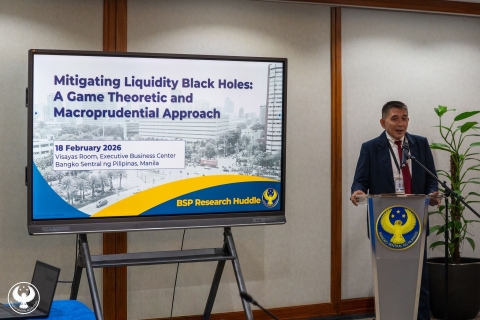
New study from JGSOM proposes framework to address sudden market liquidity collapses
Ateneo de Manila Assistant Professor Emmanuel Richard B Madarang of the John Gokongwei School of Management (JGSOM) presented his research paper “Mitigating Liquidity Black Holes
Better than adequate: AGSB's Master in Business Administration program receives AUN-QA certification
The Master in Business Administration (MBA) program of the Ateneo Graduate School of Business (AGSB) celebrates the certification received from the ASEAN University Network –