Kritika Kultura explores the beginnings of Singaporean anglophone writing
19 Nov 2025



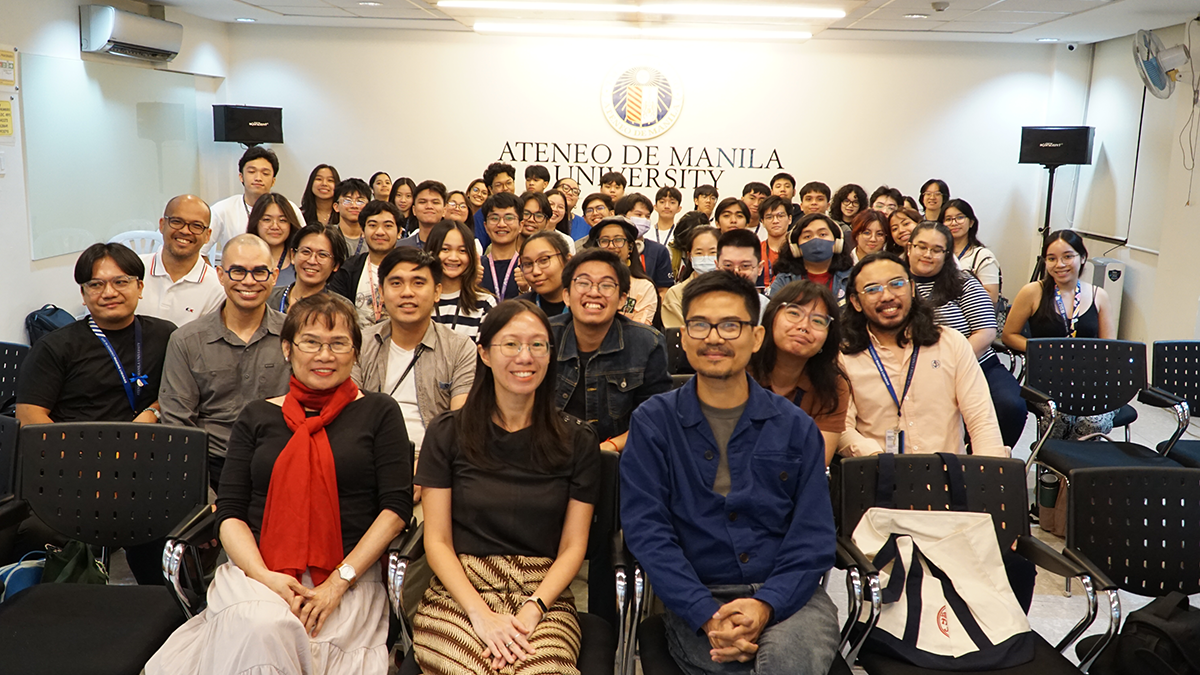
On 18 November 2025, Kritika Kultura, in collaboration with Ateneo's Literary and Cultural Studies Program and PLUME, hosted a lecture titled “From Illegible to Illicit: Anglophone Singapore Writing,” by Ann Ang PhD of Nanyang Technological University at the NGF Conference Room at De la Costa Hall.
Dr Ang's lecture investigated the contested beginnings of Singapore’s anglophone literary scene, and how writers from the 1970s to the 1990s confronted public and political resistance amid shifting policies on language and nationhood, including an examination of Damien Sin’s poetics as a culmination of this contentious relationship between literary expression and state discourse. Through this, it hopes to show how debates on morality, culture, and linguistic identity shaped the path toward a distinctly Singaporean English writing
An Assistant Professor of English Literature at the National Institute of Education, Nanyang Technological University, Dr Ang's research interests include comparative methods for anglophone Southeast Asian literatures, Singapore and Malaysian poetry, and ecocritical approaches to regional writing. Her work has been published in Kritika Kultura, the Journal of Postcolonial Writing, Interventions, and Modernism/Modernity. She is also a writer of poetry and fiction, and has edited several literary anthologies.
The lecture was opened by Claudette M Ulit, PhD, Research Coordinator of the School of Humanities of Ateneo de Manila University who introduced Dr Ang.
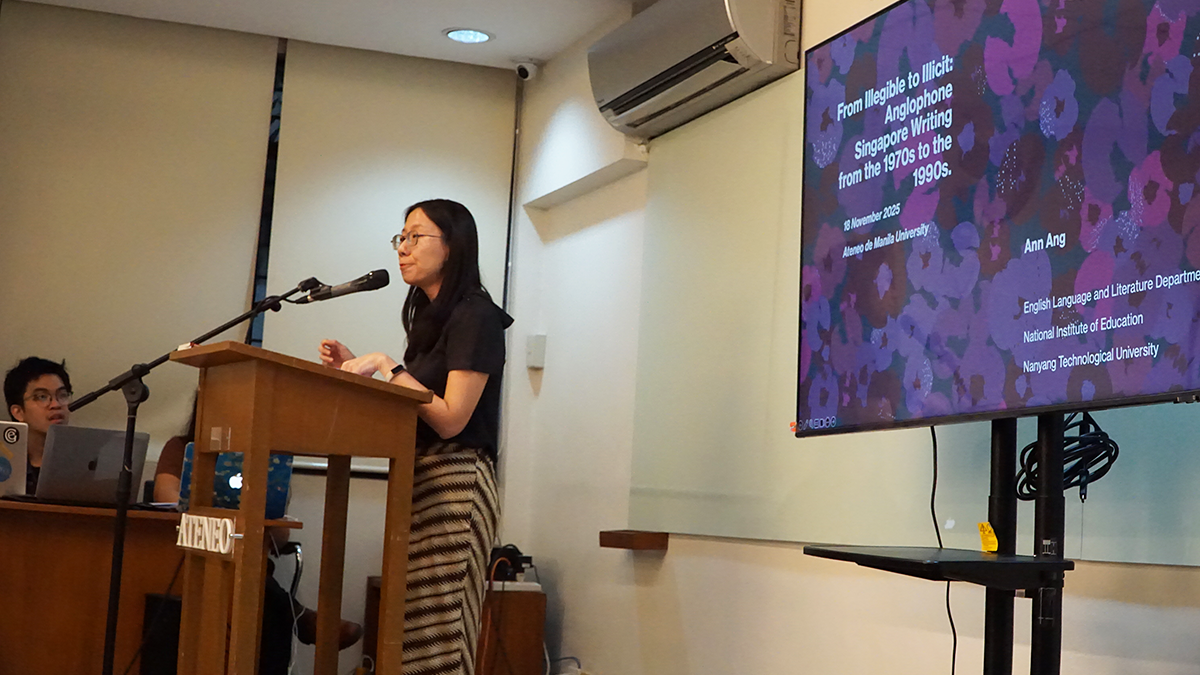
To begin her lecture, Dr Ang explained that much scholarship on Singapore writing focuses on the late 1990s to the contemporary moment, discussing themes such as migrancy, globalization, minority identity and its intersections with the city’s state narrative of national survival.
Her talk, however, focused on the decades preceding the emergence of Singapore as a global city. Starting from English as the language of the colonizers, to its eventual place as an official language alongside three other mother tongues (Singaporean Mandarin, Malay, and Tamil).
She explained that, come the 1970s, local anglophone writers in Singapore encountered an unexpected wave of resistance from state and public discourses. The rise of the hippie counterculture of the 1960s and 1970s and its associations with "sex, drugs, and rock and roll," made anglophone literature a "convenient moral scapegoat."
This came to head in March of 1980, in a parliamentary speech by, Devan Nair future President of Singapore but then the MP for Anson, who grumbled against what he called the "budding breed of new writers, poets and 'back to beyond' philosophers" for their anti-materialistic views. In his speech, Nair labeled local anglophone writers the "confidence tricksters of literature, apes of style, barren of substance, and devoid of sincerity."
As a result of this, Dr Ang states Singaporean anglophone literature and poetry was left in a state of "anglophone illegibility." It could not adopt and outright aesthetic and cultural continuity with western culture and English literature. However, it was also unable to claim a linguistic continuity with ethnic and heritage cultures as moral anchors.
Things changed, however, post-1989, following the fall of the Berline Wall and the eventual end of the Cold War. This led to a with a distinct liberalisation of Singapore's popular culture in a western, American mode. The same time also saw a burgeoning genre writing scene focusing on ghost stories and horror.
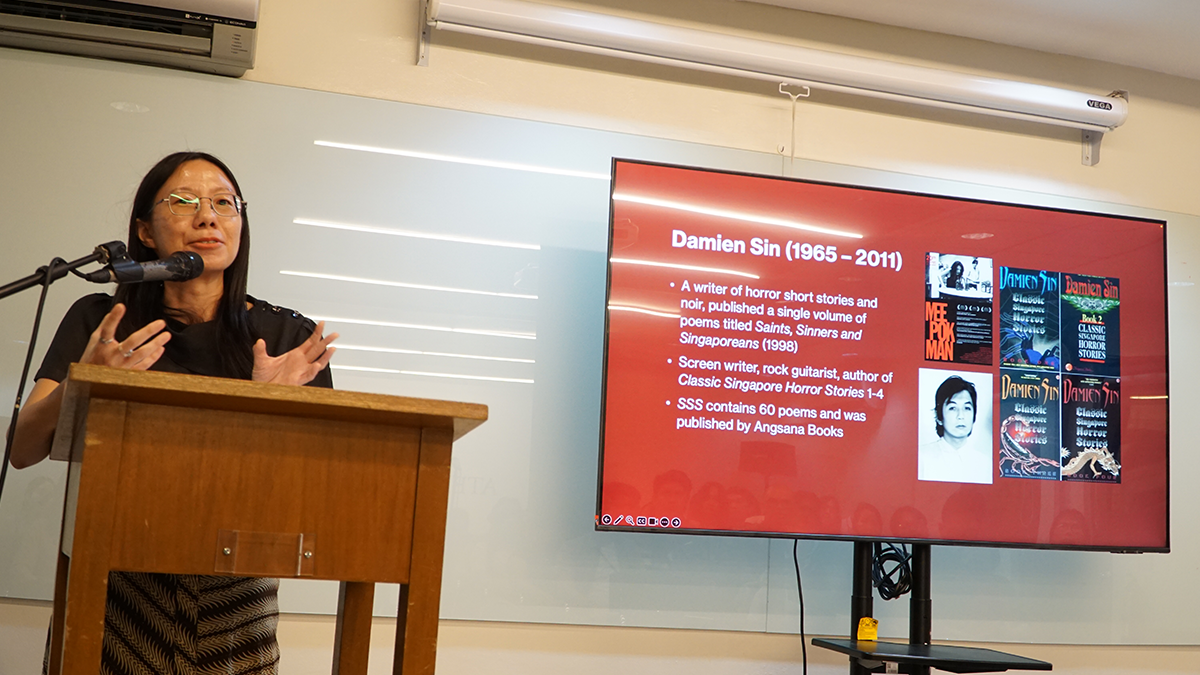
This leads into the second half of her lecture where Dr Ang talks about musician, poet and noir writer Damien Sin (born Foong Yu Lei), specifically covering his poetry collection "Saints, Sinners and Singaporeans."
After failing the Singapore-Cambridge GCE A-Level national examination, Sin started his career as a karaoke-jockey before he turned to writing erotic stories while he was in detention at Singapore's Drug Rehabilitation Centre (DRC).
The influence of these life experiences can clearly be seen in the poetry in "Saints, Sinners and Singaporeans." Poems in the collection cover a starling mix of subjects ranging from the devil, necrophila, working class anthems, and even the Roman emperor Nero.
Most obvious are allusions to Sin's unusual literary education in the DRC, with references to Oscar Wilde, combined with the poetry using prison as a setting. In addition, Ang also points out allusions to 80s and 90s music.
Woven within all these is social commentary showing Sin's deep sympathy for the game members, street hustlers and junkies on the margins of Singaporean society – people rejected and hidden from view in Singapore's new narrative as "Asia's global city."
Following her exploration of the themes of Sin's poems in the collection – including "From the Belly of the Beast," "Working Class Nero," and the titular "Saints, Sinners and Singaporeans" – Dr Ang ties it all back to the state of anglophone Singaporean writing in the previous decades.
She explained that the illicitness of genre writing in the 1990s had inherrited an earlier strain of anglophone immorality, the same one that authorities tried to condemn in previous decades. As a result of that, anglophone Singaporean writing went from, in her words, illegible, in the previous decades, to "hypervisible" in the 1990s in genre writing.
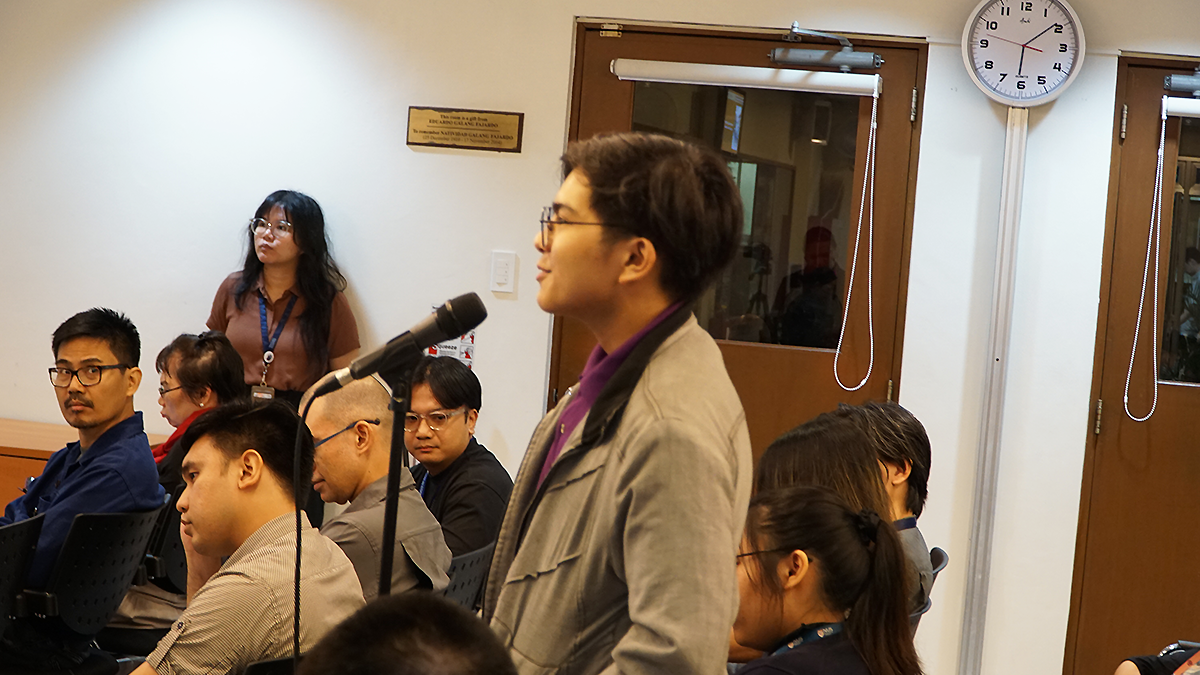
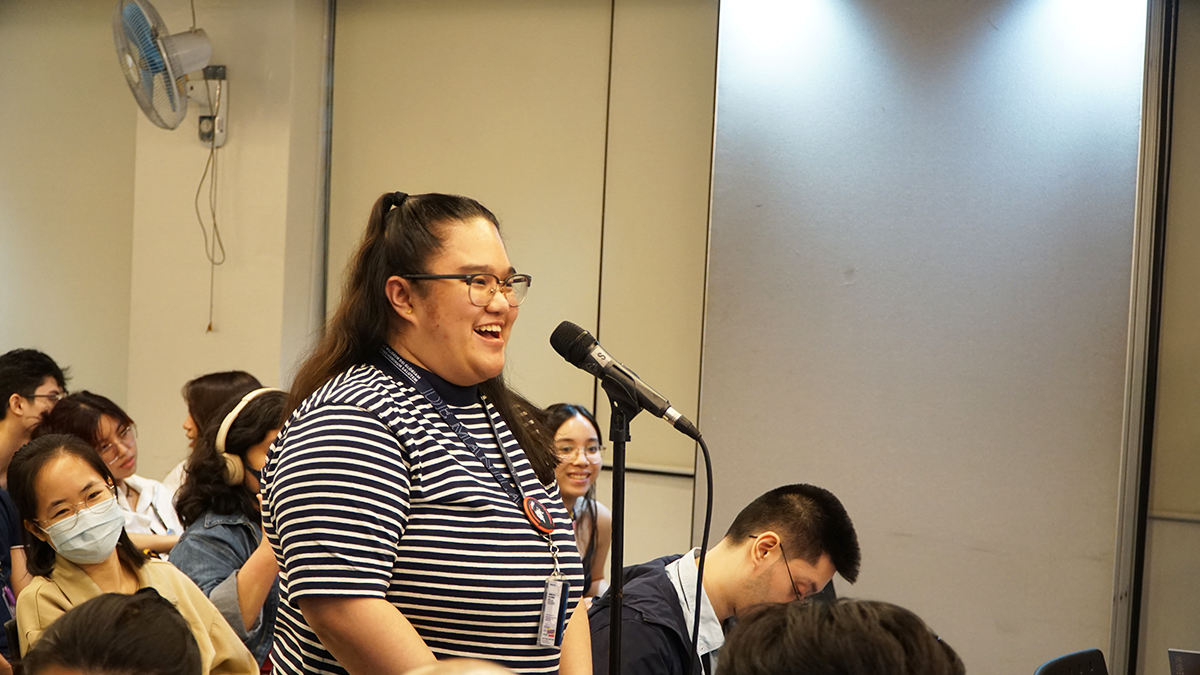
Following her lecture, Dr Ang engaged in a lively open forum with both members of the audience on site, as well as those attending online.
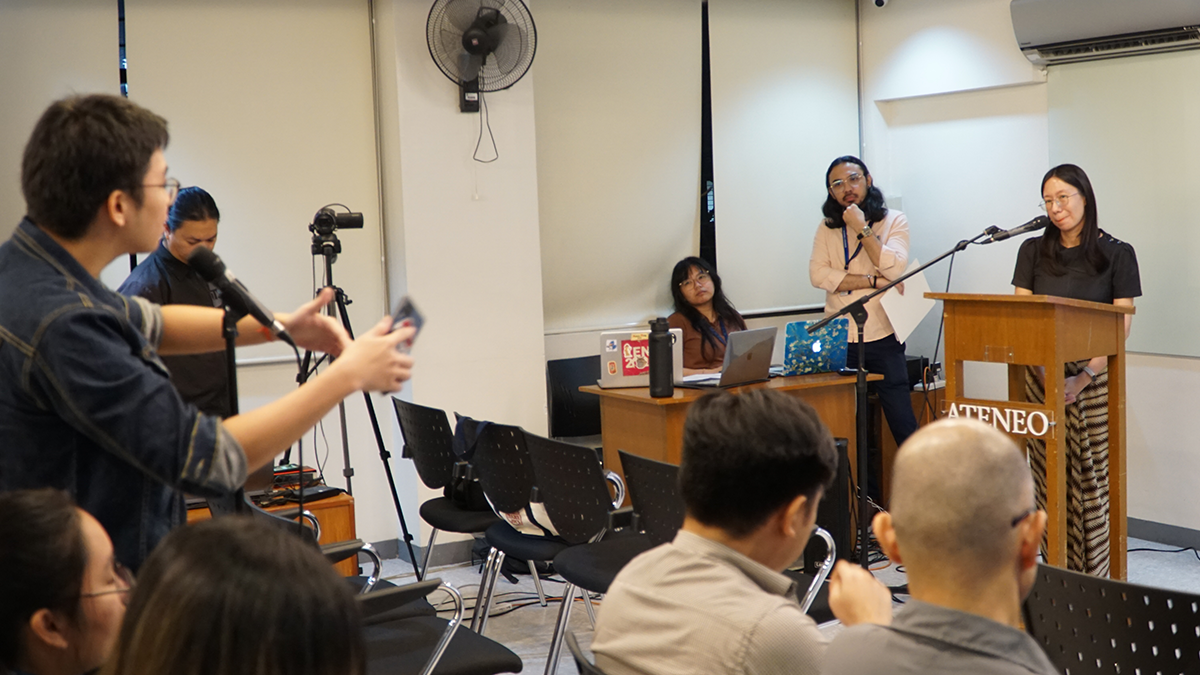
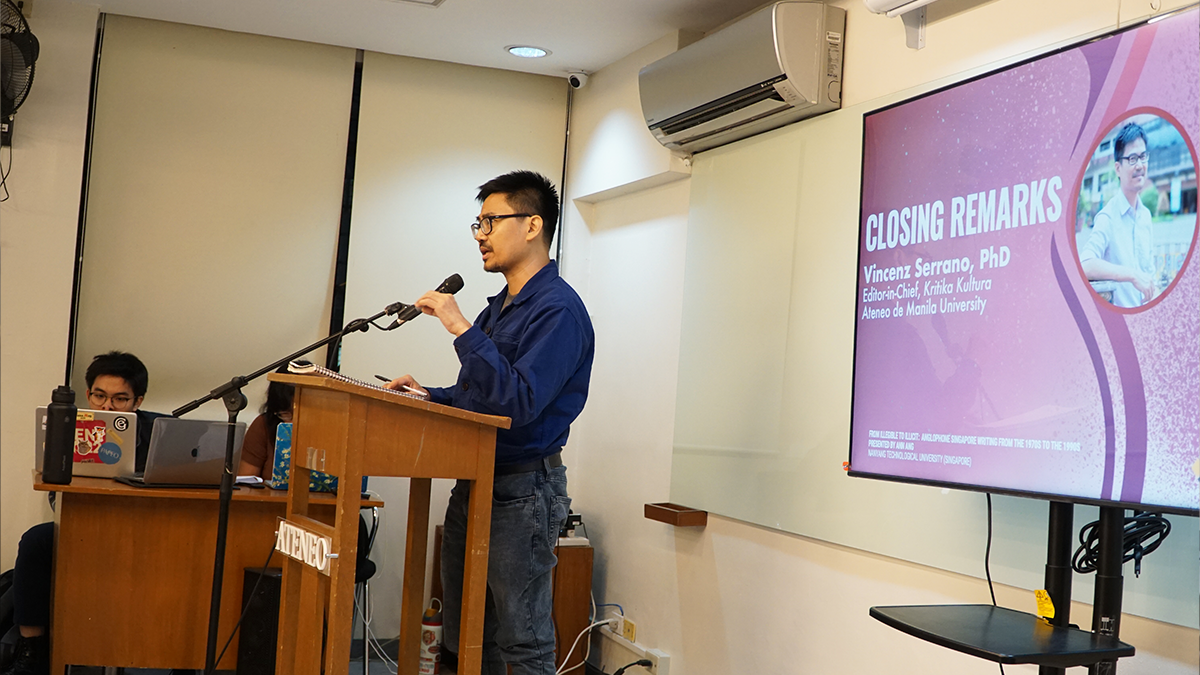
The lecture was closed by Kritika Kultura Editor-in-Chief, Vincenz Serrano, PhD who thanked the audience for attending the lecture even if it was already late in the semester.
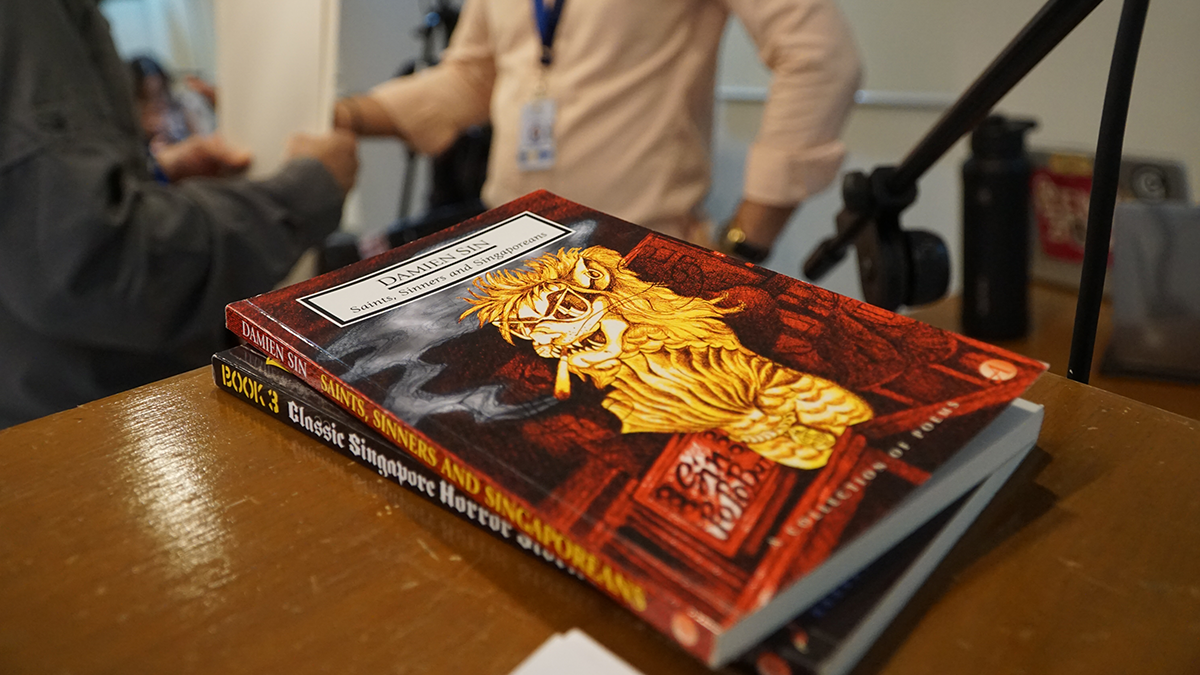
In addition, after the event, Dr Ang gave away a copy of "Saints, Sinners, and Singaporeans" as well as "Classic Singapore Horror Stories Book 3" to the students.
Recent News
You may also like these articles
[Hot Off the Press] Arkipelago
New book from the Ateneo Press Arkipelago provides a fascinating and fantastical twist on Philippine politics and history Our country is an archipelago of stories
Protecting Creativity: AIPO and Rizal Library Host Copyright Awareness Session for the Ateneo Community
On March 18, 2026, the Ateneo Intellectual Property Office (AIPO), in collaboration with the Rizal Library, successfully conducted a Copyright Awareness Session held on the
Things You Wanted to Say But Never Did: Geloy Concepcion’s six-year project makes Its exhibition debut at the Ateneo Art Gallery
Geloy Concepcion’s Things You Wanted To Say But Never Did comes to the Ateneo Art Gallery this 18 April 2026. After receiving almost 300,000 messages
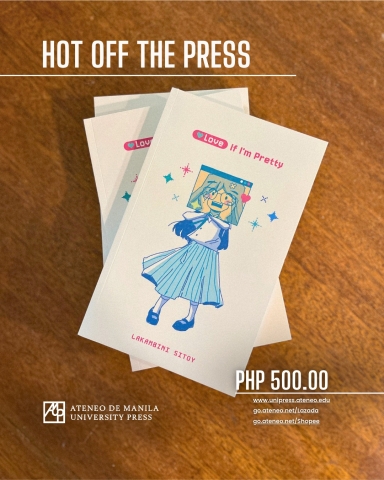
[Hot Off the Press] Love If I'm Pretty
New YA Release from the Ateneo Press Love If I’m Pretty tackles the nuances of growing up through complex characters and straightforward prose What do
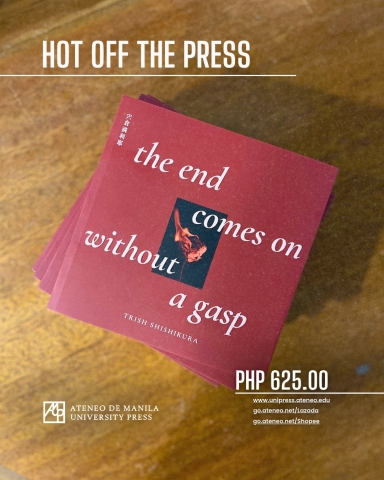
[Hot Off the Press] the end comes on without a gasp
the end comes on without a gasp: Trish Shishikura’s debut poetry collection arrives from Ateneo de Manila University Press (Bughaw) Ateneo de Manila University Press
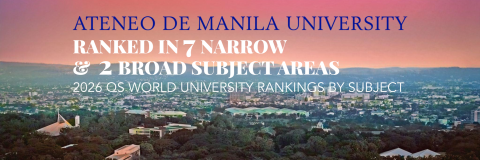
QS Subject Rankings 2026: Ateneo in top 100 for theology; ranked in 7 subject areas
Ateneo de Manila University is among the top institutions in seven subject areas, and among the top 100 for theological and religious studies, according to