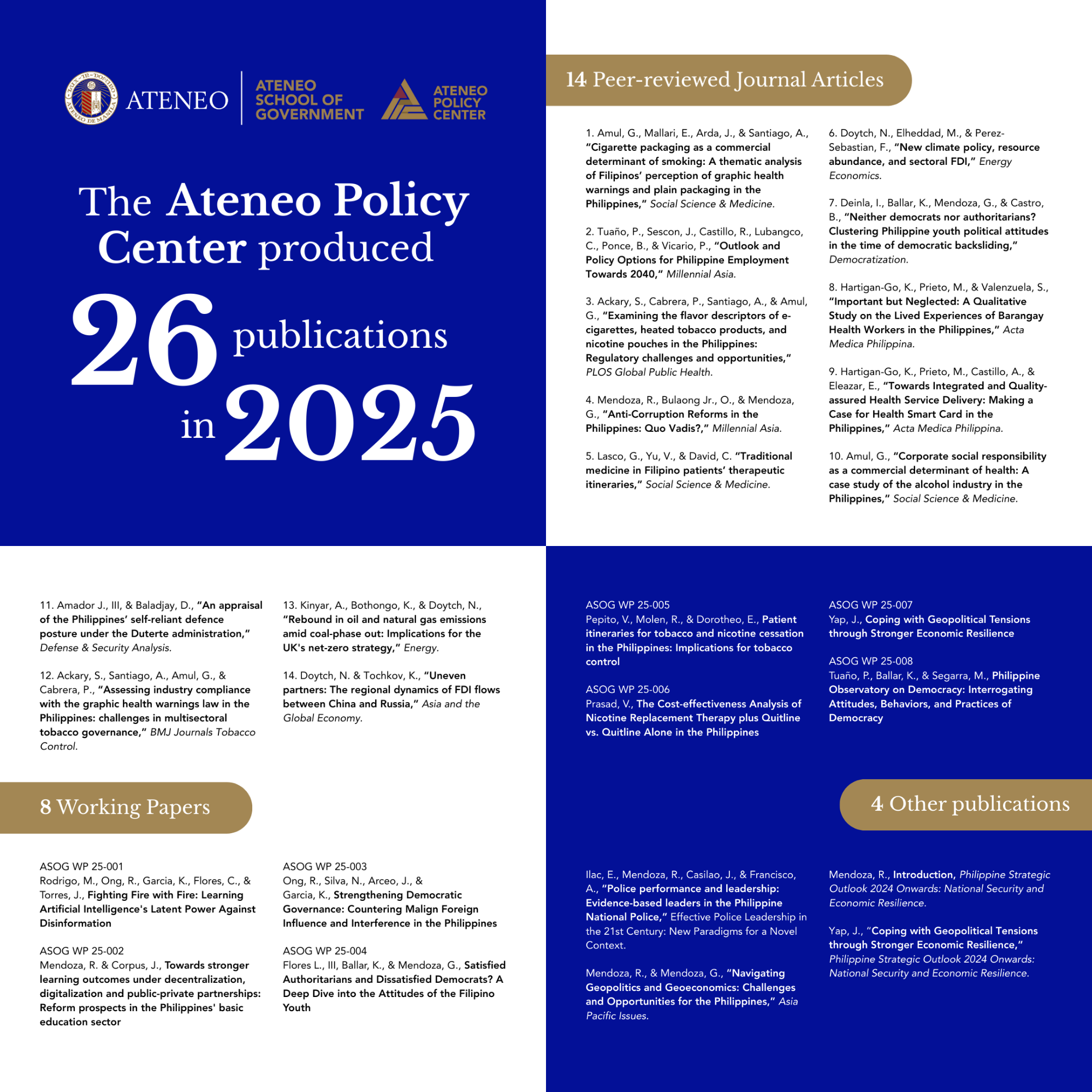
ASoG, through the Ateneo Policy Center, delivers 26 publications in 2025
06 Feb 2026

As the research and public policy unit of the Ateneo School of Government (ASoG), the Ateneo Policy Center (APC) has continued to pursue cutting-edge research and evidence-based analysis on the country’s foremost social, political, and economic issues. In 2025 alone, APC has released eight working papers, fourteen peer-reviewed journal articles, and four other publications.
Geopolitical shifts in recent years have not only presented significant risks and uncertainty but also rare opportunities for economic recalibration. These strategic and economic considerations are discussed in the Philippine Strategic Outlook 2024 Onwards: National Security and Economic Resilience launched by the UP Center for Integrative and Development Studies (UP CIDS), which features an Introduction and a book chapter by APC Senior Research Fellows. On the strategic front, working papers outlined the extent of foreign influence operations in the Philippines and the dual role of artificial intelligence in both propagating and combating complex disinformation networks. Both emphasize the importance of legal and policy frameworks that bolster democratic resilience against these emerging threats. Meanwhile, an article examined the Philippines’ pursuit of a self-reliant defence posture, noting structural constraints that temper claims of strategic autonomy.
On the economic front, a working paper highlighted the importance of economic resilience and regional financial integration, while a research report outlined policy recommendations for an economic derisking strategy in the Philippines. Dr. Nadia Doytch, Non-Resident Research Fellow of APC, has also published extensively on the drivers and effects of international trade. One article revealed asymmetries in investment patterns between China and Russia, while two articles focused on the environmental implications of foreign direct investments on climate policy and of energy transitions on natural gas and oil use.
ASoG, through APC, remains committed to its advocacy for nation-building amidst heightened inequality, populism, and authoritarian nostalgia. An article published in Democratization illustrated how public support for democracy does not necessarily translate to a commitment to the values and responsibilities that come with being democratic citizens. With this, further research on the Filipino youth contextualized support for former President Duterte and President Marcos Jr. within the youth’s distinct visions of ideal leadership, varied levels of perceived political efficacy, and sentiments on Filipino democracy. Furthermore, ASoG, through APC, has collaborated with Ateneo universities and other partner organizations to launch a topline report of a multi-stage, probability-based survey that aims to understand how Filipinos perceive and practice democracy.
Several policy-oriented papers have provided evidence-based recommendations to improve governance. Journal articles evaluated challenges in the Philippine labor market and the country’s current state of anti-corruption reforms to identify policy levers that promote sustainable and inclusive economic growth. A book chapter emphasized the role of training, mentorship, and institutional reforms in improving leadership within the Philippine National Police. Finally, a working paper laid down avenues for decentralization, digitalization, and public-private partnerships in the country’s basic education system.
Lastly, the APC continues to advance cutting-edge research in support of the Philippine healthcare sector and tobacco regulation. At the national level, a journal article called for the implementation of a health smart card to address systemic gaps in health information integration, continuity of care, and quality assurance for the Filipino people. At the local level, journal articles emphasized the critical yet undervalued role of community-based actors and culturally informed approaches to how patients experience healthcare through case studies of barangay healthcare workers and traditional medicine.
APC also continues to build a growing portfolio of research on the tobacco and alcohol industry, strengthening ASoG’s influence in this area. Journal articles examine the role of flavor descriptors and commercial packaging as central marketing strategies used to appeal to Filipinos and circumvent regulation. Further scrutiny of the tobacco industry’s compliance with the graphic health warnings law and the alcohol industry’s use of corporate social responsibility to influence policy environments and legitimize their products also shed light on systemic challenges in protecting consumer health in the Philippines. In addition, working papers on tobacco cessation services analyzed the cost-effectiveness of available cessation approaches and mapped out six patient itineraries that respond to users’ lived realities.
In sum, these research initiatives champion ASoG’s mission for a prosperous and empowered Philippines. All of these initiatives would not have been possible without the valuable support of the fellows, researchers, partners, and stakeholders.
For more information about the research materials by the Ateneo Policy Center, please visit this link.
Recent News
You may also like these articles

[Hot Off the Press] Arkipelago
New book from the Ateneo Press Arkipelago provides a fascinating and fantastical twist on Philippine politics and history Our country is an archipelago of stories
Protecting Creativity: AIPO and Rizal Library Host Copyright Awareness Session for the Ateneo Community
On March 18, 2026, the Ateneo Intellectual Property Office (AIPO), in collaboration with the Rizal Library, successfully conducted a Copyright Awareness Session held on the
Holy Week 2026 Holidays (Memo # UHR2526-038)
Memo # UHR2526-038 31 March 2026 TO: All Employees FROM: [Sgd] Maria Victoria T Cortez, PhD Vice President for University Human Resources SUBJECT: Holy Week
ASOG’s Tobacco Control initiatives spotlighted in DOH National Technical Working Group for Tobacco Prevention and Control
On March 10 to 12, 2026, the Ateneo School of Government (ASOG), through its research and public policy unit, the Ateneo Policy Center, participated in
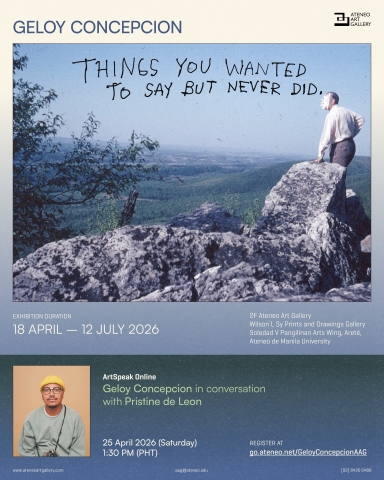
Things You Wanted to Say But Never Did: Geloy Concepcion’s six-year project makes Its exhibition debut at the Ateneo Art Gallery
Geloy Concepcion’s Things You Wanted To Say But Never Did comes to the Ateneo Art Gallery this 18 April 2026. After receiving almost 300,000 messages

[Hot Off the Press] Love If I'm Pretty
New YA Release from the Ateneo Press Love If I’m Pretty tackles the nuances of growing up through complex characters and straightforward prose What do