Tagpuan Ateneo: 2026 Call for Proposals
16 Feb 2026





Background and Purpose
Polarization in its various forms is on the rise all over the world. (Gidron, et. al., 2019) “The world is divided along numerous fault lines: social, economic, political, geographical. The world has never been more polarized, with people trapped in echo chambers, shutting out ideas and voices that diverge even the slightest bit from what they believe in. The world needs to get its act together to solve its problems—but first, people need to bridge the chasms that separate them from each other, and focus on things that unite, instead of those that divide.” (Ateneo de Manila University 2030 Lux-In-Domino Strategic Plan, 2021)
In line with this strategic area, the Tagpuan Ateneo Center for Dialogue, Research, and Collaboration was created, based on the foundation of the culture of encounter outlined in Pope Francis’ work in Fratelli Tutti, where Pope Francis talks of “the growth of a culture of encounter capable of transcending our differences and divisions...To speak of a ‘culture of encounter’ means that we, as a people, should be passionate about meeting others, seeking points of contact, building bridges, planning a project that includes everyone…What is important is to create processes of encounter, processes that build a people that can accept differences.” (Francis, 2020, secs. 215-217)
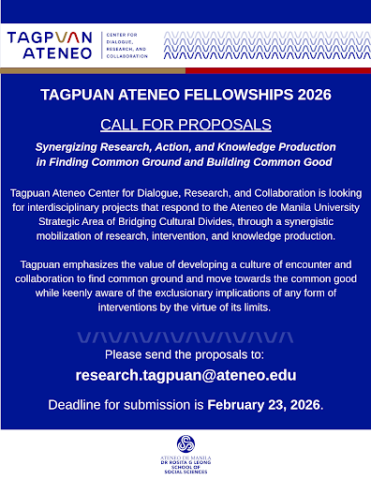
Tagpuan is thus looking for interdisciplinary projects that respond to Ateneo de Manila University's strategic area of Bridging Cultural Divides, through a synergistic mobilization of research, intervention, and knowledge production. These projects should attend to the various and puzzling ways polarization manifests in our VUCA (Volatile, Uncertain, Complex, and Ambiguous) world, and how we might respond to such polarization through concrete actions or processes. Tagpuan emphasizes the value of developing a culture of encounter and collaboration to find a common ground and move towards the common good while being keenly aware of the exclusionary implications of any form of interventions by the virtue of its limits. Proposals must show how the project synergizes the power of research, action, and knowledge production in bridging the various divides that people experience today, through clear objectives and outputs.
Possible outputs will include a scholarly component, as well as a practical component that others can use and apply in their own communities. The scholarly component can include, but is not limited to, research papers, translation work, book chapters, or other books that generate knowledge on dialogue and responding to polarization and divides, while the practical component can include, but is not limited to, toolkits, media, resources, seminars, or workshops. Proposals whose work is more scholarly in nature should commit to working with the center to produce the practical component of the project.
Fellowship Funding and Proposal Submission Deadline
Funding is available for projects of up to PHP 400,000. Funding can be used to implement a project, manpower, labor, and activities, but cannot be used to fund conference travel.
The deadline for submission is on 23 February 2026. Decisions will be released on or before 14 March 2026.
Fellowship Eligibility
We welcome proposals for short-term projects from faculty, professionals, non-teaching personnel and affiliates of the Ateneo de Manila University. Approved projects should start by March 2026 and must be completed within 6 to 9 months. Collaborations across disciplines or organizations are highly encouraged.
Specific eligibility criteria:
- The project leader, primary investigator, co-investigator, or research/project manager should be a full-time permanent employee of the University.
- The group should be willing to engage in collaborative work with Tagpuan Ateneo throughout the Fellowship.
- The group should be willing to be part of a community that will support the work of Tagpuan Ateneo, directly or indirectly, in post-Fellowship engagements such as curricular and co-curricular activities utilizing their research output or knowledge products.
Publications resulting from this project should explicitly acknowledge the support provided by the University through the center.
Note: Tagpuan Ateneo operates in compliance with the University’s protocols and guidelines governing human resources, accounting, and other administrative matters. This compliance extends to its partners, fellows, collaborators, vendors, and suppliers in all engagements, projects, and initiatives.
Topics
Topics can include, but are not limited to:
- Conceptualizing Divides and Transforming Divisions
- Definition and Scope: Define what constitutes a divide and explore its various dimensions, including cultural, socioeconomic, electoral, geopolitical, disciplinal, identity, gender, religious, and linguistic factors and values, using interdisciplinary lenses.
- Historical and Theoretical Perspectives: Review historical instances of cultural divides and theoretical frameworks that explain their emergence, evolution, persistence, resolution, and transformational trajectories.
- Current Trends, Challenges, and Interventions: Analyze contemporary issues that contribute to disruptions, conflicts, and engagements aimed at addressing them. These areas may cover and move beyond issues and intervening actions associated with politics and power, dignity and rights, socio-economic relations, inequity and inequality, translocalization, globalization, mobilities and migration, technology and digitization, health, knowledge transfer and reproduction, gender, arts and materialities, spaces and geographies, identity and memories, ecologies and ecological justice, and communications.
- Themes for Finding Common Ground and Building Common Good
- Innovating Dialogues and Collaborations: With rigorous evidentiary support, propose innovative and interdisciplinary strategies and tools to effectively find common ground, bridge cultural divides, and/or foster a “culture of encounter”. Products may come in the form of but not limited to, toolkits and arts-based materials for productive use by individuals, organizations, institutions, and communities.
- Fostering Public Understanding, Building Coalitions, and Transcending Divides : Examine the role of encounter, dialogue, interdisciplinarity, organizing, and mediation in transcending conflicts, promoting
understanding in the public spheres, and forming partnerships in approaching difficult circumstances and issues.
- Communications and Digital Platforms: Assess the shifting roles of communication technologies from its traditional to digitized forms towards a formulation of productive communicative designs addressing the divisive risks of disinformation, digital echo-chambers, and information circulation barriers.
- Curriculum Development and Teacher Training: Explore what can be incorporated into curricula in helping students and teachers respond to divides and find common ground, communicate particular ideas, and/or assess its effectiveness, such as case studies or impact assessment tools.
Required Information
The proposal should contain the following:
- Project background, including discussions on the divide puzzle being aimed at addressing; include the names of the research team and their affiliations
- Project description, including discussions on how the project fits with the theme, any research ethics concerns or clearance (as needed), as well as how it is interdisciplinary and a collaborative effort with a particular community of interest
- Projected knowledge contribution in finding common ground and building common good to bridge divides
- Methodology, including how the methodology is dialogical in itself
- Goals and objectives, including the scholarly and practical output of the project
- Timeline
- Proposed budget
- Related Literature
- Curriculum Vitae of all researchers
Note: Proposals should not exceed 3,000 words, excluding the list of references. Please send the proposals to research.tagpuan@ateneo.edu
Related Works
Alesina, A., Miano, A., & Stantcheva, S. (2020). Polarization of Reality. AEA Papers and Proceedings, 110, 324-328.
Arceneaux, K., Johnson, M., & Cryderman, J. (2013). Communication, Persuasion, and the Conditioning Value of Selective Exposure: Like minds may unite and divide but they mostly tune out. Political Communication, 30(2), 213–231.
Desmet, K., & Wacziarg, R. (2021). The Cultural Divide. The Economic Journal, 131(637), 2058-2088.
Gidron, N., Adams, J., & Horne, W. (2019). Toward a comparative research agenda on affective polarization in mass publics. APSA Comparative Politics Newsletter, 29, 30–36.
Heaney, M. T., Masket, S. E., Miller, J. M., & Strolovitch, D. Z. (2012). Polarized networks: The organizational affiliations of national party convention delegates. American Behavioral Scientist, 56(12),
1654–1676.
Jones, D. A. (2002). The polarizing effect of new media messages. International Journal of Public Opinion Research, 14(2), 158–174.
Kubin, E., & von Sikorski, C. (2021). The role of (social) media in political polarization: a systematic review. Annals of the International
Communication Association, 45(3), 188–206.
Mason, L. (2018). Uncivil agreement: How politics became our identity. University of Chicago Press.
Vassilakopoulou, P., & Hustad, E. (2021) Bridging Digital Divides: a Literature Review and Research Agenda for Information Systems Research. Information Systems Frontiers, 25, 955–969.
Recent News
You may also like these articles
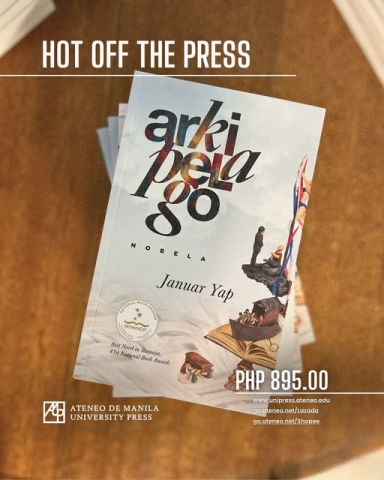
[Hot Off the Press] Arkipelago
New book from the Ateneo Press Arkipelago provides a fascinating and fantastical twist on Philippine politics and history Our country is an archipelago of stories
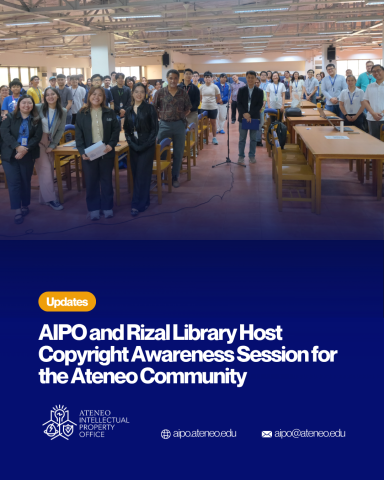
Protecting Creativity: AIPO and Rizal Library Host Copyright Awareness Session for the Ateneo Community
On March 18, 2026, the Ateneo Intellectual Property Office (AIPO), in collaboration with the Rizal Library, successfully conducted a Copyright Awareness Session held on the
Holy Week 2026 Holidays (Memo # UHR2526-038)
Memo # UHR2526-038 31 March 2026 TO: All Employees FROM: [Sgd] Maria Victoria T Cortez, PhD Vice President for University Human Resources SUBJECT: Holy Week
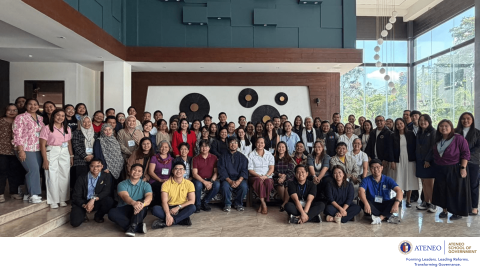
ASOG’s Tobacco Control initiatives spotlighted in DOH National Technical Working Group for Tobacco Prevention and Control
On March 10 to 12, 2026, the Ateneo School of Government (ASOG), through its research and public policy unit, the Ateneo Policy Center, participated in
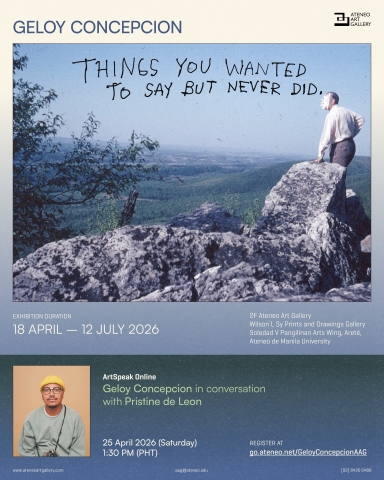
Things You Wanted to Say But Never Did: Geloy Concepcion’s six-year project makes Its exhibition debut at the Ateneo Art Gallery
Geloy Concepcion’s Things You Wanted To Say But Never Did comes to the Ateneo Art Gallery this 18 April 2026. After receiving almost 300,000 messages
[Hot Off the Press] Love If I'm Pretty
New YA Release from the Ateneo Press Love If I’m Pretty tackles the nuances of growing up through complex characters and straightforward prose What do