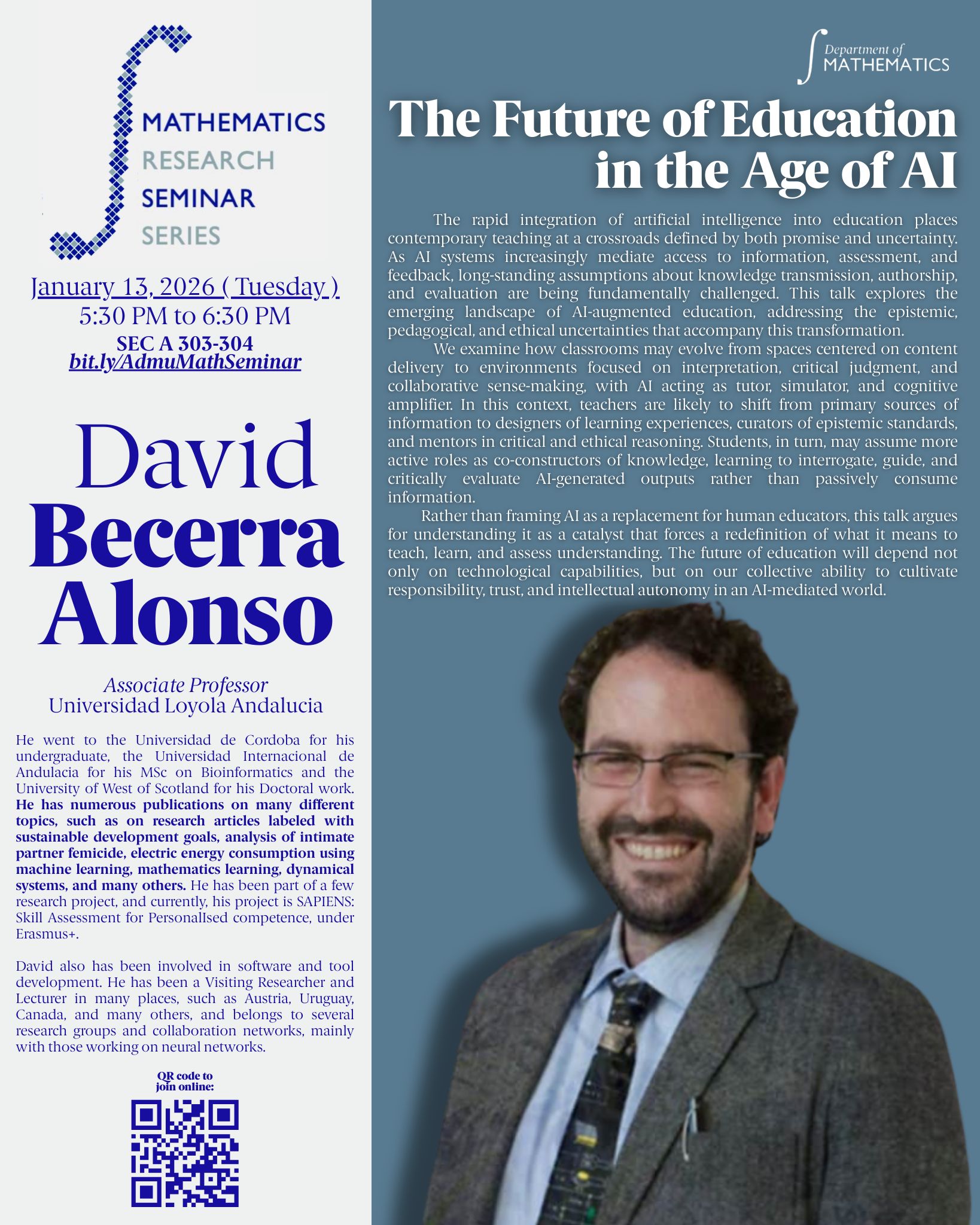
Mathematics research seminar explores the future of education in the Age of AI
16 Mar 2026


Ateneo de Manila University's Department of Mathematics hosted a session of its Mathematics Research Seminar Series on 13 January 2026, featuring Dr David Becerra Alonso, Associate Professor at Universidad Loyola Andalucía. The seminar, titled “The Future of Education in the Age of AI,” was held at SEC A 303–304, with an option for participants to join online.
In his talk, Dr Becerra Alonso examined how the rapid integration of artificial intelligence is reshaping the educational landscape. He discussed how AI systems are increasingly influencing access to information, assessment, and feedback, raising new questions about knowledge transmission, authorship, and evaluation.
The seminar highlighted how classrooms may shift from traditional content delivery toward learning environments that emphasize interpretation, critical thinking, and collaborative sense-making. In this context, artificial intelligence can serve as a tutor providing immediate feedback, a simulator for exploring complex problems, and a cognitive tool that supports analytical and creative thinking. As information retrieval becomes increasingly automated, classroom time may focus more on discussion, problem-solving, and the critical evaluation of ideas.
Dr Becerra Alonso also emphasized the evolving roles of educators and students in this changing environment. Teachers increasingly act as designers of learning experiences and mentors in ethical and critical reasoning, while students become active participants in knowledge creation by learning to question and evaluate AI-generated outputs.
Rather than replacing educators, AI was presented as a catalyst for rethinking how teaching, learning, and assessment are defined. Dr Becerra Alonso noted that the future of education will depend not only on technological advances but also on the ability of institutions to cultivate responsibility, trust, and intellectual autonomy in an AI-mediated world.
Dr Becerra Alonso earned his undergraduate degree from the Universidad de Córdoba, an MSc in Bioinformatics from the Universidad Internacional de Andalucía, and his doctorate from the University of the West of Scotland. His research spans a wide range of topics, including sustainable development goal–labeled research, intimate partner femicide analysis, machine-learning applications in electric energy consumption, mathematics learning, and dynamical systems. He is currently involved in the Erasmus+ project SAPIENS (Skill Assessment for Personalised Competence) and has participated in numerous research collaborations and software development initiatives. He has also served as a visiting researcher and lecturer in institutions across Austria, Uruguay, Canada, and other countries.
Recent News
You may also like these articles

[Hot Off the Press] Arkipelago
New book from the Ateneo Press Arkipelago provides a fascinating and fantastical twist on Philippine politics and history Our country is an archipelago of stories
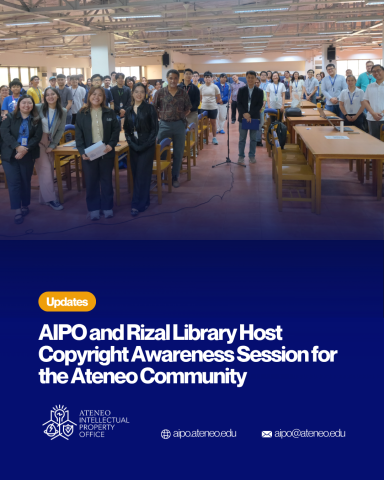
Protecting Creativity: AIPO and Rizal Library Host Copyright Awareness Session for the Ateneo Community
On March 18, 2026, the Ateneo Intellectual Property Office (AIPO), in collaboration with the Rizal Library, successfully conducted a Copyright Awareness Session held on the
Holy Week 2026 Holidays (Memo # UHR2526-038)
Memo # UHR2526-038 31 March 2026 TO: All Employees FROM: [Sgd] Maria Victoria T Cortez, PhD Vice President for University Human Resources SUBJECT: Holy Week
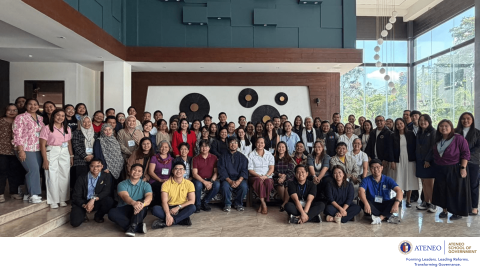
ASOG’s Tobacco Control initiatives spotlighted in DOH National Technical Working Group for Tobacco Prevention and Control
On March 10 to 12, 2026, the Ateneo School of Government (ASOG), through its research and public policy unit, the Ateneo Policy Center, participated in
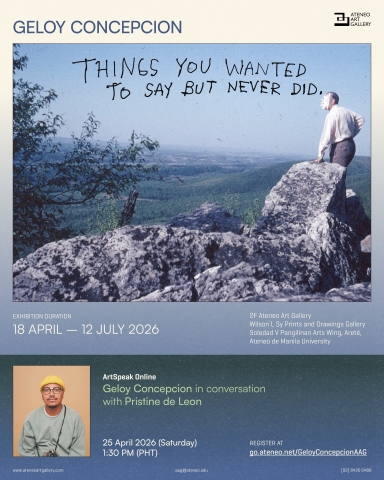
Things You Wanted to Say But Never Did: Geloy Concepcion’s six-year project makes Its exhibition debut at the Ateneo Art Gallery
Geloy Concepcion’s Things You Wanted To Say But Never Did comes to the Ateneo Art Gallery this 18 April 2026. After receiving almost 300,000 messages

[Hot Off the Press] Love If I'm Pretty
New YA Release from the Ateneo Press Love If I’m Pretty tackles the nuances of growing up through complex characters and straightforward prose What do