[Ateneo Press Review Crew] The ABCs of disposability and resistance: A review of Neferti XM Tadiar’s “Remaindered Life”
29 Apr 2025 | Dean Gabriel Amarillas








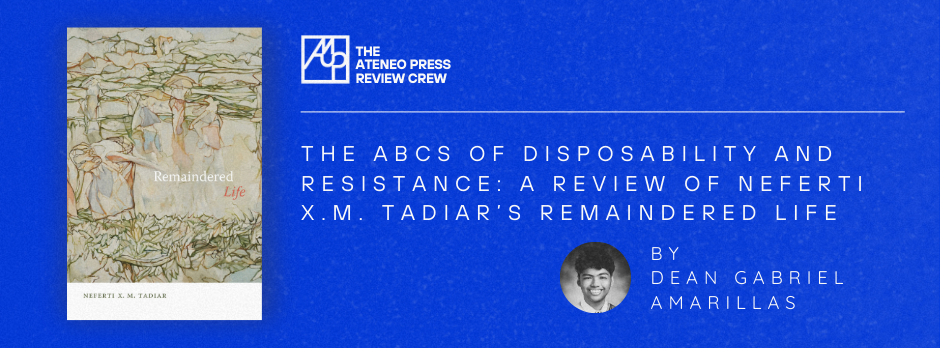
In a time of local and global wars where people are deemed expendable, the definition of the word “human” blurs. In Remaindered Life by Neferti X M Tadiar, we are offered a vocabulary to clearly understand how capitalist machinations mystify one’s humanity, while also being told a story of human resistance through art.
Divided into five parts which can be read independently, Tadiar explores multiple facets of our world’s society by differentiating “the war to be human” and “becoming-human in a time of war”, critiquing “life as labor”, defining tendencies of urban expansion in an emergent global platform economy, exploring how freedom and democracy work as code-scripts in making the global infrastructure as capital, and how artists struggle for survival to triumph over disposability.
At its core, remaindered life is the living without value—the uncounted hours, unseen care, and quiet survival that slip through capitalism’s grasp. It is not quite disposable, not quite surplus: a vitality that serves without being valued. Neither expendable nor exploitable, it lingers in the margins, sustaining life without reward. It signals a mode of living that exceeds capital’s vitalist economy, embodying ephemeral but potent capacities for survival and relation that resist commodification.
Terms like “remaindered life” are riddled throughout this book, and rightly so, as Tadiar is very transparent with her intention to not just make a case about our contemporary reality or to provide an explanation of the world, but to provide a way of seeing and interpreting cases and reports across diverse contexts, and to offer a conceptual vocabulary and syntax for understanding them.
Another example of this is seen in the opening part of the book, “In a time of War”, where Tadiar questions what it means and what it takes to be human in “the age of permanent war.” It is within this part, where she differentiated not only “the war to be human” and “becoming-human in a time of war”, but also introduced the idea of valued and disposable life. In investigating the relationships of these principles, one gets an idea of how power and capitalist accumulation shape inequalities in our world.
Tadiar offers support in understanding these terminologies by giving the reader concrete instances. For example, to understand how a big part of the war to be human is the political-military project and atrocities waged by the United States, Tadiar cited Gloria Macapagal Arroyo’s presidency which resulted in thousands of activists, human rights workers, and community leaders slain through paramilitary units. All because Arroyo declared Oplan Bantay Laya which was legitimized and financially and militarily aided by the US.
What then is the difference of this from former PNP chief Debold Sinas’s Oplan Sauron, under former president Rodrigo Duterte, which was launched as an operation to kill addicts, yet resulted in the murders of human rights defenders in Negros? Which for Tadiar, is borrowed from imperial military wars, such as the US war on drugs, which aims to extend control over illegal trade.
In fact, Duterte’s war on drugs is the central figure of Remaindered Life’s fourth part, “Dead Exchanges.” Tadiar argued that under the dictator’s regime, “killing has become a lucrative, deregulated, derivative enterprise,” through the compensation received by the police. But poor addicts aren’t the only ones whose humanity is devalued, but due to this system, hitmen are considered disposable assets by the police as well. “Executions are thus preemptive acts, a cashing in on the promised life-times of captive populations, promissory futures of discounted life for investment capital,” Tadiar wrote.
But signs of life still exist in the country, despite its ongoing demise—one of the many things explored in the book is the idea of art as a counterattack. Tadiar used the artworks of RESBAK, a broad alliance of artists formed in political resistance against Duterte, extensively to push this remark. She explored how in a world of “dead exchanges,” RESBAK artists rework signs and images of the state-formed visual and aural order, drawing on and reconnecting past struggles, which then extends the timeline of social grief. Through this, they fought back with “old and new popular forms.”
During “By the Waysides,” the book’s final part, Tadiar clarified that the idea of a remaindered life “is not itself resistance, it lives within resistance, making it possible.” Remaindered Life reminds us of times where we long for belonging, just like the talahib, who despite not having any capitalist value—just exists. A time, “which can neither be consumed nor subsumed by value-making order that transcends them.” And through an introspection of this way of seeing, which is vastly different from a life viewed under the lens of production, we find meaning.
To read Remaindered Life in one sitting would be a disservice to oneself. Tadiar’s great achievement lies in verbalizing lives, be it disposable or remaindered, offering readers a reorientation—one that asks us to reckon with how value is assigned, and at what cost. The book definitely isn’t an easy read, before being rewarded enlightenment, one must trudge through numerous terminologies and theories, as well as be familiarized with its structure and language. However, once the reader becomes fluent in Tadiar’s lexicon, the book transforms into a must-read for anyone seeking to understand and contextualize this seemingly cyclical life of violence because of war, and also learn how people push back this brutality. After all, Tadiar reminds us:
“People fight back. They organize. Their fighting is lifesaving, life-making. Their organizing creates openings and connections so they are not engulfed.”
Get your copy in paperback: Website | Shopee and Lazada

Recent News
You may also like these articles
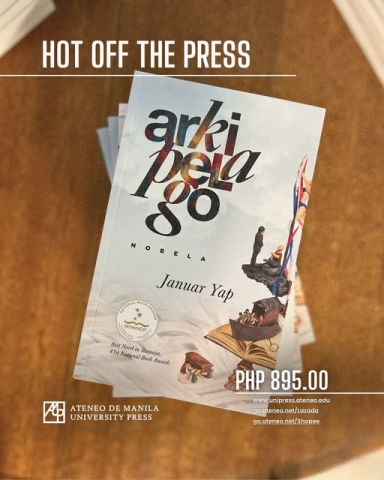
[Hot Off the Press] Arkipelago
New book from the Ateneo Press Arkipelago provides a fascinating and fantastical twist on Philippine politics and history Our country is an archipelago of stories
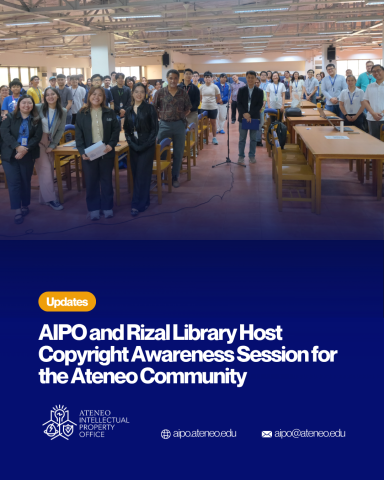
Protecting Creativity: AIPO and Rizal Library Host Copyright Awareness Session for the Ateneo Community
On March 18, 2026, the Ateneo Intellectual Property Office (AIPO), in collaboration with the Rizal Library, successfully conducted a Copyright Awareness Session held on the
Holy Week 2026 Holidays (Memo # UHR2526-038)
Memo # UHR2526-038 31 March 2026 TO: All Employees FROM: [Sgd] Maria Victoria T Cortez, PhD Vice President for University Human Resources SUBJECT: Holy Week
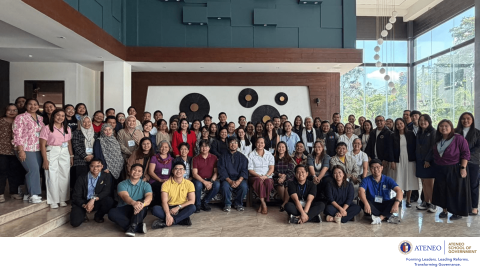
ASOG’s Tobacco Control initiatives spotlighted in DOH National Technical Working Group for Tobacco Prevention and Control
On March 10 to 12, 2026, the Ateneo School of Government (ASOG), through its research and public policy unit, the Ateneo Policy Center, participated in
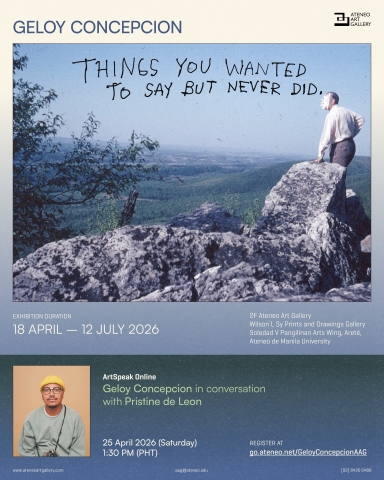
Things You Wanted to Say But Never Did: Geloy Concepcion’s six-year project makes Its exhibition debut at the Ateneo Art Gallery
Geloy Concepcion’s Things You Wanted To Say But Never Did comes to the Ateneo Art Gallery this 18 April 2026. After receiving almost 300,000 messages
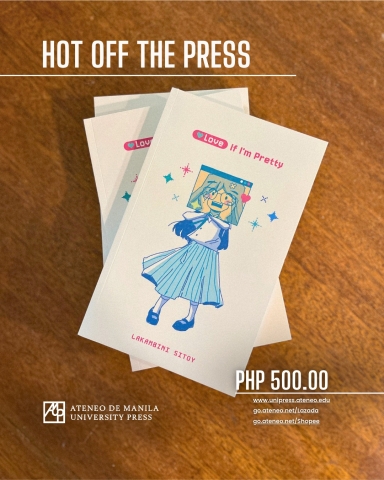
[Hot Off the Press] Love If I'm Pretty
New YA Release from the Ateneo Press Love If I’m Pretty tackles the nuances of growing up through complex characters and straightforward prose What do