[Ateneo Press Review Crew] Stories Hold Power—And So Do the Women Who Tell Them
16 Jun 2025 | Arienne Therese Guinto



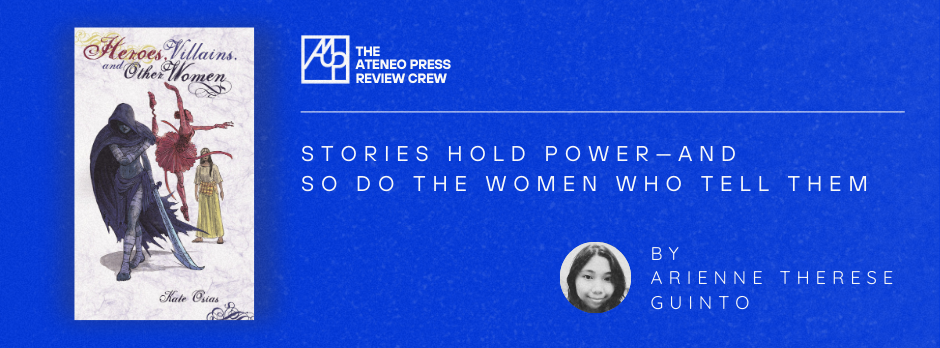
Stories have always been sites of resistance. Whether through myths repurposed, fairy tales unraveled, or histories rewritten from the margins, storytelling has long been a battleground where the silenced claw their way into speech. Kate Osias’ Heroes, Villains, and Other Women understands this well, offering not just a collection of stories but an interrogation of power, myth, and womanhood—crafted through the lens of fantasy, science fiction, and the uncanny.
The collection gathers a series of speculative tales that explore the shifting roles of women as heroes, villains, and everything in between. Osias reimagines myths, folklore, and genre conventions to challenge the narratives that have shaped women’s identities. Some stories pull from history, others from the realm of the fantastical, but all wrestle with the constraints imposed upon women and the ways they resist. Through magic, rebellion, and survival, these characters navigate landscapes both imagined and painfully familiar, mirroring the struggles of real-world women who must contend with the weight of expectation and the consequences of defiance.
Reading this collection feels like moving through a hall of mirrors, with each story reflecting a different facet of women’s experiences, but none offering a simple, singular truth. These are tales of warriors and lovers, gods and mortals, rebels and victims, but none fit neatly into their assigned roles. A heroine may have to become a monster to survive, a villain may be merely someone rewriting her own fate, and the lines between myth and memory blur in ways that feel both fantastical and devastatingly real. In Silang, we see a woman’s body turned into both a battleground and a legend, her transformation echoing the violent reshaping of history itself. The Maiden’s Song reminds us of the power of voices long buried, weaving a tale where a song becomes both resistance and reclamation. Meanwhile, The Secret Adobo Wars brings a sharp, satirical edge to questions of identity, inheritance, and the absurdity of cultural gatekeeping. Osias plays with the familiar—reimagining folklore, sci-fi archetypes, and literary tropes—but bends them to reveal something deeper: the insidious ways women’s agency is stolen, the stories that bind them, and the quiet (or not-so-quiet) rebellions that shape their lives.
What makes the collection particularly gripping is how it wrestles with the weight of storytelling itself. Whose stories are told? Who gets to be a hero, and who is cast as the villain? These questions feel especially urgent in a time when historical revisionism runs rampant, when the powerful seek to rewrite the past to serve their own ends. The book lands in a political moment where narratives are wielded as weapons—where governments erase the struggles of the oppressed, where the myth of progress is used to mask continued exploitation, where women’s roles are dictated and then punished when they step beyond them. In this sense, Osias’ work is not merely speculative fiction; it is deeply, unflinchingly political.
Yet, the collection is not simply about resistance—it is also about the cost of it. Many of Osias’ protagonists are women who make impossible choices, who carry the weight of survival in worlds that offer them no easy paths. Departures lingers in the space between longing and loss, showing how even escape carries its own grief. Rescuing the Rain God presents a hero’s journey where salvation is not just about saving another but reclaiming the self. This makes the collection profoundly relevant, particularly when looking at the ongoing struggles of women under regimes that tighten their grip through policies that shrink freedoms, criminalize dissent, and frame resistance as villainy. Here, the label of “hero” or “villain” is a matter of perspective—an observation that feels chillingly relevant in a time when activists, feminists, and truth-tellers are vilified while those in power reshape history to cast themselves as saviors.
As a woman navigating a world where narratives are often weaponized, I felt an acute recognition in these pages: the weight of unspoken histories, the defiance woven into every act of survival. Osias’ stories evoke the same urgency I feel when witnessing women stand their ground despite forces determined to erase them. And perhaps that is why this book resonates so deeply—not just for those who see themselves in its pages, but for anyone willing to confront the biases embedded in the stories they have been told.
But Osias does not only dwell in the grim and the tragic. There is also tenderness here—moments of fierce love, unexpected joy, and a reclamation of the self that defies categorization. In this way, Heroes, Villains, and Other Women resists the easy dichotomies of heroism and villainy, showing instead the messy, complicated, and deeply human ways in which women carve out space for themselves in an unforgiving world.
Stylistically, Osias’ prose is elegant and evocative, shifting seamlessly between lush, poetic passages and sharp, cutting truths. The stories are immersive, though some demand patience, requiring the reader to sit with discomfort, to rethink what they assume about power and gender. It is not a difficult read in the sense of complexity, but rather in its unflinching look at the ways women are made and unmade by the narratives around them. Some stories grip instantly, others linger, unfurling their impact only after reflection. This is a book that rewards the reader willing to engage deeply not just consume, but to witness.
It is precisely this complexity that makes the collection vital. It refuses to be boxed into neat categories, much like the women it portrays. And in a time when narratives are being weaponized to control, to erase, to dictate who gets to be remembered and how, reading stories like these is an act of defiance. Because in the end, the battle over stories is a battle over truth. And Osias, through her brilliant and subversive storytelling, reminds us that truth—however fragmented, however reimagined—will always find a way to surface. And perhaps, in reading these stories, we are reminded that the fight to reclaim our own narratives is not just necessary—it is inevitable.
Read between the lines of myth and memory. Get your copy here: Website | Shopee and Lazada
Arienne Therese Guinto is a people's researcher at the Institute for Nationalist Studies, with a background in Human Ecology. She critically engages with public policy, disaster resilience, feminist thought, grassroots organizing, and nationalist movements, emphasizing the intersections of power, resistance, and social transformation. In her capacity as a reviewer, she seeks to interrogate dominant narratives, foreground marginalized perspectives, and contribute to a more critical and emancipatory discourse in literature and scholarship.
Recent News
You may also like these articles
[Hot Off the Press] Arkipelago
New book from the Ateneo Press Arkipelago provides a fascinating and fantastical twist on Philippine politics and history Our country is an archipelago of stories
Protecting Creativity: AIPO and Rizal Library Host Copyright Awareness Session for the Ateneo Community
On March 18, 2026, the Ateneo Intellectual Property Office (AIPO), in collaboration with the Rizal Library, successfully conducted a Copyright Awareness Session held on the

Things You Wanted to Say But Never Did: Geloy Concepcion’s six-year project makes Its exhibition debut at the Ateneo Art Gallery
Geloy Concepcion’s Things You Wanted To Say But Never Did comes to the Ateneo Art Gallery this 18 April 2026. After receiving almost 300,000 messages
[Hot Off the Press] Love If I'm Pretty
New YA Release from the Ateneo Press Love If I’m Pretty tackles the nuances of growing up through complex characters and straightforward prose What do
[Hot Off the Press] the end comes on without a gasp
the end comes on without a gasp: Trish Shishikura’s debut poetry collection arrives from Ateneo de Manila University Press (Bughaw) Ateneo de Manila University Press
QS Subject Rankings 2026: Ateneo in top 100 for theology; ranked in 7 subject areas
Ateneo de Manila University is among the top institutions in seven subject areas, and among the top 100 for theological and religious studies, according to