[Ateneo Press Review Crew] Reclaiming Forgotten Lives in Vin dela Serna Lopez’s 1762
01 Aug 2025 | Des Suarez



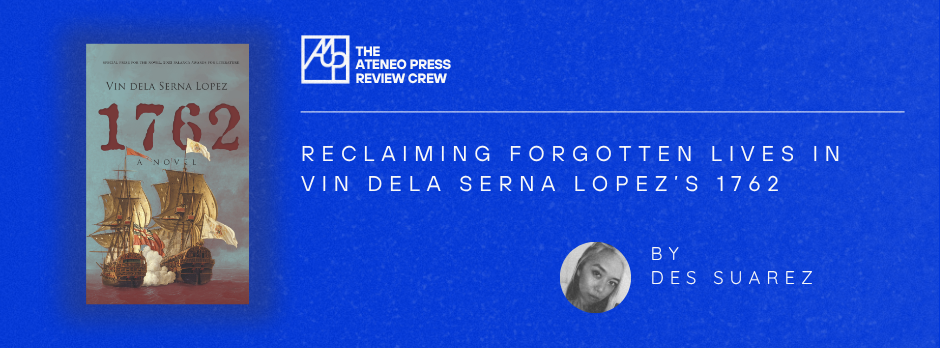
What is the difference between a historian and a fictionist? Both take reality and shape it into narrative. Both have to make a decision on what to include and what to leave out. They have to choose a beginning, and they have to choose an end. Everything in between is, likewise, the result of many little decisions made in order to make the narrative seem coherent. Both have biases that influence these decisions. With each voice that they chose to amplify, many conflicting or even concurrent voices have to be silenced, too.
The difference between a historian and a fictionist is that history presents itself as fact - as something complete, objective, and verifiable. Fiction has no such illusion; it is an act of imagination, and because of this, fiction is better suited to approach what history cannot hold: the silences, contradictions, and emotional truths that resist neat documentation. Fiction is able to dwell in uncertainty, imagine what was left out, and give shape to what was never allowed to take form. In this way, fiction does not compete with history, it challenges its limits, and sometimes, it answers its failures.
Vin dela Serna Lopez’s gripping and incisive 1762 exemplifies fiction’s function to step in where history has gone quiet. It is one of my favorite questions to bring up about our history: did you know that we were almost colonized by the British? “Really?” is the most common answer, and that’s fair enough because it was a relatively brief period from 1762-1764, but for dela Serna Lopez, it was nevertheless a consequential chapter in our national story.
The novel recounts the British arrival on Philippine shores, their violent seizure and pillaging of Intramuros and surrounding areas, and the chaotic response from the Spanish colonial government. In the middle of this battle between two imperial powers, dela Serna Lopez also follows a group of Filipinos from Cavite who attempt a revolt of their own. Like any good historical novel, 1762 blends the sweep of politics with the intimacy of character: romance, personal ambition, and conflicted loyalties heighten the drama without ever distracting from the deeper questions.
1762 doesn’t simply follow the arcs of revolt or conquest. It turns its attention to those caught in the teeth of empire: the natives forced into unpaid labor and tortured if they resist; the Chinese migrants confined to ghettos, forever suspected as future traitors; the mestizos trying to find a place to belong in their racially complicated world; and even the well-off Filipinos have had their whole lives dismantled by colonial manipulation. Dela Serna Lopez paid attention to the lives that history tends to flatten in service of the bigger picture. In doing so, dela Serna Lopez captured the way that “Filipinas” functioned not as a unified colony, but as a layered, fragile economy built on exploitation based on a rigid racial hierarchy. He was able to show how the Spanish–and later the British–turned their backs on the very people whose labor, trade, and suffering made the colony a profitable prize in the first place.
Another thing that I appreciated, and maybe even admired the most, was how dela Serna Lopez wrote about women. In a world already shaped by colonial violence, they were doubly, even triply oppressed: by race, by class, by gender. The novel doesn’t push them to the margins or just use them to add emotional weight to the men’s conquests. It bears witness. As a reader, I was presented with that impossibility: how little control women back then had over their own lives, how their futures are decided for them, how their bodies are negotiated by men, how silence becomes both punishment and protection. Yet they were not just put there to suffer. They make equally impossible choices; they try to survive anyway. As a woman, I found myself holding onto dela Serna Lopez’s female protagonists long after I finished reading, not because they were tragic, but because they were real. It has made the novel resonate on a more intimate level for me.
Ultimately, the result of the care that dela Serna Lopez has given to the depiction of these many characters’ lives is a kind of national thesis. 1762 suggests that the Filipino wasn’t forged in a single revolution, but in a protracted fight for freedom and national identity that has lasted to this very day. There is a magical chapter that demarcates the arrival of the British. In the middle of the action, dela Serna Lopez interrupts his own story in order to retell an event that wouldn’t happen until 134 years later: that of the assassination of our national hero, the alleged “First Filipino,” Jose Rizal. The historian has called him the messiah, but the fictionist, by imagining him alongside others who fought for our national identity, is able to turn him into a voice in harmony with the many others who struggled, resisted, endured, and dreamed of freedom. Vin dela Serna Lopez’s 1762 insists that no single life can carry the burden of a nation. It makes heard these silenced voices from history not only so that we can hear them again today, but so that we can carry them forward into the future.
Vin dela Serna Lopez’s 1762 may well be one of the most important books of the decade. Every Filipino should read it.
Grab your copy in paperback: Website | Shopee and Lazada

Des Suarez is an MA Literature student at the University of San Carlos. She graduated cum laude with a BA in Mass Communication from the University of Philippines Cebu in 2019. Outside of her studies, she runs the subreddit and book club r/Cebooklub for a small community of readers in Cebu City.
Recent News
You may also like these articles
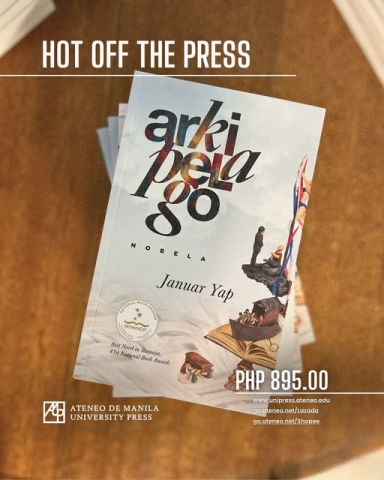
[Hot Off the Press] Arkipelago
New book from the Ateneo Press Arkipelago provides a fascinating and fantastical twist on Philippine politics and history Our country is an archipelago of stories
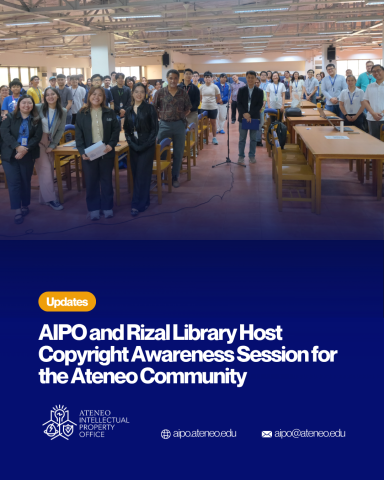
Protecting Creativity: AIPO and Rizal Library Host Copyright Awareness Session for the Ateneo Community
On March 18, 2026, the Ateneo Intellectual Property Office (AIPO), in collaboration with the Rizal Library, successfully conducted a Copyright Awareness Session held on the
Holy Week 2026 Holidays (Memo # UHR2526-038)
Memo # UHR2526-038 31 March 2026 TO: All Employees FROM: [Sgd] Maria Victoria T Cortez, PhD Vice President for University Human Resources SUBJECT: Holy Week
ASOG’s Tobacco Control initiatives spotlighted in DOH National Technical Working Group for Tobacco Prevention and Control
On March 10 to 12, 2026, the Ateneo School of Government (ASOG), through its research and public policy unit, the Ateneo Policy Center, participated in
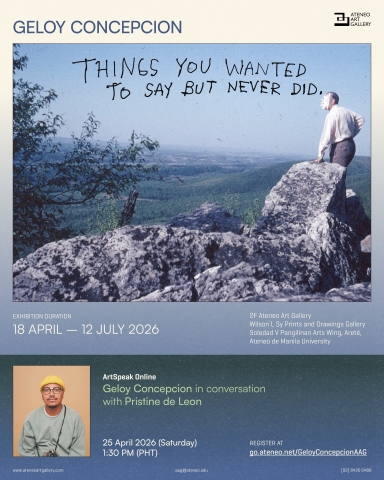
Things You Wanted to Say But Never Did: Geloy Concepcion’s six-year project makes Its exhibition debut at the Ateneo Art Gallery
Geloy Concepcion’s Things You Wanted To Say But Never Did comes to the Ateneo Art Gallery this 18 April 2026. After receiving almost 300,000 messages
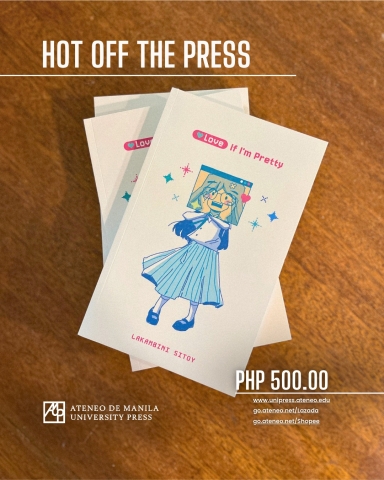
[Hot Off the Press] Love If I'm Pretty
New YA Release from the Ateneo Press Love If I’m Pretty tackles the nuances of growing up through complex characters and straightforward prose What do