[Ateneo Press Review Crew] Abaca Frontier: History’s Rope-line
04 Aug 2025 | Abigail C. James







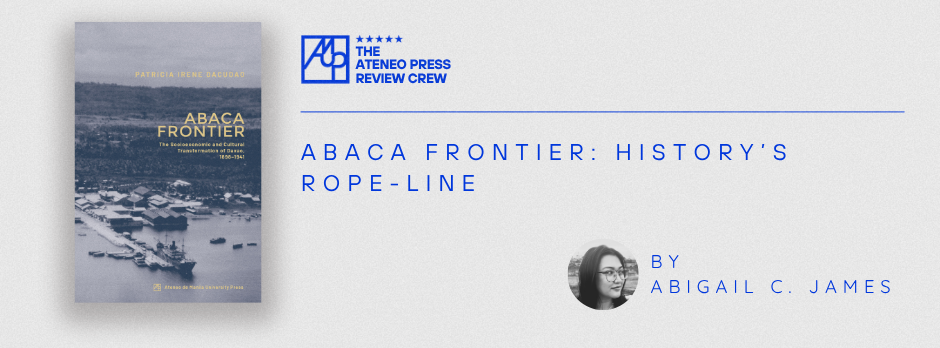
On my second trip to Davao in 2015 for the Philippine International Literary Festival, I realized, with some surprise, how culturally diverse the city was. No longer housed in a hotel tucked away from the city proper like I was for my first foray (attending the Davao Writers Workshop in 2014), I, along with two other friends from Cagayan de Oro, got to see more of the city. We were invited to a slam poetry event called LitOrgy, hosted by the Davao Writers Guild and Young Davao Writers. A friend from the workshop took us to an area of rooftop bars that operated with caution because of the city curfew. We encountered a number of different groups, including a cohort of young Indian men looking for the next gig, a sight not common in CDO. After LitOrgy, I began to understand the city’s slogan of “Life is Here” a bit more. Reading Abaca Frontier by Patricia Irene Dacudao deepened this conception of Davao through an unexpected lens: plantation crops.
As a Mindanaon, I find our history so precious, almost delicate, like it can slip through fingers if you don’t pay attention. There are so many things not taught to us because of the notion that it was all happening somewhere in the north. Philippine history as we know it was shaped by the movers and actors who spoke a different language. The rest is folk tale, regional, less significant. It takes a more scrutinizing eye to disprove this notion, something Dacudao achieves in her thorough account of Davao’s progress from 1898-1941 through the chronicling of the abaca trade. Her meticulous research, that included scouring through American archives for mentions of Davao along with painstaking contextualization to deepen her findings, results in an exhaustive narrative of an otherwise forgotten age.
Davao re-entered the contemporary consciousness in 2016. Around that time, I even saw a meme where someone flipped the Philippine map upside down and declared that with the election of Duterte, Mindanao would come out on top. And fair enough, the other cities in this island group have always looked to Davao as its premier, being the only official metropolitan area. Abaca Frontier explains the origins of this rise more than a hundred years in the making.
For those who don’t know (as I didn’t), abaca became a priority export crop after the Americans, during their surveying of Mindanao’s east coast, noticed indigenous clothing made from the material. They soon developed it into what would be called Manila hemp, used for ropes in naval rigging. As more land became converted towards abaca plantations, Davao became the largest producer and exporter of Manila hemp in various qualities, rivalling previous sites further north. This invited foreign and regional migrants to find fortune on the new frontier.
Pervasive throughout Dacudao’s account is the American colonial presence. Though Filipinos know by heart our three colonizers, America often gets the middle child treatment. The implementation strategies of its colonial rule are seen in a positive manner (most of all by the Americans themselves). America “gave” us democracy, the public school system, the eventual global lingua franca. They even named it “benevolent assimilation.” Perhaps this outlook stems from the traumatic events of Japanese occupation. However, it’s important to acknowledge that though American rule facilitated the development of Davao through its plantation system, there was still a level of exploitation happening. Indigenous land was converted to accommodate market trends and instead of food, export crops like abaca were prioritized. The book points out several times how the Americans employed the same tactics previously used in overtaking the western frontier from Native Americans.
With that said, it is interesting to know that the Davao coast was generally more welcoming of the American presence, though not without pockets of resistance in times of cultural clashes. This attitude is contrasted with Misamis (where CDO is located) that rebuked the secondary colonizers in the Philippine-American war. Davao and its indigenous population were more receptive to contact, forging bonds with government agents and even anthropologists who came to study the cultural practices of the Manobos, Bagobos, Mandayas, among many other ethnic groups that lent to the land’s diversity. The photo of Sarah Metcalf sitting among the Bagobo in their indigenous garb is one of the striking images included in this book, showing that despite differences, empathetic bonds could be created between cultures. Another delightfully surprising detail is how well paid harvesters of abaca were due to the scarcity of labor. Though capitalist interests were at work, landowners had no choice but to give high wages or else be left with no workers.
My favorite section of Abaca Frontier was undoubtedly Part 3: Creating Culture. Here Dacudao illustrates the cultural impact created by the abaca economy in Davao. The author goes into the human aspect of the abaca trade, and how it created an intermingling between Filipinos, Americans, and Japanese. The latter had a significant presence in Davao, particularly following the implementation of the pakyaw system that gave them more incentive to plant and harvest export crops. This mix of peoples and cultures was instrumental to the progress of the city and created a sort of microcosm separate from the national. When the “Davao Land Problem” became a hot topic among politicians from the central insular government, Filipinos and Japanese alike held the line to protect their assets. These events fostered a closer connection among those in Davao, even lulling them slightly as World War II approached.
I chose to review this book because I no longer wished to be ignorant about Mindanao, though I am from here and have lived here most of my life. I encourage anyone curious about our country’s past to take the time and explore the overlooked stories. Davao was significant long before the 2016 election, before certain personalities came to power. Though this book is a lengthy read, I think that’s what good history should be. Abaca Frontier does its due diligence and invites more people to grasp history in their hands, like the sturdy rope made from abaca.
Grab your copy in paperback: Website | Shopee and Lazada
Abigail C James is the Director of Creative Development at Nagkahiusang Magsusulat sa Cagayan de Oro (NAGMAC). She holds a Master of Arts in English Language from Xavier University - Ateneo de Cagayan and is currently pursuing her PhD in Literature at De La Salle University Manila.
Recent News
You may also like these articles
[Hot Off the Press] Arkipelago
New book from the Ateneo Press Arkipelago provides a fascinating and fantastical twist on Philippine politics and history Our country is an archipelago of stories
Protecting Creativity: AIPO and Rizal Library Host Copyright Awareness Session for the Ateneo Community
On March 18, 2026, the Ateneo Intellectual Property Office (AIPO), in collaboration with the Rizal Library, successfully conducted a Copyright Awareness Session held on the
Holy Week 2026 Holidays (Memo # UHR2526-038)
Memo # UHR2526-038 31 March 2026 TO: All Employees FROM: [Sgd] Maria Victoria T Cortez, PhD Vice President for University Human Resources SUBJECT: Holy Week
ASOG’s Tobacco Control initiatives spotlighted in DOH National Technical Working Group for Tobacco Prevention and Control
On March 10 to 12, 2026, the Ateneo School of Government (ASOG), through its research and public policy unit, the Ateneo Policy Center, participated in
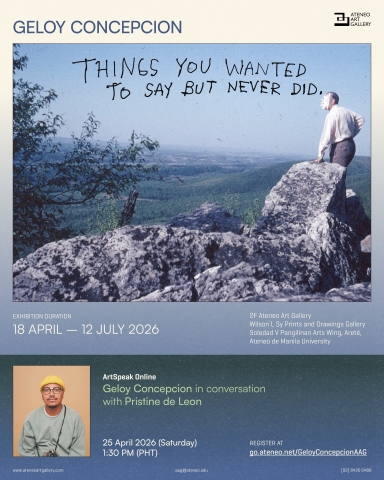
Things You Wanted to Say But Never Did: Geloy Concepcion’s six-year project makes Its exhibition debut at the Ateneo Art Gallery
Geloy Concepcion’s Things You Wanted To Say But Never Did comes to the Ateneo Art Gallery this 18 April 2026. After receiving almost 300,000 messages

[Hot Off the Press] Love If I'm Pretty
New YA Release from the Ateneo Press Love If I’m Pretty tackles the nuances of growing up through complex characters and straightforward prose What do