[Ateneo Press Review Crew] Fossils, Folklores, and the Filipino: Resil Mojares’ Enigmatic Objects as a Reclamation of the Stolen World
04 Aug 2025 | Andrea Genesis Sobremonte




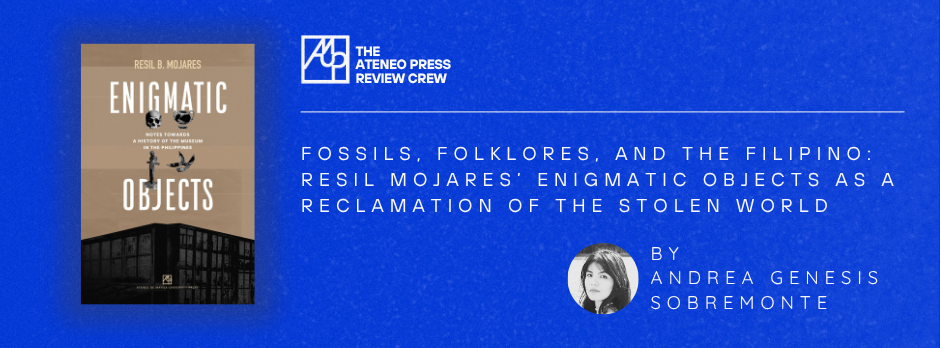
Resil Mojares’s Enigmatic Objects is a book that doesn’t just recount history, it also recovers the feelings and the forgotten frameworks through which our history has been told. What stood out most to me was not merely the stories of old museums, or the peculiarity of teapots carved from coconut shells. It was the way Mojares compels us to reflect on what we think we know. Every object in this book, whether skull or statue becomes a mirror that reflects not just the empire that framed it, but the viewer who looks back.
What makes Enigmatic Objects remarkable is how it transforms the act of collecting into a site of inquiry. We are made to ask: why were certain things preserved and others erased? Who held the power to decide? The themes that gripped me most were the collisions between science and superstition, and colonizer and colonized.
At its core, this book is about how museums and libraries we often treat as neutral have served as battlegrounds where the Filipino identity was dissected, displayed, and sometimes even distorted. In a present moment where historical revisionism festers and collective memory is commodified or manipulated, Enigmatic Objects feels painfully urgent because it reminds us that the struggle to tell our story has always been a struggle for truth.
I chose to focus on the essays “The Filipino as Collector” and “Four Ways of Looking” because these essays refuse to see history as static. They illuminate how the objects that are seemingly silent and still carry the consideration of how we, too, become both collectors and exhibits in the story of nationhood.
Enigmatic Objects is not just about artifacts; it is about us. Our ways of seeing, our hunger to know, and our responsibility to remember. What Mojares has given us is not simply a book, but a carefully arranged room of questions. And in walking through it, we begin to understand: the archive is not closed. We are still curating the future from the ruins of the past.
THE FILIPINO AS A COLLECTOR
"What we collect, preserve, and display says a great deal about who we are."
But perhaps even more telling is how we collect, under what weight, against which currents, and in whose language. To collect is never neutral. It is a gesture of care, yes—but also of memory and survival. Especially for the colonized, the act of collecting carries a double charge: to resist.
In the imperial imagination, it is always the colonizer who does the gathering. They name, classify, catalogue, and claim authority not only over the object, but over the world that object comes from. The colonized, meanwhile, are the ones collected: bodies, artifacts, stories pinned and boxed behind glass. In this light, to collect as a Filipino during and after empire is not merely an archival impulse, it is a reclamation of voice.
This is what makes José Rizal, for Mojares, a figure of such radical possibility. In annotating Sucesos de las Islas Filipinas, Rizal was drafting a counter-narrative: a shadow history, as Mojares calls it. Not only a history of the Philippines, but a history for it.
Rizal’s dream of a museum wasn’t glass cases and dusty halls curated by foreign hands. It was an act of sovereignty: an independent museum that would serve not the empire but the people. Here, the act of collecting becomes a right to remember on one’s own terms.
But Rizal wasn’t the first to dare such a gesture. Long before his annotations, in the town of Gasan, a humble priest named Father Clemente Ignacio was already building a kind of proto-museum inside his home. The French naturalist Alfred Marche stood stunned before his collection of shells, santos, music boxes, clocks, beetles, all tumbling into what Mojares calls a “promiscuous” assemblage.
This wasn’t science and order. It was something stranger and more subversive. It said: I, too, can marvel. I, too, can know. For Ignacio, collecting became a mode of self-fashioning and to gather was to assemble a self in defiance of erasure. In a world where the colonized are always being sorted, simplified, and stripped of interiority, Ignacio’s collection was a kind of declaration: I contain multitudes.
There is also Trinidad H. Pardo de Tavera, who is more formal, more meticulous, but no less haunted by colonial institutions, although fiercely protective of Filipino cultural memory. Among his porcelains and portraits, one senses a tension: What does it mean to collect the remnants of the empire that shaped and warped you?
Mojares offers a poignant answer: perhaps, in Pardo de Tavera’s case, collecting was a way to preserve a heritage that defined him, even as it threatened to consume him. In recovering rare books, maps, and manuscripts, he wasn’t simply building a library. He was fighting for continuity in a country designed for forgetting.
He knew the odds. “There is no house there that has not been completely burned twice in the course of fifty years,” he wrote as he was describing a material reality in which history is always on the verge of ash. Preservation, then, becomes an act of desperation.
Pardo stitched native fabrics into his pamphlets to protect them from pests. He scattered peppercorns inside his rare volumes to ward off decay. Every act of care was resistance and every attempt at preservation was a battle against a system that rendered Filipino culture either a quaint curiosity or an aristocratic luxury.
But Mojares doesn’t stop there. Into this carefully arranged gallery, he throws the unruly, impassioned presence of Isabelo de los Reyes. If Pardo is museum glass, Isabelo is folklore shouted in the streets. His Folk-Lore de Filipinas aspired to gather everything—agriculture, anthropology, religion, language, music, and myth. It was not for display, but for remembrance.
Isabelo’s museum had no walls. It lived in books, performances, and oral traditions. His archive was less a catalogue and more of a chorus that was messy, ambitious, overflowing.
And yet, the tragedy: even this radical, breathing archive was boxed and exhibited at the 1887 Madrid Exposition, not as knowledge but as specimen. The Filipino, once again, reduced to artifact. Even when we curate ourselves, the colonial gaze remains.
But Isabelo fought that gaze. He wrote feverishly, with urgency and love, documenting rituals no one thought to preserve. He sensed, perhaps too clearly, what would be lost. He knew the stone churches would last, but not the wooden shrines, the chants, the names of things in dying tongues. He wrote to rescue what he could.
And this, perhaps, is the heart of the essay: that for the Filipino, collecting is never just about the object. It’s about the act. To collect is to resist oblivion. To piece together what empire shattered. To rethread a self, a people, a story.
Still, Mojares is teary-eyed. He knows that many collections have been lost. Ignacio’s beetles now sit in Paris. Pardo’s manuscripts had to be reclaimed from foreign archives. The colonial machine doesn’t stop just because the collector is Filipino.
Intention will endure because in a world that demands forgetting, the most radical thing a Filipino can do is refuse to forget.
FOUR WAYS OF LOOKING
How late is late when we remember to look again?
In Four Ways of Looking, Resil Mojares begins with a marine mammal and ends with a mirror. What first appears to be a zoological profile unfolds slowly into a postcolonial allegory. The dugong, at first described in the language of science, is transformed across the essay into something far more profound: not just a creature of legend, but a cipher of empire; not simply a species, but a metaphor for the Filipino.
There is a deceptive stillness in how the essay begins. The dugong is catalogued with precision: its vertebrae, its tusks, its teats. But even in this act of naming, something unsettling stirs. To name is to possess, as Glissant reminds us. And from the moment the dugong is rendered in the pages of colonial taxonomy, it is no longer only a sea cow—it is pexemulier, “woman fish,” “hogfish,” “sea pig.” It is folklore twisted into pathology, which legend has made legible by the scalpel. It is, in short, the beginning of the gaze.
Mojares does not offer a single way of looking, but five. Four are the ones we expect—scientific, folkloric, economic, and sentimental. But the fifth is the one that indicts. It is the look that returns.
To see the dugong is to also see ourselves. And what do we find?
In the imperial imagination, the dugong swims between the waves of curiosity and consumption. Its meat is carved and praised and its bones become rosaries, souvenirs, and scientific specimens. It is dissected in Manila and shipped to Batavia and made to perform in expositions, displayed in aquariums, packed in camphor glass, and even grotesquely fashioned into papier-mâché mermaids for public delight.
The essay does not only grieve what has been done. It also reveals what is lost in this process. “When the dugong is finally gone,” Mojares writes, “what becomes extinct is not just a species but a way of looking at the world.” This is the deeper tragedy because the extinction of the dugong signals the extinction of a gaze that once held the world in reverence. In its place, we inherited the gaze of conquest.
That gaze is still with us.
Today, the dugong is endangered, yet still featured on tourism brochures. It has become a mascot for marine conservation campaigns as a form of nostalgia. This echoes the modern Filipino experience. We, too, are endangered in another way—culturally fractured, politically co-opted, aesthetically marketed. The Filipino body is now curated for global attention: on TikTok, in diaspora museums, on fashion runways where the barong and the banig are exoticized anew. We have become fluent in how to be seen, we pose for the gaze, we perform for funding, and we archive our own image before someone else gets the chance to do it first.
The dugong swims in us.
It is the OFW cradling the weight of a nation she cannot see. It is the Lumad child filmed by journalists, a witness but never a speaker. It is the fisherfolk of Palawan whose stories are rarely heard, though they have known the dugong longer than any naturalist. It is also in the heritage artist pressured to “represent” culture, but only in digestible forms.
What Mojares offers is not an elegy, but a reckoning. To look again is not enough. We must look otherwise because not all creatures were meant to be caught and not all stories should end in glass.
And if the dugong is a mirror, may we, at last, refuse to blink.
Reading Enigmatic Objects is like stepping into an old room filled with dust and echo. The reader realizes the room is not empty, but alive with voices we have tried too long to forget. Resil Mojares does not shout history at us; instead, he whispers it through the contours of bones, shells, teapots, cabinets, and crocodile tears. And in this whispering, we begin to hear how the past is never really past.
It lingers, compels, and indicts.
This book could not be more relevant to the moment we live in. At a time when truth is flattened into spectacle, and history is either politicized or erased, Enigmatic Objects offers an act of deep remembering. In a world obsessed with progress, he asks us to pause and consider what we have abandoned in our rush to modernity. What kinds of knowledge have we overlooked? Whose stories have we shelved?
The reading experience is not easy, but it is rewarding. Mojares writes with intellectual rigor, but also with reverence. There are moments when the prose slows you down, insists that you sit with the discomfort of an unremarked collection. But these moments are necessary. This is not a book to skim through; it is a book to dwell in.
I would recommend Enigmatic Objects to those who are willing to unlearn. To readers who understand that the nation is not only built by revolutions and heroes, but also by habits of seeing, classifying, displaying, and defining what is worth keeping.
Mojares reminds us that buried beneath the vitrines, there are stories still waiting to be claimed. And if we dare to look closely, we might finally see ourselves.
Not as footnotes, but as the authors of our own wondrous, and still-unfolding story.
Grab your copy in paperback: Website | Shopee and Lazada

Andrea Genesis Sobremonte navigates the intersections of literature, culture, and storytelling with an inquisitive lens. A college instructor, and an MA candidate in Language and Literature at the University of the Philippines Baguio, she is fond of exploring gender studies and feminist studies, Ilocano studies, and pop culture. Committed to both advocacy and analysis, she believes literature behaves like a prism that refracts reality into different perspectives, while ultimately promoting emancipatory narratives.
Recent News
You may also like these articles
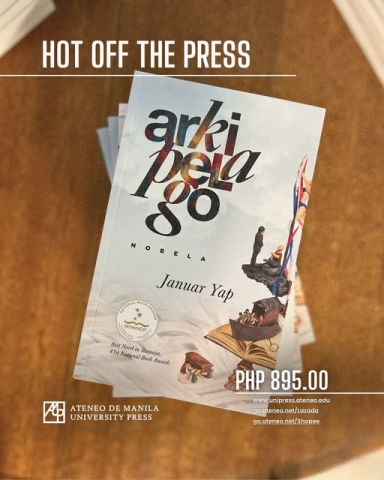
[Hot Off the Press] Arkipelago
New book from the Ateneo Press Arkipelago provides a fascinating and fantastical twist on Philippine politics and history Our country is an archipelago of stories
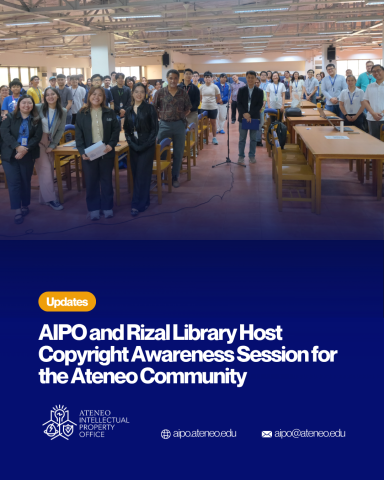
Protecting Creativity: AIPO and Rizal Library Host Copyright Awareness Session for the Ateneo Community
On March 18, 2026, the Ateneo Intellectual Property Office (AIPO), in collaboration with the Rizal Library, successfully conducted a Copyright Awareness Session held on the
Holy Week 2026 Holidays (Memo # UHR2526-038)
Memo # UHR2526-038 31 March 2026 TO: All Employees FROM: [Sgd] Maria Victoria T Cortez, PhD Vice President for University Human Resources SUBJECT: Holy Week
ASOG’s Tobacco Control initiatives spotlighted in DOH National Technical Working Group for Tobacco Prevention and Control
On March 10 to 12, 2026, the Ateneo School of Government (ASOG), through its research and public policy unit, the Ateneo Policy Center, participated in
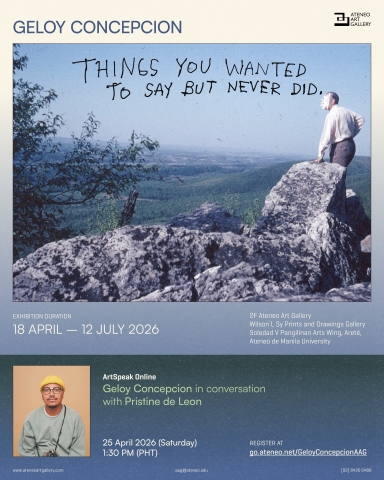
Things You Wanted to Say But Never Did: Geloy Concepcion’s six-year project makes Its exhibition debut at the Ateneo Art Gallery
Geloy Concepcion’s Things You Wanted To Say But Never Did comes to the Ateneo Art Gallery this 18 April 2026. After receiving almost 300,000 messages
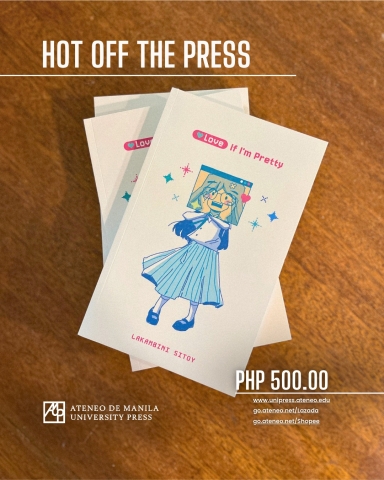
[Hot Off the Press] Love If I'm Pretty
New YA Release from the Ateneo Press Love If I’m Pretty tackles the nuances of growing up through complex characters and straightforward prose What do