[Ateneo Press Review Crew] Carlos Bulosan’s affectionate satire, and the inextricability of politics from the person
14 Aug 2025 | Tina Marañon




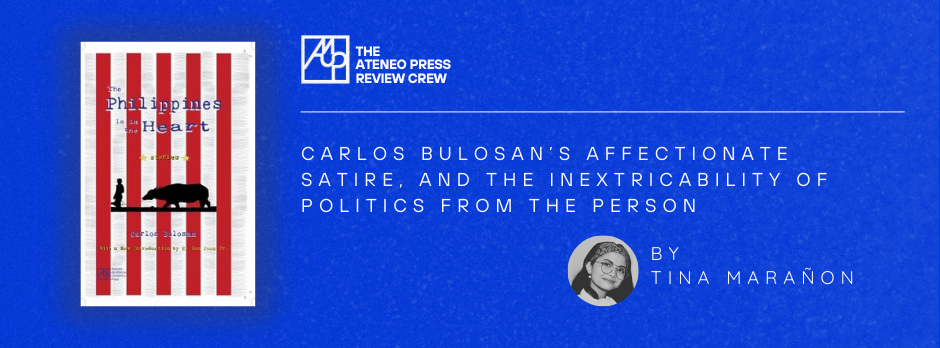
Before you get to Carlos Bulosan’s socialist politics, you must first grapple with his farmer’s heart.
When I first encountered Carlos Bulosan's work, I was a third year college student rushing frantically through the first chapters of America is in the Heart, gripped by the unblinking affection that colored Bulosan’s writing: a profound love for the land, deep reverence and respect towards his father’s unshakeable moral character, and an unwavering tenderness that seemed to weather him through even the most abject circumstances.
It was this deep enjoyment of his seminal work that ultimately piqued my interest in The Philippines is in the Heart, a collection of short stories that was first published just over two decades after Bulosan’s death in 1956. What greets readers here, however, is a sharper, more variegated Bulosan—whose provincial vignettes range from fantastical, even sentimental (“The Rooster’s Egg,” “The Summer of Beautiful Music,” “The Lonesome Mermaid”), to downright sardonic (“The Springtime of my Father,” “The Homecoming of Uncle Manuel”) in a charged indictment of the host of socio-economic aberrations that ailed the Philippine landscape during his time, and persist even to this day.
As always, Bulosan’s style is sumptuous—even his more absurd, sometimes upsetting shorts are, for lack of a better word, fun to read. Take “The Springtime of my Father,” for example, which directly follows what is perhaps the most reverent, straightforwardly sentimental items in the collection, and which I would personally place closest in overall tone and atmosphere to America is in the Heart, with a tale of an adulterous, lecherous farmer who lusts after his brother’s mistress, all told from the viewpoint of his young son.
The annotations penned breathlessly in the margins of this particular short range from, “oh lord,” “oh lord (2),” to “this is killing me,” and “a really fun way to describe vomiting and fainting, honestly”; which, as any annotation advocate can tell you, is as sure a way as any to tell that someone thoroughly enjoyed themself while reading.
As academic and writer Epifanio San Juan Jr. might agree, the content and style of this collection is by no means a full departure from that of Bulosan’s seminal work, but an extension of and elaboration on his experiences as a farmer’s son-turned-colonial-ward in the early 20th century, which led to his radicalisation and shaped his project as a Filipino writer.
I will admit that, prior to even drafting or outlining this review, I became overwhelmed with the need to highlight and unpack in painstaking detail the totality of this collection’s literary project—what San Juan identifies in his introduction as the “task of the carnivalesque satirist” (xxi), invoking Bakhtin's literary theory. I wanted to uncover wholly and completely the many evidences of Bulosan’s socialist convictions, his “radical edge” and otherwise “subversive qualities” (xxii) that conventional readings tend to discard. Eventually, however, I realized that the introduction does exactly that, more beautifully and comprehensively (and theoretically sound) than I could ever hope to be capable of.
So, I stick to what I know—and what I know is, Bulosan’s stories are the kind that grip the heart and rattle the mind. Their familiarity is a warning. It shouldn’t just tickle Filipino readers’ funny bones that the absurd hedonism, duplicity, and viciousness found in Bulosan’s Uncle Sator cycle are somehow immediately identifiable with the ethics of our current political landscape (or, rather, the void that often is found where ethics should be). It should raise a cacophony of red flags and warning signs, wailing over the land like a typhoon siren.
For the greater part of this collection, we watch as Bulosan’s narrator, nameless and ill-informed, steps deeper and deeper into the haphazardly knit web of his uncles’ loose morals and materialistic greed. Time and time again, the young boy—our surrogate just as much as Bulosan’s—falls into dishonesty and naivete of almost comic proportions, consorting with his Uncles Sator, Soyoc, and Sergio then betraying them in turns.
Bulosan’s tales, though some of fiction, are spun from the thread of his own life. To presume that Bulosan’s satirization of provincial poverty and the complex dynamics of intra-familial power play is intended as an expression of derision specifically towards the peasant class would be wildly errant. His material has always necessarily responded to the plight of the farmer and the working man as he intimately experienced it, both in the motherland and during his time as a colonial ward of the United States.
As much as his cartoonishly twisted characters may call to mind the odd government official (the image of Uncle Sator, for instance: a rich man amongst the poor, who routinely gorges himself on various meats and fine liquor as his family lives in squalor), the roles that they play in their stories can just as easily be identified with politico-economic dynamics that emerged within Bulosan’s historical milieu and have persisted since. What San Juan identifies as Uncle Sator’s “donor/villain function,” for instance, would seem to mirror the vampiric relation of the United States and the Philippines since the latter was annexed at the turn of the 19th century.
As I encounter it, Bulosan’s writing, its import and its impact lie inextricable from his politics, precisely because these are so closely wound to the fabric of his person. A farmer’s boy, Bulosan was never a stranger to the plight of the hungry, the economically disadvantaged, enslaved, and exploited peasant. This sensitivity to injustice only crystallized throughout the 20th century, rising to the surface in both his writing and his politics.
Yet the writing in this collection does not lose wholly the affectionate strain that first attracted me to Bulosan’s work: in “Rooster’s Egg,” a personal favorite, ritual and reverence for the land are passed down from the old to the young, from a father to his son. Here, a quietly unfurling love for the land and its creatures births also a love for its people:
“I knew, as the moon and the stars gazed down upon us on the earth, that I would always seek beauty and be kind to everyone.”
Grab your copy in paperback: Website | Shopee and Lazada

Tina Marañon is a Humanities graduate from the University of Asia and the Pacific whose most recent research venture looks at the value of attentiveness in informing pedagogical design and fostering student motivation. When not working on independent research or writing projects, she enjoys delving into media she missed out on in the early 2000s to 2010s—zipping through classics like Death Note, CW's Supernatural, and others similarly of the 2000s tumblerina haze.
Recent News
You may also like these articles
[Hot Off the Press] Arkipelago
New book from the Ateneo Press Arkipelago provides a fascinating and fantastical twist on Philippine politics and history Our country is an archipelago of stories
Protecting Creativity: AIPO and Rizal Library Host Copyright Awareness Session for the Ateneo Community
On March 18, 2026, the Ateneo Intellectual Property Office (AIPO), in collaboration with the Rizal Library, successfully conducted a Copyright Awareness Session held on the
Holy Week 2026 Holidays (Memo # UHR2526-038)
Memo # UHR2526-038 31 March 2026 TO: All Employees FROM: [Sgd] Maria Victoria T Cortez, PhD Vice President for University Human Resources SUBJECT: Holy Week
ASOG’s Tobacco Control initiatives spotlighted in DOH National Technical Working Group for Tobacco Prevention and Control
On March 10 to 12, 2026, the Ateneo School of Government (ASOG), through its research and public policy unit, the Ateneo Policy Center, participated in
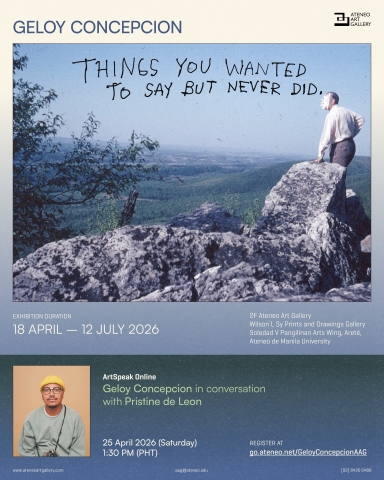
Things You Wanted to Say But Never Did: Geloy Concepcion’s six-year project makes Its exhibition debut at the Ateneo Art Gallery
Geloy Concepcion’s Things You Wanted To Say But Never Did comes to the Ateneo Art Gallery this 18 April 2026. After receiving almost 300,000 messages
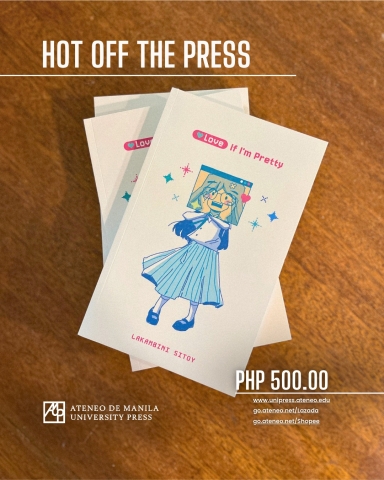
[Hot Off the Press] Love If I'm Pretty
New YA Release from the Ateneo Press Love If I’m Pretty tackles the nuances of growing up through complex characters and straightforward prose What do