[Ateneo Press Review Crew] The ghost in the hacienda: What Clash of Spirits teaches us about power
14 Aug 2025 | Arienne Therese Guinto







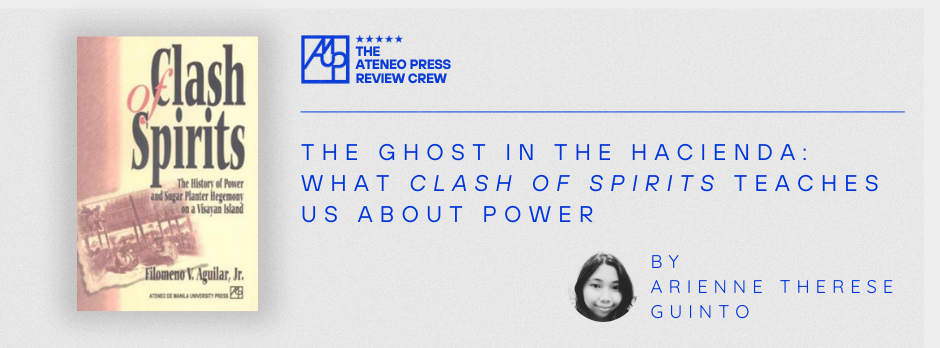
It’s not every day that a book about sugar, spirits, and power in the Visayas makes you rethink what history means, but this one did. When I first picked up Clash of Spirits, I expected an account of haciendas and class struggle, perhaps in the conventional sense. What I got instead was something deeper, messier, and much more surprising: a layered, dialectical history of how people made sense of their exploitation not only through labor and land, but through rituals, myths, and the unseen.
Clash of Spirits, published as the first major work of Filipino educator and scholar Filomeno V Aguilar Jr., is a historical sociology of the sugar industry in Negros from the Spanish colonial period through American occupation. Aguilar examines the formation of planter class power—how it was built, maintained, mythologized, and contested. He does this by fusing archival research with oral histories, local folklore, and ethnographic observation. What emerges is a portrait of a society where the supernatural coexists with capitalist development, and where domination is never absolute.
In the book, Aguilar delivers a masterclass in historical analysis that shatters the illusion of the hacienda system as a static, hegemonic monolith. With an acute sensitivity to both empirical rigor and cultural nuance, he presents a social history that breathes with contradictions, complexities, and struggles. The most compelling element of this book is how it foregrounds the ideological and symbolic terrain in the making of capitalist hegemony in Negros: a history haunted not only by global economic structures but also by spirits, myths, rituals, and everyday social relations.
Rather than treating culture as a passive backdrop to class relations, Aguilar leads the reader into moments where ideology becomes tangible and contested. He recounts how Protestantism and Freemasonry, filtered through local consciousness, came to signify not just religious difference but foreign threat and domination. Naming conventions and gambling rhythms become lenses into how people negotiated identity and imagined alternatives to planter rule. These are not cultural side notes; instead, they are the very texture of how meaning, power, and resistance took form. The book does not shout these connections, but threads them subtly, encouraging readers to notice what often goes unnoticed.
From the very first pages, I was pulled into the surreal yet historically grounded anecdote of a sugar mill explosion—a result, workers believed, of the neglect of the ritual daga. This ritual, rooted in indigenous Visayan belief systems, was performed to appease spirits before beginning the use of a new structure or machine. It reflects a broader indigenous knowledge system that understood the world as spiritually inhabited and morally ordered, and which demanded respect even in the most modern, industrial settings. The story opens up an entire world of alternative rationalities: where machines and spirits intersect, where capitalism's material infrastructures are woven into cosmologies, and where workers insist on respect for both the laws of labor and the laws of the unseen. It sets the tone for a book that refuses to dismiss these narratives as superstition. Instead, Aguilar centers them as legitimate ways of knowing, ways of navigating and making sense of oppression.
This is where the book succeeds most brilliantly. It does not view culture as secondary to material conditions, nor does it romanticize indigenous knowledge. It treats culture as a living, changing force; a site of both subjugation and resistance. The concept of "Masonic Capitalism" is a particularly striking innovation. Aguilar traces how planters and foreign traders were perceived by the masses as agents of evil, coded as Masons, Protestants, or even demons. Rather than dismissing this as ignorance, he unpacks it as a historical consciousness shaped by colonial experience. This approach gives the book a rich complexity, showing how ideology, religion, and the supernatural have been mobilized to understand and contest capitalist exploitation.
Aguilar is clearly responding to a long-standing problem in Philippine historiography and sociology, which is the tendency to depict the masses as voiceless victims. He takes direct aim at static depictions of Negros society as simply "feudal" or unchanged for centuries. While not dismissing structural inequality, he challenges us to see the fluidity within it: shifting alliances, negotiated spaces of agency, and the subtle forms of rebellion that erupt even in everyday life—in the way people gamble, name their children, or tell stories. He insists that the past is not just about what happened, but how people made meaning out of what happened.
That said, there were parts of the book I found challenging, and I say this with deep respect for the author’s commitment to complexity. The writing style can be dense, and some sections (especially the early theoretical framing) may require more time and care to fully absorb. I sometimes found myself pausing, rereading, cross-checking, especially as someone more attuned to historical narrative than academic theory. But I do not see this as a flaw. If anything, it is a reminder that the kind of historical work Aguilar is doing here isn't meant to be easily digested. It is meant to be wrestled with.
There are also interesting tensions in how the book navigates indigenous knowledge systems. Aguilar makes it clear he doesn't want to romanticize them, but there are moments where his presentation comes close to doing so. Still, this doesn't feel like a shortcoming to me. Writing about the symbolic and the spiritual is inherently difficult, and I find it meaningful that Aguilar takes on that challenge with care and thoughtfulness. Rather than diminish the work, these tensions make it more layered and thought-provoking.
In terms of relevance, Clash of Spirits is indispensable. In our era of resurgent authoritarianism, elite impunity, and rural neglect, Aguilar’s work is a reminder that our history is not just one of heroes and villains, but of systems, symbols, and struggles that endure. As debates rage over agrarian reform, regional inequality, and the cultural roots of corruption, this book equips readers to think more historically and more dialectically. It resonates beyond Negros, offering insights into the political economy of culture and the cultural economy of politics.
More importantly, it invites anyone (activist or academic, student or cultural worker, rural or urban Filipino) to reflect on what it means to understand a society not only through policy or economy, but through the spirits it remembers, the debts it negotiates, the language it uses to name its pain and aspirations. Aguilar shows us that these "non-rational" aspects of life are not marginal; they are central to how power is lived, contested, and remembered.
It is the kind of book that doesn’t just leave you with more knowledge, but with more questions and a deeper sensitivity to how people live through systems of power. Whether you're reading it for research, reflection, or even out of curiosity, Clash of Spirits has a way of unsettling familiar narratives and inviting more complex ways of seeing.
In the end, what stayed with me the most wasn’t just the content, but the method: the way Aguilar carefully traces meaning-making from the ground up, refusing to treat people’s beliefs as mere footnotes or curiosities, and instead showing how the cultural and historical are always intertwined. It reminded me why revisiting the past matters, not for neat conclusions or nostalgic narratives, but to understand how power works through symbols, stories, and everyday life. If you’re trying to make sense of how the present came to be, or how people live through and push against the systems around them, this book offers a set of tools—subtle, rigorous, and deeply grounded—that stay with you long after the last page.
There’s more to unpack than a single review allows. Grab your copy in paperback: Website | Shopee and Lazada

Arienne Therese Guinto is a people's researcher at the Institute for Nationalist Studies, with a background in Human Ecology. She critically engages with public policy, disaster resilience, feminist thought, grassroots organizing, and nationalist movements, emphasizing the intersections of power, resistance, and social transformation. In her capacity as a reviewer, she seeks to interrogate dominant narratives, foreground marginalized perspectives, and contribute to a more critical and emancipatory discourse in literature and scholarship.
Recent News
You may also like these articles

[Hot Off the Press] Arkipelago
New book from the Ateneo Press Arkipelago provides a fascinating and fantastical twist on Philippine politics and history Our country is an archipelago of stories
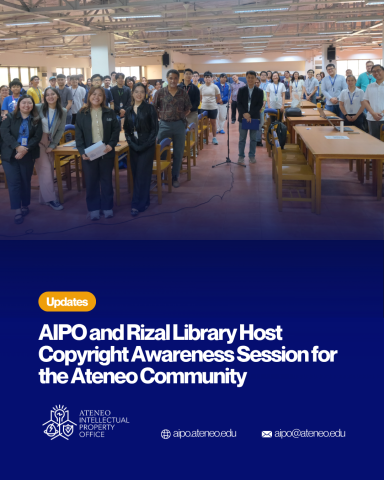
Protecting Creativity: AIPO and Rizal Library Host Copyright Awareness Session for the Ateneo Community
On March 18, 2026, the Ateneo Intellectual Property Office (AIPO), in collaboration with the Rizal Library, successfully conducted a Copyright Awareness Session held on the

Holy Week 2026 Holidays (Memo # UHR2526-038)
Memo # UHR2526-038 31 March 2026 TO: All Employees FROM: [Sgd] Maria Victoria T Cortez, PhD Vice President for University Human Resources SUBJECT: Holy Week
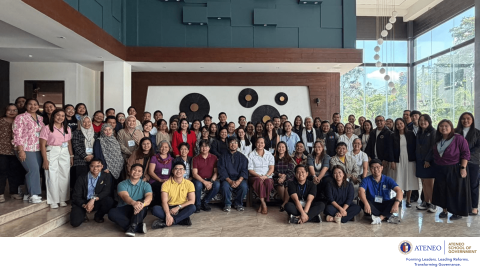
ASOG’s Tobacco Control initiatives spotlighted in DOH National Technical Working Group for Tobacco Prevention and Control
On March 10 to 12, 2026, the Ateneo School of Government (ASOG), through its research and public policy unit, the Ateneo Policy Center, participated in
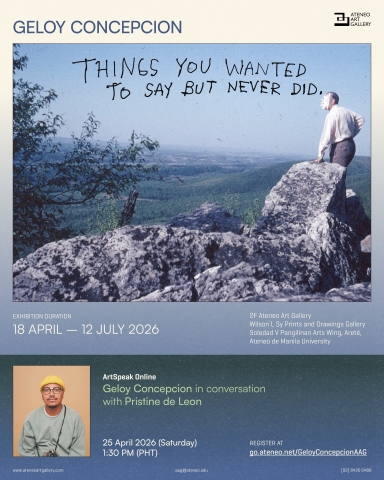
Things You Wanted to Say But Never Did: Geloy Concepcion’s six-year project makes Its exhibition debut at the Ateneo Art Gallery
Geloy Concepcion’s Things You Wanted To Say But Never Did comes to the Ateneo Art Gallery this 18 April 2026. After receiving almost 300,000 messages
[Hot Off the Press] Love If I'm Pretty
New YA Release from the Ateneo Press Love If I’m Pretty tackles the nuances of growing up through complex characters and straightforward prose What do