[Ateneo Press Review Crew] Language and Deception in Iñigo Ed. Regalado’s Love Without a Heart
20 Aug 2025 | Ashley Martelino



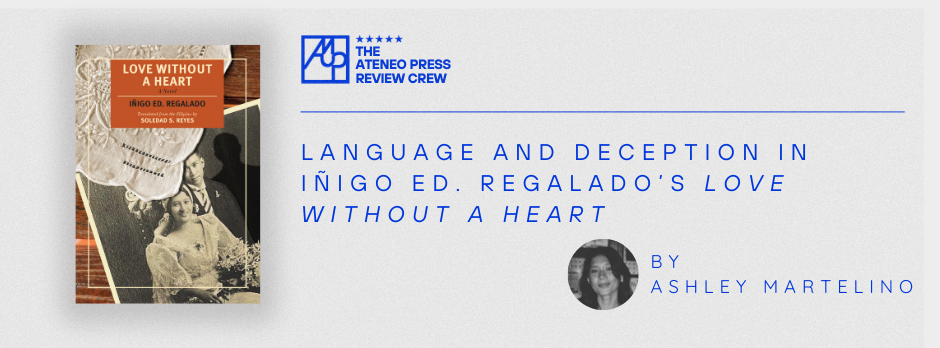
Something is lost in every translation. This is not a slight against Soledad S Reyes’ English reworking of Inigo Ed. Regalado’s 1921 novel, May Pagsinta'y Walang Puso, but an inevitability of the process. Even the title, now reinterpreted as Love Without a Heart, seems to have surrendered some of its punch and melodrama to the restrictions of language. Perhaps the original work’s most impressive quality is its mastery of Tagalog, wielding it with depth and richness, stretching it as far as the vernacular can go. Take, for example, the opening line: “Ang kalumbayang lumulunod sa puso ni Sela ay lalo nang nang-ibayo nang umagang sumunod sa gabing tanggapin ang malupit na balita,” now rewritten for the English reader as, “Already drowning in grief, Sela endured more pain the morning after she received the heart-breaking news.” To the native speaker, the former cuts more harshly, while the latter may simply scratch.
Thus, readers who first encounter Reyes’ translation will likely be curious about Regalado’s original expressions, especially as the novel is loaded with pro-longed internal monologues. This is not to say that the translation waters the novel down. A side-by-side reading of the two versions may be even more enriching. In fact, part of what makes the novel so fit for linguistic reinterpretation is its own exploration of language in flux—the many forms communication can take, its limited mediums, its deceptive powers, and its imperfect messengers.
Love Without a Heart was originally published at the tail end of the Golden Age of the Tagalog Novel—a term Regalado himself coined for the period between 1905-1921 that produced countless Tagalog classics. This literary boom was driven in part by the rise of journalism in the Philippines, an era when local newspapers—many founded during the last years of the Spanish period—provided public forums for young writers.
So it seems only fitting that what sets in motion the events of the novel are two Tagalog newspapers, from which our protagonist Sela discovers that her lover, newspaperman and poet Fidel, is engaged to a woman named Maria. This is despite Sela and Fidel’s scandalous long-term affair, during which he supported her financially and even lived with her. What Sela doesn’t know is that the announcement (though factual) was only published as a joke by Fidel’s friends.
The novel is divided into three parts and in the first, we jump sporadically between the two former lovers’ points of view as each recounts their affair through misaligned perspectives. From Sela, we get a tale of passion, romantic courtship, and even love, turned despair, confusion, and heartbreak. Fidel, on the other hand, tells a story of guilt, pity, lust, and carelessness. The two meet at a staged tribute to Jose Rizal, whose death was still fresh in collective memory during the book’s 1910s setting. Sela, at this time, was still in intermediate school, Fidel already an accomplished poet. Upon meeting her, Fidel assumes she is an immoral woman and pursues her primarily for sexual gratification. What brings them together is the same thing that ultimately drives them apart—ink on paper.
Fidel wins the young woman’s heart through rhythm and verse under the pseudonym Takip-Silim. In his poems, he refers to her as Bituing Lupa. By his own unwitting description, he is the moment between sunset and nightfall, a light signalling darkness. Meanwhile, she is a star of the earth, a fallen angel. The written word, then, serves as both deception and truth, particularly in the early parts of the novel. It conceals as it reveals. Regalado himself makes use of its obfuscating power. The novel was published at a time when adultery was still a sensitive topic, and so the prose is shrouded in lengthy metaphors, euphemisms, words left unsaid, actions merely implied, uncomfortable truths intentionally discarded—all veiling over (and simultaneously pointing at) the taboo subject matter.
In the second and third parts of the novel, Sela’s point of view takes center stage. Readers may quickly tire of her endless (even redundant) ruminations, but it cannot be overlooked that it was still uncommon then for a Filipino novel to explore this kind of complex internal turmoil, especially from a woman. Regalado does not just give Sela space to mourn, he carves it out for her.
Early on, we are caged by Sela’s perspective, doomed alongside her to a life of destitution. What finally progresses the narrative—frees both Sela and the reader from total hopelessness—is when our protagonist finally speaks openly to other women. With the reduction of Fidel’s perspective comes the bullish voices of Pura and Pakita. The former introduces her to potential new suitors, and more importantly, recounts the stories of other scorned women in their midst—women who were similarly betrayed by men, but found redemption through respectable marriages. And from the latter—herself a victim of a previous affair gone wrong—Sela discovers the ability to survive without Fidel’s financial support.
Thus, the gossip that once burdened Sela becomes her way out. Where her reputation was once at the mercy of such hearsay, she becomes empowered by the whispered stories of Pura and Pakita. Once a victim of Fidel’s deceptive poetry, she comes to understand her own ability to wield such words. “Women are born liars,” Pura later says. “It is easy for these men to fall for lies.”
The only way for Sela to be redeemed from the misfortunes that have turned her into a fallen woman is to marry a respectable man. She’s able to do so later in the novel when she meets the wealthy Rufo who falls in love with her instantly. Ultimately, it’s her own clever verbal obfuscation that seals the deal. “Think about it first,” she repeatedly urges Rufo as he pursues her, implicitly suggesting the secret she will not say out loud. And his ignorance prevails, eventually asking for her hand in marriage and then bearing a child with her.
By the end of the novel, once her secret is out, Sela is acting more deliberately, knowing now why all women are born liars. “Sela thought, with calmness and deliberation, of the best way to deflect Rufo’s accusation and deny him the truth,” Regalado writes. And before her husband can wring her neck, she knows what to say. “I was a fallen woman, with a mark on my forehead,” she proclaims. “But everything happened before I met you…And when I stepped in your garden, I was clean.”
Finally, as if winking at the reader, Regalad throws in one last cheeky detail: As Rufo finally forgives his wife, Fidel walks down the stairs, having just spoken to his former lover, satisfied knowing she is at peace. Sela emerges a pragmatic heroine, rather than a romantic one. Once the victim of language’s deceptive power, she becomes its master—free of love’s illusions and enjoying “the glory that thousands of women with the same kind of sordid past are now enjoying.”
Grab your copy in paperback: Website | Lazada and Shopee
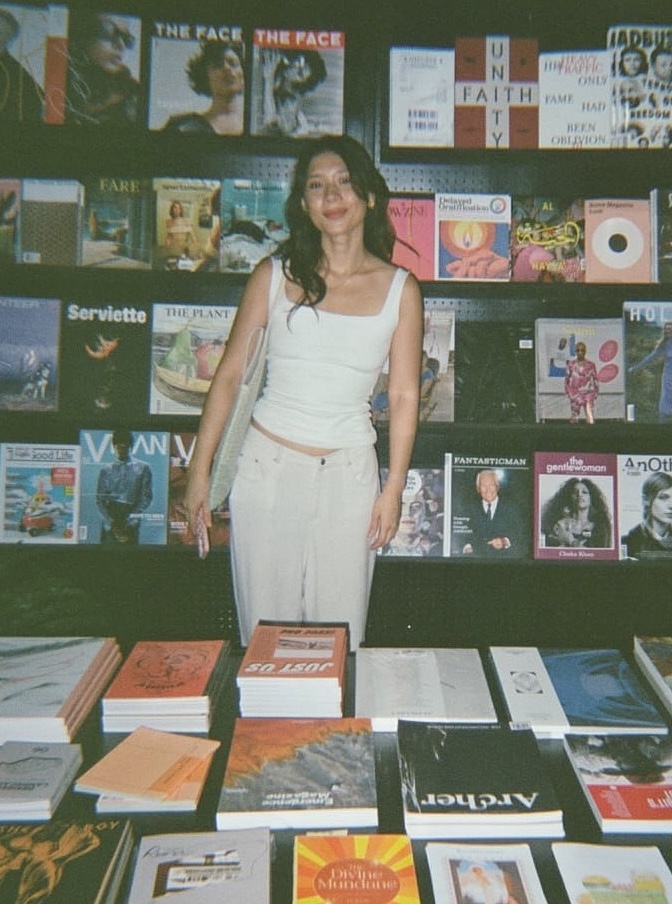
Ashley Martelino is a writer and editor based in Metro Manila. Her work has been featured on various local publications. She graduated from the Ateneo de Manila University with a degree in English Literature.
Recent News
You may also like these articles

[Hot Off the Press] Arkipelago
New book from the Ateneo Press Arkipelago provides a fascinating and fantastical twist on Philippine politics and history Our country is an archipelago of stories
Protecting Creativity: AIPO and Rizal Library Host Copyright Awareness Session for the Ateneo Community
On March 18, 2026, the Ateneo Intellectual Property Office (AIPO), in collaboration with the Rizal Library, successfully conducted a Copyright Awareness Session held on the
Holy Week 2026 Holidays (Memo # UHR2526-038)
Memo # UHR2526-038 31 March 2026 TO: All Employees FROM: [Sgd] Maria Victoria T Cortez, PhD Vice President for University Human Resources SUBJECT: Holy Week
ASOG’s Tobacco Control initiatives spotlighted in DOH National Technical Working Group for Tobacco Prevention and Control
On March 10 to 12, 2026, the Ateneo School of Government (ASOG), through its research and public policy unit, the Ateneo Policy Center, participated in
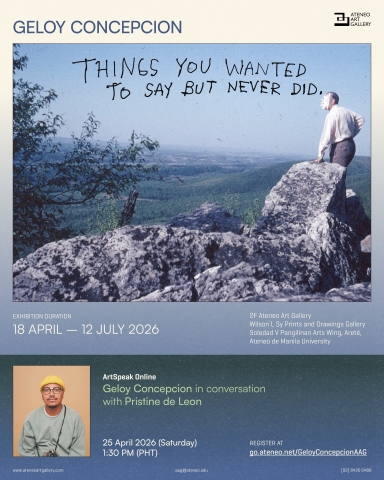
Things You Wanted to Say But Never Did: Geloy Concepcion’s six-year project makes Its exhibition debut at the Ateneo Art Gallery
Geloy Concepcion’s Things You Wanted To Say But Never Did comes to the Ateneo Art Gallery this 18 April 2026. After receiving almost 300,000 messages
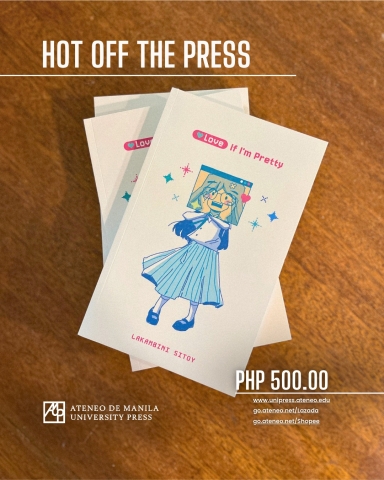
[Hot Off the Press] Love If I'm Pretty
New YA Release from the Ateneo Press Love If I’m Pretty tackles the nuances of growing up through complex characters and straightforward prose What do