[Ateneo Press Review Crew] Illuminating craft, history, and memory through The Collected Stories of Gregorio C Brillantes
03 Oct 2025 | Nick Garcia




I first encountered Gregorio C Brillantes through "Distance to Andromeda," a required reading in my literature classes over a decade ago back when I was a lanky and spiky-haired college boy, one who was unsure how to fare in this chosen field of letters.
The short story follows Ben, a 13-year-old who is profoundly moved by a post-apocalyptic sci-fi movie. Amid the trappings of Earth's domesticity, he feels an inexplicable hum resonating within him, forming a deep connection to the universe and its vastness and enigmas.
I can't, for the life of me, remember how I did in the recitation or quiz concerning that particular piece. But what I'm sure of is that Brillantes, true to his name, was a brilliant storyteller. He had an acuity of observation and a grasp of relevant detail, as Butch Dalisay once wrote about him.
My next Brillantes encounter was through "Faith, Love, Time, and Dr Lazaro," another required reading for that same lanky and spiky-haired college boy, who perhaps carried some Ben within him. The story follows the titular doctor, who has become emotionally numb and spiritually detached after years of medical practice. One late night, Dr Lazaro receives a call to attend to a week-old infant with tetanus in a remote barrio. Though he considers it a hopeless case, he goes there anyway, chauffeured by his religious teenage son. The child dies as expected, prompting his son to perform a lay baptism. Dr Lazaro takes over the wheel on their way back home, and his son's quiet act of faith stirs something within him, if only for a moment.
Even from those two stories alone, one can easily say that Brillantes was a master storyteller. His evocative descriptions, precise details, and rhythmic cadences turn the ordinary into extraordinary. He made a seemingly simple plot evoke lasting emotions and reveal deep truths about the human condition via his meditative narrations and nuanced characters. More importantly, his work is Filipino, featuring local landscapes and cultural traditions that are undeniably ours.
Looking back, I may have taken Brillantes for granted; he had dozens of other short stories written from 1952 to 1993.
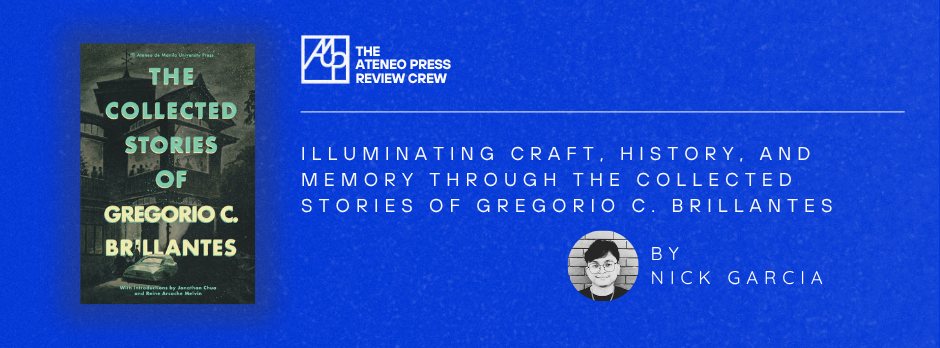
But not anymore. Three decades after his last new short story was published, Ateneo de Manila University Press gathered them all in The Collected Stories of Gregorio C. Brillantes.
The volume brings together his 39 stories spanning 41 years, originally published in The Distance to Andromeda and Other Stories; The Apollo Centennial: Nostalgias, Predicaments, and Celebrations; and On a Clear Day in November, Shortly Before the Millennium: Stories for a Quarter Century. These books have long been out of print, making the compendium not only relevant but also essential; it's basically the only way to read Brillantes in full today.
Reine Arcache Melvin has a seven-page introduction that primes readers, especially new ones, on what plotlines and themes they can expect from Brillantes. As his magnum opus suggests, Brillantes explored faith, love, and time in all their forms, as well as war, loss, and politics.
Editor Jonathan Chua also has a 25-page introduction—complete with footnotes—that traces Brillantes' trajectory, from his debut in The Philippines Free Press ("Manong Ramon") during the postwar period to his last new publication in National Midweek ("On a Clear Day in November, Shortly Before the Millennium") after EDSA. As Chua writes, "they tell a story of a singular writer's development in various milieus."
As Brillantes scholars like Chua have observed, the maestro repeatedly centered his narratives on his hometown, Tarlac (particularly in Camiling), showcasing many of its features and, in essence, historicizing and immortalizing the place.
Brillantes' fans, longtime and new, may also be delighted to learn about his writing journey, from devouring his father's library to studying in Ateneo to joining the campus literary magazine to producing short stories that earned him several prizes, including a Hall of Fame at the Carlos Palanca Memorial Awards in Literature, the Catholic Mass Media Award of Merit, the Southeast Asian WRITE Award, and a Gawad Tanglaw ng Lahi from his beloved alma mater.
Beyond his accolades, I had an especially great "TIL" moment that Brillantes, then a literature and creative writing teacher, became a media worker for a few years. That experience shaped the political sensibilities of his later fictions, which tackled topics like the Marcos dictatorship, the United States, the middle class, and the leftists. He also explored humor and satire in newer works, departing from his trademark poignant, spiritual, and philosophical writing style. After decades of working in realist mode, he ventured into speculative fiction and experimented with point of view and plot, demonstrating his versatility and evolution as a writer.
What I find particularly interesting is his penultimate story, "The Flood in Tarlac," which won the Palanca Award for First Prize in 1987. Set in a middle-class subdivision, the story follows the family of Dr Jose Caridad, who, ironically, shows little charity toward a group of farmers asking for help over a land dispute with his in-laws. Heavy rains soon bring floodwaters inside the Caridad residence—and a banca carrying armed men, who would kill Dr Caridad's wife and children.
While written decades ago, it brings to mind the anomalous flood control project issue of 2025. While Brillantes’ flood isn't about corrupt contractors and lawmakers, it symbolizes how human indifference, social inequality, and environmental forces intersect. Wealth and privilege don't guarantee comfort, and moral apathy can have catastrophic consequences. The flood also acts as a catalyst that brings long-standing social conflicts to the surface, literally and figuratively.
Brillantes' stories often have subtle, reflective, and open-ended conclusions, as seen in "Distance" and "Dr Lazaro." In "Flood,” the bittersweet ending—Dr Caridad's lament, "They had no right... coming into my house that way... my house... absolutely no right... no... right..."—underscores Brillantes’ enduring critique of class privilege and moral neglect.
Through his 39 stories, one can witness how his craft matured while remaining unmistakably Filipino. The Collected Stories of Gregorio C Brillantes more than lives up to its name; it also serves as an annal of Philippine literary history that every Filipino reader must have on their shelves.
The wordsmith that was THE Gregorio C Brillantes demands utmost attention, especially from aspiring fiction writers. The same goes for nonfictionists—and even casual readers—who will surely learn much from him and draw inspiration from his legacy.
I couldn't be happier to have his book in my late 20s: working in the media industry for nearly a decade, reading whatever I can get beyond any class requirement, and finishing my graduate thesis. Little did that lanky, spiky-haired boy from yesteryears know that his future self—heavier by a few kilos, sporting a neater haircut, though still unsure how to fare in this chosen field of letters—would carry a "silent vibrating hum inside him and far away... somewhere, moving across the world..."
Grab a copy in paperback: website | Shopee, and Lazada

Nick Garcia is a journalist, essayist, literary critic, and poet. His writing has appeared in PhilSTAR L!fe, Rappler Voices, Inquirer Young Blood, Voice & Verse, and Cha, among others. He is pursuing a Master of Fine Arts in Creative Writing at De La Salle University.
Recent News
You may also like these articles
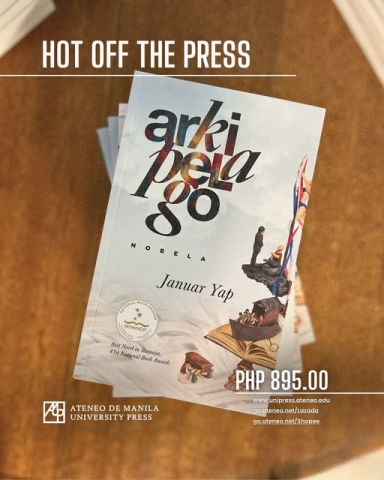
[Hot Off the Press] Arkipelago
New book from the Ateneo Press Arkipelago provides a fascinating and fantastical twist on Philippine politics and history Our country is an archipelago of stories
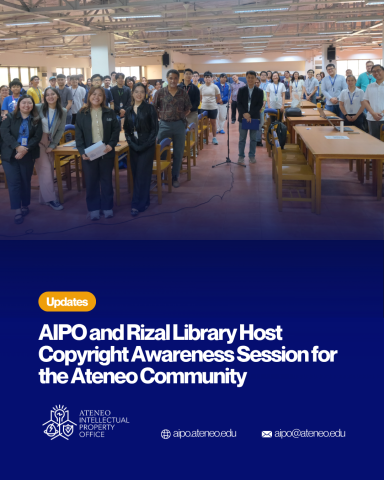
Protecting Creativity: AIPO and Rizal Library Host Copyright Awareness Session for the Ateneo Community
On March 18, 2026, the Ateneo Intellectual Property Office (AIPO), in collaboration with the Rizal Library, successfully conducted a Copyright Awareness Session held on the
Holy Week 2026 Holidays (Memo # UHR2526-038)
Memo # UHR2526-038 31 March 2026 TO: All Employees FROM: [Sgd] Maria Victoria T Cortez, PhD Vice President for University Human Resources SUBJECT: Holy Week
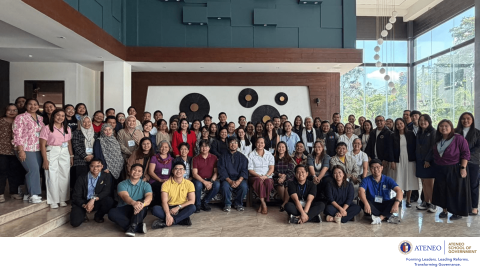
ASOG’s Tobacco Control initiatives spotlighted in DOH National Technical Working Group for Tobacco Prevention and Control
On March 10 to 12, 2026, the Ateneo School of Government (ASOG), through its research and public policy unit, the Ateneo Policy Center, participated in
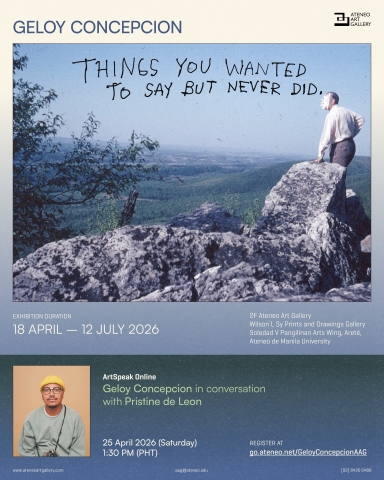
Things You Wanted to Say But Never Did: Geloy Concepcion’s six-year project makes Its exhibition debut at the Ateneo Art Gallery
Geloy Concepcion’s Things You Wanted To Say But Never Did comes to the Ateneo Art Gallery this 18 April 2026. After receiving almost 300,000 messages
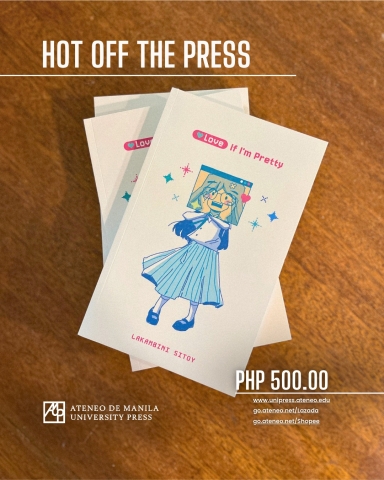
[Hot Off the Press] Love If I'm Pretty
New YA Release from the Ateneo Press Love If I’m Pretty tackles the nuances of growing up through complex characters and straightforward prose What do