Ateneo School of Government (ASOG) Position Paper on Corruption Issues in Government
22 Sep 2025










Ateneo School of Government (ASOG) Condemns Perverse Level of Greed
22 Sept 2025
We are appalled by the gravity of human greed that we are witnessing. We are horrified by the blatant disregard for the rule of law. We are stunned by the complicity of leaders in flagrant corrupt practices.
The deepening crisis of corruption is systematically eroding the integrity of public institutions, and corroding the moral fabric of public service. The magnitude of resources siphoned through these practices is not only alarming but profoundly disturbing.
We offer the following data to contribute to finding greater clarity, and deepening the level of discourse on the issue.
- Flood-gate scandal
|
Fiscal Year |
Flood Control Budget (FCB) |
Percentage of FCB in GAA |
|
2015 |
42,283,158,000 |
1.62% |
|
2016 |
64,200,000,000 |
2.14% |
|
2017 |
72,926,249,000 |
2.18% |
|
2018 |
127,734,500,000 |
3.39% |
|
2019 |
90,723,796,000 |
2.48% |
|
2020 |
90,123,209,000 |
2.20% |
|
2021 |
101,813,674,000 |
2.26% |
|
2022 |
128,966,726,000 |
2.57% |
|
2023 |
182,989,695,000 |
3.47% |
|
2024 |
244,577,911,000 |
4.24% |
|
2025 |
254,300,000,000 |
4.02% |
Source: GAA; DPWH
The scandal involving ghost projects, misallocation of funds, collusion between contractors and government officials, conflicts of interest, and monopolies of contractors involving billions of pesos, makes one’s head spin.
Based on a report by the Congressional Policy and Budget Research Department (CPBRD), the Flood Management Program (FMP) has the biggest allocation in the DPWH budget, at P254.3 billion or 32.1% of the DPWH operations budget in 2025, almost doubled compared to 2022. The FMP budget is higher than the budget of the Department of Social Welfare and Development (P230.1 billion), the Department of Health (P223.2 billion), the Department of Transportation (P180.9 billion), and the Department of Agriculture (P129.0 billion).
Corruption in the DPWH has spanned decades, and fixing the system requires strong political will from the political leaders. The DPWH budget, which for the first time hit one trillion pesos in the 2025 GAA, has so far surpassed the budget for education, in violation of the Constitutional mandate. . We therefore ask – Are flood control projects (which constitute 22% of the DPWH budget) more important than addressing the 160,000 classroom backlog and the dilapidated condition of 70% of existing classrooms?
The Flood-gate scandal, however, is just the tip of the iceberg. Deeper and more serious concerns need to be surfaced in the debate.
- Development for whom?
|
Budget Cut from Agencies |
Amount |
|
Natl Irrigation Authority |
23.2 |
|
DA |
22.4 |
|
DOLE |
18 |
|
DOTr |
16.7 |
|
AFP Modernization |
5.0 |
|
PNOC |
2.0 |
|
Budget Diverted to Agencies |
Amount |
|
DPWH |
94.3 |
|
LGSF (Local Govt Support Fund) |
7.2 |
|
MMDA |
3.4 |
|
NEA |
3.2 |
|
TIEZA |
1.5 |
|
PPA |
1.4 |
Source: 2025 GAB Bicameral Report
Urban infrastructures at the expense of rural development underscores the bias of privileging urban-based over rural-based development. Budget cuts and movement away from strategic transport, infrastructure, agriculture-based investments, to graft-prone projects like flood control, multi-purpose buildings, and hyper-micro local projects, like local roads, footbridges, and deep wells, interrogate the supposed rural development priority of the administration.
Moreover, the inability to properly manage the budget will continue the over reliance on borrowing, and will keep the trend of the national debt growing faster than the GDP growth. For 2025, forty percent of the budget is funded by borrowings. As of the end of April 2025, the national debt has grown to ₱16.75 trillion, up from ₱12.79 trillion in 2022; and debt as a percentage of GDP is 63.1% as of the end of the 2nd quarter 2025, which is above the threshold. The accumulation of debt, combined with high interest rates, will continue to increase the cost of servicing. It was ₱ 1.6 trillion in 2023, grew by 26% in 2024, and may continue to grow in 2025. Debt servicing will continue to eat up a significant portion of budget expenditure.
- Rules-based versus Padrino-based poverty reduction
The poverty reduction program of the administration is among the casualties in the current corruption malady. The budget cut and subsequent budget diversion are indicative of the priority direction of the administration.
|
Budget Cut from Agencies |
Amount |
|
DSWD |
94.3 |
|
PhilHealth |
74.4 |
|
DOH |
25.8 |
|
DepEd |
12 |
|
DOLE |
18 |
|
NCIP |
1.6 |
|
Budget Diverted to Agencies |
Amount |
|
AKAP (Ayuda para sa Kapos ang Kita Program) |
26 |
|
MAIFID (Medical Assistance to Indigent and Financially Incapacitated Patients) |
14.3 |
|
AICS (Assistance to Individuals in Crisis Situation) |
9.5 |
|
SUCs (State Universities and Colleges) |
7.0 |
|
TUPAD (Tulong Panghanapbuhay sa Ating Disadvantaged/ Displaced Workers) |
3.4 |
Rules-based programs, like the 4Ps or the Conditional Cash Transfer Program, the flagship of the country’s anti-poverty efforts, together with Philhealth, have suffered severe cuts in their budgets.
In 2025, the 4Ps budget was reduced by ₱50 billion, part of the ₱94 billion taken from the DSWD budget. Philhealth’s subsidy of ₱74.4 billion was reduced to zero. In their place, generous funding was provided to cash dole outs, like AKAP, AICS, MAIFP and TUPAD.
These programs have no system for identifying beneficiaries and conditions for qualifying as a beneficiary. In 2025, the budget for these programs totaled ₱130 billion. Greater roleand discretion are given to politiciansin the selection of projects, beneficiaries and amountsof assistance and visibility in the distribution of the same. Social services are headed towards becoming a matter of utang na loob, not a matter of right.
- Complicity in corruption
The executive and legislative directly benefited from budget diversion.
|
Diverted to (in Php Billion) |
|
|
House of Rep |
17.3 |
|
Office of the Pres |
5.0 |
|
Senate |
1.0 |
Source: 2025 GAB Bicameral Report
The table below presents the total annual budget of the Office of the President, the Office of the Vice President, the Senate, and the House of Representatives. A computation is made to show the breakdown of how much taxpayers pay to sustain each political leader on a per month and per day basis. The 2016 budget is shown for comparative purposes.
|
Institution |
2025 Budget (Php) |
2016 Budget (Php) |
Percentage increase over 2016 budget |
|
Office of the President |
15,845,475,000 |
2,825,998,000
|
461% increase
|
|
OP budget per Month |
1,320,456,250 |
||
|
OP Budget per day |
43,412,260 |
||
|
Office of the Vice Pres |
733,198,000 |
500,000,000
|
47% increase
|
|
OVP budget/ Month |
61,099,833 |
||
|
OVP budget / day |
2,008,762 |
||
|
Senate |
13,930,174,000 |
3,717,633,000
|
275% increase
|
|
Budget Per Senator/ Year |
580,423,917 |
||
|
Budget/ Senator/ month |
48,368,659 |
||
|
Budget/ Senator/ day |
1,590,202 |
||
|
House of Representatives |
33,670,000,000 |
8,861,413,000
|
280% increase
|
|
Budget/ Representative/ year |
105,880,503 |
||
|
Budget/ Rep per Month |
8,823,375 |
||
|
Budget/ Rep per Day |
290,083 |
Source: 2025 GAB Bicameral Report; 2016 GAA
Why was there an exponential increase in the budget of these agencies? How much of these are under oversight scrutiny, and how much are confidential funds?
We therefore pose this challenge – if the administration is serious in weeding out corruption, we demand that it carry out an institutional scrutiny up to the highest echelon of power.
The Pillage of the Budget Demoralizes the Bureaucracy
The repeated violation of laws and jurisprudence on matters of budget has weakened the rule of law and the system of checks and balances that are cornerstones of our system of representative democracy.
As an institution that’s committed to ethics and integrity in governance, we join the public in making the following demands:
- We call on our legislators to continue the conduct of hearings in aid of legislation, and correct the flaws and loopholes of our existing laws; we must end the grandstanding and public hearings in-aid-of-reelection practice;
- We call on the newly created Independent Commission on Infrastructure (ICI) to remain faithful to its mandate and sworn duty, and carry out the investigation truthfully;
- We call on agencies - DPWH, DBM, DILG, and concerned LGUs, to give their full support to the investigation of the ICI -
The Senate and the House of Representatives must also submit to the ICI the Bicameral Conference Committee Reports of 2023, 2024 and 2025 that were signed by the Bicam conferees and ratified by the plenary of both chambers.
These Reports are public documents and therefore must also be made accessible to the public.
-
We ask the ICI to include the following in the conduct of their investigation -
a. Senate and HOR Chairpersons and Vice-Chairpersons of the Finance and Appropriation Committees, including the technical staff;
b. Former Senate President Chiz Escudero and former Speaker Martin Romualdez;
c. Executive Secretary and members of the Development Budget Coordinating Committee (DBCC), to answer why huge budget cuts and diversions happened in 2023, 2024 and 2025 without any interventions and protestations from the Executive;
d. Commission on Audit for its failure to ensure responsible use of public funds.
- We call for transparent, inclusive, and honest hearings and investigations, giving the public due access to the records related to government funds and the national budget.
Public office is a public trust. Today, the trust is broken.
We support the current efforts of the administration to address the issue and regain the trust of the public. We challenge the President to sustain the momentum and to penalize all who are involved in corruption. We offer our talents to help find solutions to governance problems.
Ateneo School of Government
Quezon City, Philippines
22 Sept 2025
Recent News
You may also like these articles

[Hot Off the Press] Arkipelago
New book from the Ateneo Press Arkipelago provides a fascinating and fantastical twist on Philippine politics and history Our country is an archipelago of stories
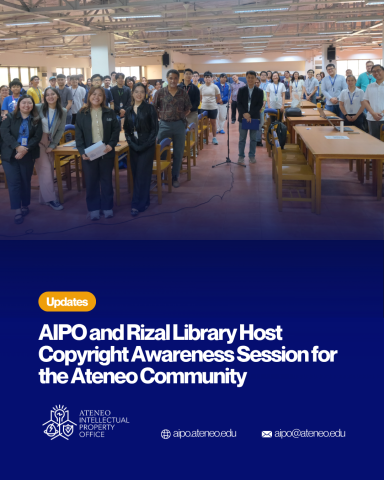
Protecting Creativity: AIPO and Rizal Library Host Copyright Awareness Session for the Ateneo Community
On March 18, 2026, the Ateneo Intellectual Property Office (AIPO), in collaboration with the Rizal Library, successfully conducted a Copyright Awareness Session held on the
Holy Week 2026 Holidays (Memo # UHR2526-038)
Memo # UHR2526-038 31 March 2026 TO: All Employees FROM: [Sgd] Maria Victoria T Cortez, PhD Vice President for University Human Resources SUBJECT: Holy Week
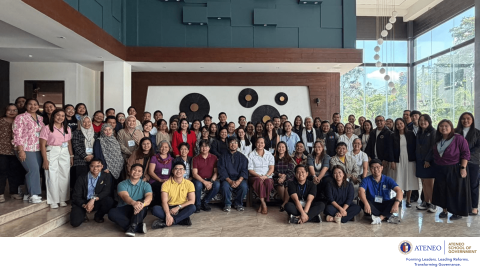
ASOG’s Tobacco Control initiatives spotlighted in DOH National Technical Working Group for Tobacco Prevention and Control
On March 10 to 12, 2026, the Ateneo School of Government (ASOG), through its research and public policy unit, the Ateneo Policy Center, participated in
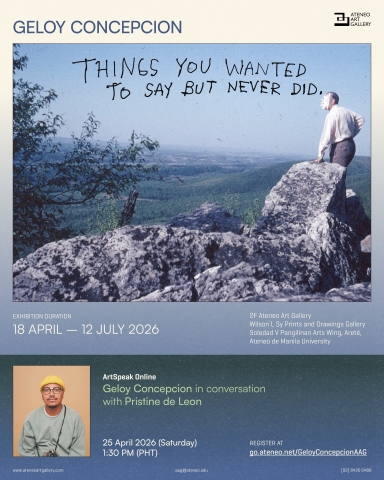
Things You Wanted to Say But Never Did: Geloy Concepcion’s six-year project makes Its exhibition debut at the Ateneo Art Gallery
Geloy Concepcion’s Things You Wanted To Say But Never Did comes to the Ateneo Art Gallery this 18 April 2026. After receiving almost 300,000 messages

[Hot Off the Press] Love If I'm Pretty
New YA Release from the Ateneo Press Love If I’m Pretty tackles the nuances of growing up through complex characters and straightforward prose What do