[Ateneo Press Review Crew] The Art of Living Alongside Empire in Eric Gamalinda’s Amigo Warfare
21 Nov 2025 | Des Suarez



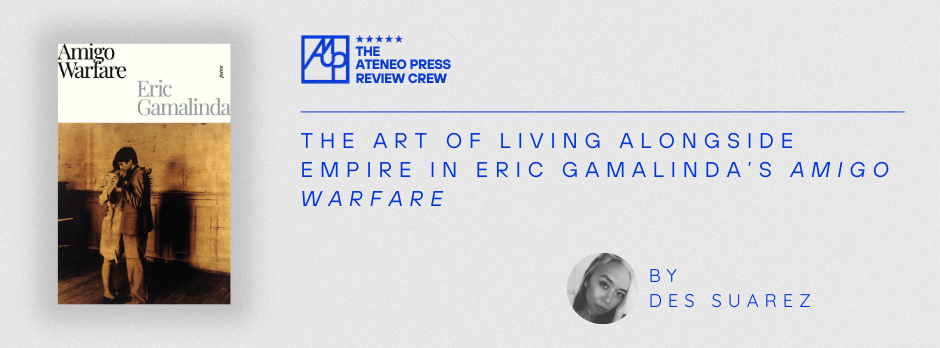
In a cruel twist of fate, Amigo Warfare was the book I took with me when I braved the American Embassy in Manila, where, after tens of thousands of pesos, an hour and a half in a queue, and just 30 seconds in front of a window, a cutthroat white man told me that (a) I couldn’t be allowed to enter his country for my business trip, (b) to please refer to this blue paper for the full spiel, and (c) be on my way out, next!
I wasn’t really prepared, on that quiet, lonely walk back to my hotel, to feel the weight of the oxymoron (“amigo warfare”) so hotly on my skin, but I only had to hear myself apologizing on the phone to my boss of six years because we wouldn’t be seeing each other for the first time this year after all, and I only had to say, when asked how come, “because I’m Filipino.” Gamalinda might as well have finished the sentence for me: “I am blacker than I’ve ever been (‘Flash Fiction’).”
What a time to read this collection, not only in my unfortunate yet quite common case (The refusal rate for nonimmigrant visas was at 28.33% in 2024.), but in large part because the world has once again reached a level of apocalyptic that demands poetry to save us. Initially published in the US during the Bush administration, this Philippine edition of Amigo Warfare came just in time for the reign of Trump in the US, the return of the Marcoses in the Philippines, and all the other faces of the hydra of facism rearing itself all around the globe today. How can a poem save us from that?
In ‘Sprung Pidgin,’ Gamalinda talks about "turn[ing] so white / you’re practically invisible." (People who worked at some American call centers know the feeling of having their names replaced with an American sounding one as a rite of passage to the production floor.) A poem can recover you from that kind of erasure, but it's about as easy as photographing a chameleon. Gamalinda's poetry is full of allusions and references to directors, painters, writers, photographers, and even mathematicians from many different cultures, not just America. It reflects the fragmented postcolonial body that became itself through translation, so many times over, in borrowed tongues, in order to survive, yes, but also to partake in all the beauty hidden from its view.
People often call Eric Gamalinda a “diasporic” writer, but he has never described himself in that way. He finds that the label implies a writer split between here and there (i.e. the Philippines and outside the Philippines) yet what drives his work, in this collection especially, isn’t location but memory and history, the things that refuse to be left behind no matter where he goes. In a Rappler interview, he explained it simply like this: "I write about what matters to me, no matter where I am."
This statement perfectly describes the architecture of the collection itself. When Amigo Warfare was first published in the United States, what mattered was survival: how to live amidst the chaos and violence of empire without surrendering tenderness. 'DMZ' opens the book exhausted by so much fighting and grief. The poems that follow widen the scale of survival by moving from the personal to the historical, from the ache of one body to the memory of a nation. But the book never settles there. By the time we reach the end of the third section in ‘Umbertide,’ the gaze turns inward again, emptied of revelation. What began as a collective reckoning collapses back into solitude – a voice still reaching for meaning after faith, after history, after even poetry itself.
The fourth section, unique to Ateneo Press’s Philippine edition, gives the book a new kind of closure. The twelve additional poems, many written for the poet’s late mother, shift the tone from isolation to communion. In the final poem, 'No Fly Zone,' the speaker blesses even those complicit in the world’s suffering: “I am glad to share this lifetime with you.” The gesture feels like peace, but only because it’s learned to live with ruin. That same awareness shapes 'Daisy Cutter' (a nickname for a fragmentation bomb used during the Vietnam War, which was designed to detonate a few feet above the ground, creating a wide, flat blast that tore everything in its radius into fragments), where the poem itself becomes the record of what beauty survives after a blast. The poem actually explodes across twenty-six fragments, each one a shard of thought, memory, or history. ‘Daisy Cutter’ turns violence into pattern, ruin into structure. It’s the book’s perfect image of survival: the self remade out of what tried to destroy it.
This push-and-pull of violence and tenderness; and of hate and love in Amigo Warfare is exactly the kind of absurd reality that we wake up to every day, and we don’t even have to go abroad for it anymore. Thanks to the internet, we can export our citizens right from the comfort of their homes, and the race to the bottom just got even lower. How can a poem save us from that? It can’t. But it keeps faith in the act of speaking. My favorite poem in the collection begins with “I hope you never get tired of waiting for the world / to come to its senses (‘Plan B’),” a line that already knows the world very likely won’t, but asserts the importance of keeping a door open or keeping a light on for what might still be possible (until the world finally, truly, ends, which it has not done yet so far).
Maybe that’s all a poem can do: hold open that small space before the end, the one where something else might still happen. It’s what Bifo Berardi calls futurability – the idea that the future isn’t just one straight line, but a field of many possible paths. Power works by pretending there’s only one choice, one story worth following, and in doing so it erases everything else that could have been. We see in ‘Plan B’ how the poet can resist that narrowing simply by “tak[ing] shelter / in uncertainty, all that open space.” As long as we can still imagine another version of the world, then it isn’t over yet.
Grab your copy in paperback: Website | Shopee and Lazada

Des Suarez is an MA Literature student at the University of San Carlos. She graduated cum laude with a BA in Mass Communication from the University of Philippines Cebu in 2019. Outside of her studies, she runs the subreddit and book club r/Cebooklub for a small community of readers in Cebu City.
Recent News
You may also like these articles
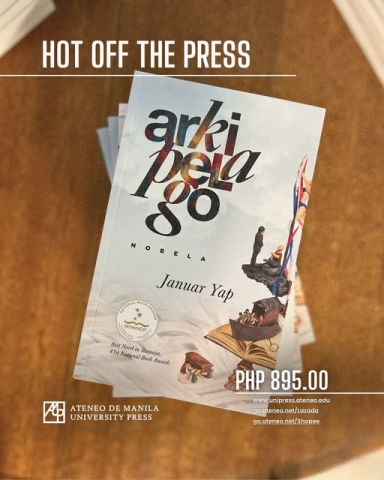
[Hot Off the Press] Arkipelago
New book from the Ateneo Press Arkipelago provides a fascinating and fantastical twist on Philippine politics and history Our country is an archipelago of stories
Protecting Creativity: AIPO and Rizal Library Host Copyright Awareness Session for the Ateneo Community
On March 18, 2026, the Ateneo Intellectual Property Office (AIPO), in collaboration with the Rizal Library, successfully conducted a Copyright Awareness Session held on the
Holy Week 2026 Holidays (Memo # UHR2526-038)
Memo # UHR2526-038 31 March 2026 TO: All Employees FROM: [Sgd] Maria Victoria T Cortez, PhD Vice President for University Human Resources SUBJECT: Holy Week
ASOG’s Tobacco Control initiatives spotlighted in DOH National Technical Working Group for Tobacco Prevention and Control
On March 10 to 12, 2026, the Ateneo School of Government (ASOG), through its research and public policy unit, the Ateneo Policy Center, participated in
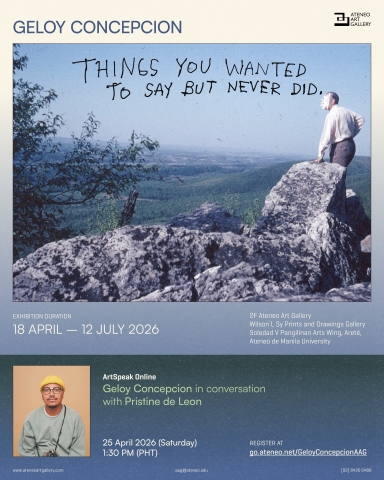
Things You Wanted to Say But Never Did: Geloy Concepcion’s six-year project makes Its exhibition debut at the Ateneo Art Gallery
Geloy Concepcion’s Things You Wanted To Say But Never Did comes to the Ateneo Art Gallery this 18 April 2026. After receiving almost 300,000 messages
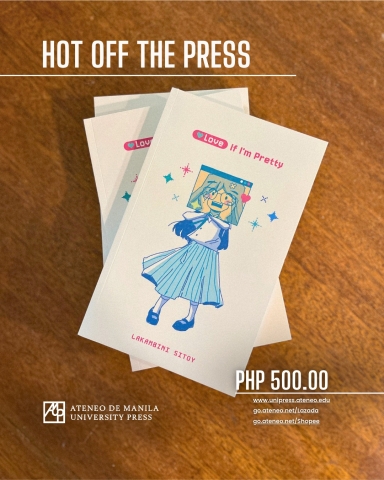
[Hot Off the Press] Love If I'm Pretty
New YA Release from the Ateneo Press Love If I’m Pretty tackles the nuances of growing up through complex characters and straightforward prose What do