[Ateneo Press Review Crew] The Disturbance and Comfort in Queer Past, Present, and Future: Plus/+, at Iba Plus, Maramihan Nonfiction Anthology
17 Nov 2025 | Abigail C. James



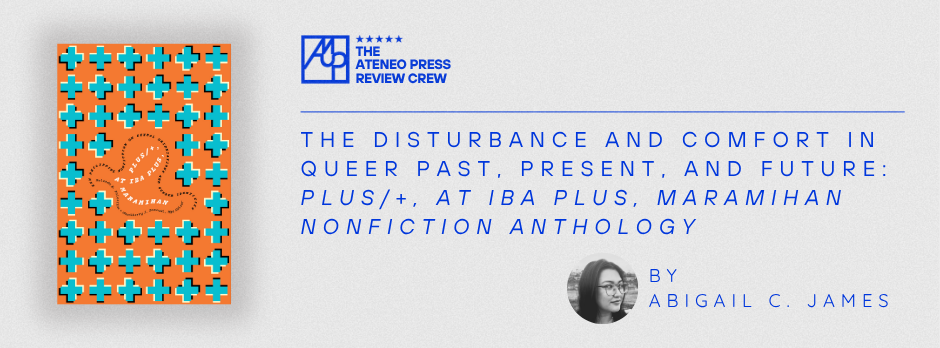
It’s a familiar saying, “Art is supposed to comfort the disturbed and disturb the comforted.” When it comes to writing about the LGBTQIA+ community, this resonates even more. Even in the usage of terms for this review, I find myself tripping over what is “right” or appropriate to encapsulate this combined body, the chorus of voices. I do not resent this struggle, as it is of course a representation of a fight for representation. Perhaps in the vein of this anthology, I can use my preferred term, which is (the ever controversial) “queer.” Though as I use it, I acknowledge the frictions it causes and let things remain uncomfortable. Here, already, I wade into the title and impetus of this anthology, the “maramihan” aspect. How best to capture all colors of an ever-shifting reality that is to be queer? This book is a valiant attempt.
Maramihan Nonfiction is the essayistic counterpart of its fraternal twin of the same name, the latter dealing with fiction. To distinguish itself, Rolando Tolentino says in the introduction, “[M]ahirap, masalimuot ang formasyon at transformasyong inaakda at ginugunita sa personal na sanaysay pero may tapang, dangal, at katotohanang sinasambit. Ang personal na sanaysay ay pangungumpisal sa sarili at mambabasang publiko… Kailangang mapagbigay ang manunulat ng personal na sanaysay kahit hindi nagging mapagbigay ang heterosexualidad, lipunan, pamilya, at kapwa sa kanya” (3). It somewhat sets up the stakes for the essayist, the writer who dares to bare a truth that cannot hide behind disclaimers. It also emphasizes the contract the essayist signs alongside the reader: Contained herewith is the truth and nothing but the truth. The words personal/dramatic/artistic before truth are silent.
Though I primarily write fiction, essay collections and anthologies always draw me because as another famous saying goes, truth is stranger. I find that essays invoke an even greater stimulation of the imagination, given that I must readjust my world view to accommodate a “true” narrative that I might not have ever considered. No suspension of disbelief here. In the context of Maramihan’s queer experiences, I felt my world expanding in many such directions. I let myself be confronted by the lives of others, some strangers, but in this case, I would not call them strange. The truth here is merely different, in a welcomed way. The act of writing down an experience that would have otherwise been silenced by a conservative society is already transgressive and so necessary. The fact that this book exists is already motivation enough to read it and of course, participate in the radicality of the queer written word. Essayists are often accused of navel gazing, but in a country with limited SOGIE education, perhaps we should look more closely, confronting ourselves and our society simultaneously.
While the nonfiction anthology is admittedly slimmer than the fiction edition, its contents deliver such impactful works that confirm size doesn’t matter. Even in an essay such as “Penisology” by Jaime An Lim, which gives a description of the (non)existence of a queer scene in 1960s Cagayan de Oro, where I’m from. Having heard from my own mother that queer people didn’t “exist” during her youth, this piece both affirms and denies this, describing multiplicities in the confusion of navigating queer spaces from past to present. I use this work as an example of how integral essay writing is to preserving queer history. With the AIDS epidemic in the 80s and 90s, a generation of queer people’s lives were ended prematurely, because no one wished to acknowledge their suffering. This is just on top of the insistence on silencing and shaming queer people’s existences in all facets of society. But the community has endured, despite it all. The essay “From Jumanji to Jurassic Park: An (Un)Holy Week in White Beach, Puerto Galera” by R. H. Ng shows that queer people have been making their own spaces and doing their own thing long before opinions on queer visibility have changed.
Maramihan covers ample ground, becoming a 21st century beacon for collective queer writing. I appreciated the two essays on bisexuality, “Lying, Conniving Nymphomaniac” by Julian Kara and “He, She, Me, Her” by Andrew Bonifacio L. Clete, given that we are often erased, even more so in Filipino society that seems to continually dwell on binaries. The essays also don’t shy away from hard truths, criticism, or pop culture. My personal favorites in the collection evoke strong personal responses. I am directly confronted by shane carreon’s essay, “In Trans-it in Philippine Literature,” and his critique of the use of “queer,” given its Western origins and vagueness, as well as its inequivalence in Filipino culture. I cried at the endnotes in Jhoanna Lynn Cruz’s “To my darling daughter on your 18th birthday” and at the reconciliation of Ria Valdez and her mother in “My Mother Learning Facebook.” But I would also say that all the essays make me glad that these conversations are being had and I get to learn from them.
As it stands, I feel the need to point out that the QIA is not addressed in personal narratives, resulting in somewhat of a minus rather than a plus. This suggests there is still room for another edition and a further push for more inclusion. The annual Philippine Queer Studies Conference shows that the unincluded groups are present and visible and perhaps can be tapped to write about their experiences to fully embrace the whole rainbow that the pride flag wishes to embody. I look forward to that possibility because reading this anthology taught me so much about Filipino queer experiences.
I believe that is the best part about Maramihan, both editions. These are books that can help educate people on SOGIE, directly and indirectly. The introduction painstakingly addresses Philippine queer history, and by the end, there are educational tools for the classroom on how to use the works in the book. It’s an invitation to be disturbed and comforted in a presumed safe space, with writing that moves as much as it stills. Queerness is inherently political and literature can be a tool for positive change. As Tolentino says at the end of the introduction, “Halina’t magbasa at umakda sa pagbabasa, maging bukas at umakda sa pagiging bukas sa bukas ng ating lipunan at mundo. Magbasa, makibaka, ‘wag matakot” (36).
Grab your copy in paperback: Website and Shopee
Abigail C James is the Director of Creative Development at Nagkahiusang Magsusulat sa Cagayan de Oro (NAGMAC). She holds a Master of Arts in English Language from Xavier University - Ateneo de Cagayan and is currently pursuing her PhD in Literature at De La Salle University Manila.
Recent News
You may also like these articles
[Hot Off the Press] Arkipelago
New book from the Ateneo Press Arkipelago provides a fascinating and fantastical twist on Philippine politics and history Our country is an archipelago of stories
Protecting Creativity: AIPO and Rizal Library Host Copyright Awareness Session for the Ateneo Community
On March 18, 2026, the Ateneo Intellectual Property Office (AIPO), in collaboration with the Rizal Library, successfully conducted a Copyright Awareness Session held on the
Holy Week 2026 Holidays (Memo # UHR2526-038)
Memo # UHR2526-038 31 March 2026 TO: All Employees FROM: [Sgd] Maria Victoria T Cortez, PhD Vice President for University Human Resources SUBJECT: Holy Week
ASOG’s Tobacco Control initiatives spotlighted in DOH National Technical Working Group for Tobacco Prevention and Control
On March 10 to 12, 2026, the Ateneo School of Government (ASOG), through its research and public policy unit, the Ateneo Policy Center, participated in
Things You Wanted to Say But Never Did: Geloy Concepcion’s six-year project makes Its exhibition debut at the Ateneo Art Gallery
Geloy Concepcion’s Things You Wanted To Say But Never Did comes to the Ateneo Art Gallery this 18 April 2026. After receiving almost 300,000 messages
[Hot Off the Press] Love If I'm Pretty
New YA Release from the Ateneo Press Love If I’m Pretty tackles the nuances of growing up through complex characters and straightforward prose What do