[Ateneo Press Review Crew] Lives Beyond the Labels: Reading Michael Beltran’s The Singing Detainee and the Librarian with One Book
11 Nov 2025 | Arienne Therese Guinto





It’s strange, reading about people you’ve only ever heard through other people’s fear.
That was my first thought opening Michael Beltran’s The Singing Detainee and the Librarian with One Book. It’s not the kind of book you pick up casually, nor the kind you breeze through in one sitting. It asks for a different kind of readiness—not just ideological, but emotional. To enter this book is to step into a space where the lines between memory and distortion, exile and belonging, are never stable. It’s a book that asks for attention, and not allegiance; curiosity, and not certainty.
Across twenty-two essays, Beltran traces the contours of exile, memory, and political conviction through the intertwined lives of Jose Maria “Joma” Sison and Julieta “Julie” de Lima. In public imagination crowded with caricatures, these names often stand in for symbols that are stripped of ordinariness and flattened into either heroism or threat. But in these pages, they are allowed to take shape as people in full: thinkers, partners, migrants, elders, and witnesses to a long, unfinished struggle that outlived them—and still outlives us.
The collection is impressively varied: reportage, portraits, travel writing, interviews. Written across years, the essays are stitched together not by chronology but by concern. Each one stands on its own, yet together they circle a shared question: what does it mean to persist in conviction under conditions that demand surrender?
I wanted to write about all of them, honestly. Each chapter has its own mood, its own clarity. But I settled on two that, to me, capture the book’s pulse through its balance of observation, care, and complexity.
In A Particular Purgatory, Beltran follows Joma’s struggle as a recognized refugee still denied residence, a contradiction that leaves him trapped in legal limbo. The essay is as much about paperwork as politics. Through patient reporting, Beltran shows how bureaucracy becomes a quiet weapon by systems that claim to protect but, in truth, contain. What stands out here is not outrage but precision: a portrait of a man who has lived decades in waiting, reporting to police every month, existing inside a geography of scrutiny. Exile, for many, is not mere departure; it is displacement without end.
Then there’s Mangoes and Escape Plans, a quieter piece that lingers. Joma’s longing for mangoes—the sweetness of home—becomes shorthand for everything exile cannot touch. It’s such a small detail, but in Beltran’s hands, it carries weight because longing in this context isn’t weakness at all, but rather endurance at its best. As a reader, it reminds me that even the most hardened lives are sustained by tenderness, by memories that insist on surviving. And there’s something disarming about seeing a man so often defined by ideology revealed instead in appetite, nostalgia, humor.
Together, these two essays open a window into the book’s broader project: to humanize without erasing struggle, and to historicize without sanctifying. The same care extends throughout the collection.
What emerges from these is not a single thesis but a constellation of themes: displacement as discipline, memory as resistance, tenderness as method. Beltran’s writing makes visible the quiet, repetitive work of living politically, insisting on integrity in a time that rewards forgetfulness.
Stylistically, he writes with restraint but clearly not to the point of detachment. The prose is unadorned, yet each sentence feels deliberate, which I see as a kind of discipline that mirrors the lives he documents. You sense his awareness of risk, but also of responsibility. That dual awareness of the danger of misrepresentation and the urgency of precision gives the book its strength. Beltran doesn’t wield language as a weapon; rather, he uses it as a tool for repair, to bridge the distance between myth and memory.
In many ways, this book is as much about method as memory. Beltran isn’t only chronicling in this book; he’s modeling how to write about politically fraught lives—with curiosity, context, and care. He refuses the two extremes so often imposed on narratives like these: the defensive hagiography that flattens complexity, and the moralistic critique that thrives on distance. Instead, he offers something harder but truer; a writing that sits with contradiction and refuses to look away.
Joma’s passing in 2022 adds a quiet gravity to the book. Written while he was still alive, the essays now read like dispatches from a life nearing closure. Yet even in hindsight, they resist sentimentality. There’s no rush to canonize or condemn. Beltran writes as if aware the story is unfinished, and that the questions exile poses do not end with death. In that sense, the book is also about what it means to live after revolution: when struggle becomes history, and when belief must adapt or calcify.
And this, really, is where the book meets the present. In a time when red-tagging has become reflex, when fear masquerades as fact, Beltran’s essays challenge the habit of easy labeling. They don’t ask readers to agree with Joma or Julie. They ask us to understand what they stood for, and what it meant to stand at all. The point of the entire book is not vindication, but context; not persuasion, but clarity.
Read closely, the book also reveals how silence operates not just as absence, but as architecture. You start to notice how public discourse shapes what can be said, and how easily certain lives are pushed outside the bounds of sympathy. By paying attention, Beltran reclaims that space —slowly, carefully, without spectacle.
I must say that this is not a difficult book in style, but it is demanding in substance. It asks readers to unlearn convenience, to pause, to sit with unease. And in return, it offers a rare thing: an account that trusts its audience enough not to simplify.
If anything, that’s what I value most about this book. It doesn’t talk down to its readers or trap them in binaries. It moves with this confidence of believing that complexity is not a barrier to understanding—it’s the way to it.
And being a book that belongs to a tradition of Philippine non-fiction that carries risk in its bones, it offers a kind of writing that understands how truth-telling is never neutral. To write patiently, precisely, unflinchingly and to refuse shortcuts, is itself a form of resistance, especially in a culture that rewards erasure.
I ended the book thinking about how easy forgetting comes, and how powerful it is to resist it. Beltran writes about people who held their ground, even as it kept shifting. Some lives are worth reading closely—not because they’re safe, but because they aren’t. In remembering them clearly, we begin to see the forces that tried to silence them.
And maybe, in a time when understanding itself feels radical, that’s enough to begin with.
Learn more, read deeper. Grab your copy in paperback: Website | Shopee and Lazada

Arienne Therese Guinto is a people's researcher at the Institute for Nationalist Studies, with a background in Human Ecology. She critically engages with public policy, disaster resilience, feminist thought, grassroots organizing, and nationalist movements, emphasizing the intersections of power, resistance, and social transformation. In her capacity as a reviewer, she seeks to interrogate dominant narratives, foreground marginalized perspectives, and contribute to a more critical and emancipatory discourse in literature and scholarship.
Recent News
You may also like these articles

[Hot Off the Press] Arkipelago
New book from the Ateneo Press Arkipelago provides a fascinating and fantastical twist on Philippine politics and history Our country is an archipelago of stories
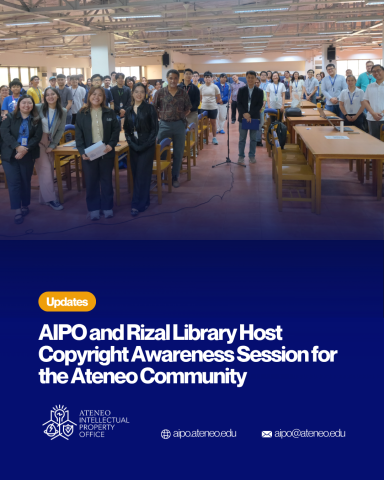
Protecting Creativity: AIPO and Rizal Library Host Copyright Awareness Session for the Ateneo Community
On March 18, 2026, the Ateneo Intellectual Property Office (AIPO), in collaboration with the Rizal Library, successfully conducted a Copyright Awareness Session held on the
Holy Week 2026 Holidays (Memo # UHR2526-038)
Memo # UHR2526-038 31 March 2026 TO: All Employees FROM: [Sgd] Maria Victoria T Cortez, PhD Vice President for University Human Resources SUBJECT: Holy Week
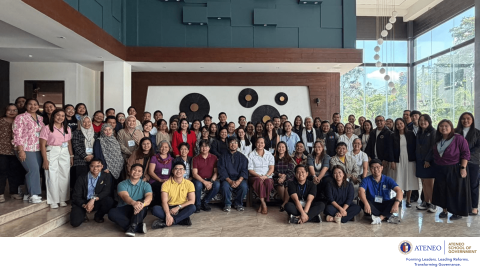
ASOG’s Tobacco Control initiatives spotlighted in DOH National Technical Working Group for Tobacco Prevention and Control
On March 10 to 12, 2026, the Ateneo School of Government (ASOG), through its research and public policy unit, the Ateneo Policy Center, participated in
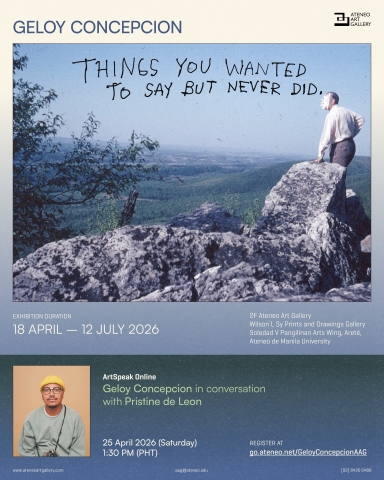
Things You Wanted to Say But Never Did: Geloy Concepcion’s six-year project makes Its exhibition debut at the Ateneo Art Gallery
Geloy Concepcion’s Things You Wanted To Say But Never Did comes to the Ateneo Art Gallery this 18 April 2026. After receiving almost 300,000 messages

[Hot Off the Press] Love If I'm Pretty
New YA Release from the Ateneo Press Love If I’m Pretty tackles the nuances of growing up through complex characters and straightforward prose What do