[Ateneo Press Review Crew] Tracing the Fragile Trail: A Review of Jim Pascual Agustin's Waking Up to the Pattern Left by a Snail Overnight
12 Nov 2025 | Christine Marie Lim Magpile




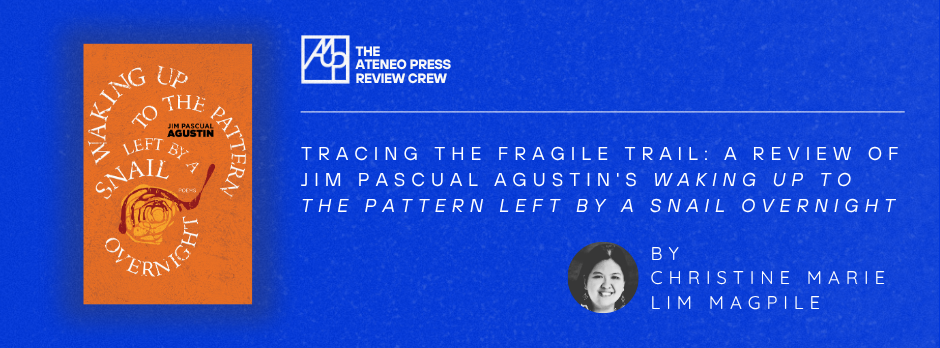
The snail's metaphor, which is a fragile and glistening trail across surfaces, becomes a powerful symbol of poetic witness. While Agustin's language is accessible, the meanings are layered. The poet's response to injustice, violence, and loss as his poems explore themes of grief, memory, social commentary, and nature. As exemplified in Agustin's works, Philippine poetry could transform trauma into lyric and lyric into action. For example, the poem “My Mother Had a Concrete Garden” illustrates a conflict between nature and the political sphere. The mother nurtures young shoots in a garden of unwanted pots, performing this act far from where the government stabbed the names of politicians in poles. This suggests a quiet, natural resistance to official political presence.
Meanwhile, the poem “The Struggle for Water” connects a basic human need and societal failure (lack of access to water/taps for hygiene) with a dangerous natural environment. While the virus is a threat, the need to reach the narrowing river exposes people to “Teeth. Claws. More real than any virus.” Similarly, “The World is Round as a Drop of Water” links the natural cycle of rain and drought to political concepts like the “bordered land” and barbed wire.
In Agustin's poetry collection, it shows how nature provides the location, material, or sensory context for expressing or dealing with loss and mourning. For example, the act of grieving is physically connected to nature in “Ashes,” where the remains of a mother-in-law (a mixture of ash and flowers) are secretly scattered in the garden near the branches of the frangipani. Likewise, the theme of grief is reflected in nature through objects like the wooden coffin, which is described in “Containing Light” as the body of a tree reduced to panels of measured dimensions. This wood, which once pulsed with life and silently performed “magic” by gathering light and water, is stripped and skinned for death. Likewise, Agustin's poems illustrate those political and historical events, particularly those surrounding authoritarian rule and violence, are often the root cause of the expressed grief.
For example, “Fingertips” connects the speaker's personal life and family history to the political context of the Marcos dictatorship. The speaker questions if his father “warmed the trigger among strangers” during those “dark times.” This personal grief over uncertainty regarding a father’s role is bound to the era of dictatorship. The clandestine burial of Marcos in 2016 is also addressed in “Ear of Wax,” a poem that describes the mock effigy and expresses the wish for the "post-World War II king of plunderers” to turn in your grave. Poems recall political violence, and they disappeared. “Injured in the Night” mentions that September is a “war of memories in the home country,” with roads and alleys, and unmarked cemeteries. The poem questions who will remember those “injured in the night, they disappeared.” Similarly, “And You Ring the Night” depicts the struggle to remember the disappeared, as the speaker calls a night watchman who doesn't pick up.
Agustin's poetry traverses geographical, historical, and emotional borders. Themes of exile, environmental degradation, political violence, and familial memory recur throughout the collection. I was especially drawn to poems that explore the fragility of ecosystems and the violence of forgetting. His work reminds us that poetry can be a form of ecological and historical preservation. Agustin's reflections on the Marcos regime, Duterte’s drug war, and the silencing of dissent are not just historical commentary, but also urgent reminders of how easily truth can be erased. In this way, the book feels deeply relevant to current events, especially in a time when authoritarianism and disinformation continue to threaten democratic spaces.
As a Philippine History teacher and graduate student of Philippine Studies, the most striking poem for me is "Ear of Wax." The poem explicitly describes Marcos's "crime against humanity," referring to him as the "Guinness-stamped post-World War II king of plunderers" and "commander of troops that delivered eternal silence and disappearances.” The description of the dictator's remains makes this a powerful poem because it captures the rage and lingering trauma felt by those who reject the normalization of the dictatorship’s legacy. "Ear of Wax" stood out for me for discussing corruption, impunity, and the fragility of truth in post-dictatorship Philippine society.
I would recommend Agustin's collection to Gen-Z who might feel overwhelmed by the current state of our country and the world. Agustin's poetry collection can offer solace and clarity for readers as Agustin's works remind us that even in the most mundane moments, there is beauty, truth, and a quiet strength to be found.
Pascual Agustin’s Waking Up to the Pattern Left by a Snail Overnight is a meditation on endurance, demonstrating how the smallest, quietest details of existence persist and leave indelible marks against the backdrop of political chaos and consuming grief. Agustin's poetry collection asserts that the patterns of suffering and survival are often woven into the environment itself, creating a geography of memory. Grief is made tangible through physical acts, such as secretly scattering a mother-in-law's ashes near the “network of bone” that is the frangipani branches, or the journey to the “wind phone” (Kaze no Denwa) to speak words of loss. The poetry insists that human grief, fear, and resilience are bound together: the world is “round as a drop of water,” and though drought may choke the land, rain possesses the eventual power to “soften even the tips of barbed wire.”
Waking Up to the Pattern Left by a Snail Overnight serves as the perfect final metaphor for Agustin’s achievement. The snail, slow and vulnerable, nonetheless leaves a shimmering, watery track that is “troubled as a dream without an end.” Agustin’s poems function as this pattern: minute observations that, upon closer inspection, reveal the deep, historical, and deeply personal path of survival across a world “bound by wood, not knowing it was a window.”
Grab your copy in paperback: Website | Shopee and Lazada

Christine Marie Lim Magpile is a teacher, book editor, textbook author, and creative writer. She has a BS Education – History (cum laude) from the University of Santo Tomas, Manila and currently finishing her MA in Araling Pilipino (Philippine Studies) from the University of the Philippines, Diliman. She is a fellow of several national writers’ workshops in the Philippines such as the Iligan National Writers Workshop (2024), DLSU Young Screenwriters Workshop (2023), LIRA Poetry Workshop (2023 and 2007), La Salle Kritika National Workshop on Art and Cultural Criticism (2019), 6th Angono Writers’ Summer Workshop (2018), and the UST National Writers’ Workshop (2008).
Recent News
You may also like these articles
[Hot Off the Press] Arkipelago
New book from the Ateneo Press Arkipelago provides a fascinating and fantastical twist on Philippine politics and history Our country is an archipelago of stories
Protecting Creativity: AIPO and Rizal Library Host Copyright Awareness Session for the Ateneo Community
On March 18, 2026, the Ateneo Intellectual Property Office (AIPO), in collaboration with the Rizal Library, successfully conducted a Copyright Awareness Session held on the

Holy Week 2026 Holidays (Memo # UHR2526-038)
Memo # UHR2526-038 31 March 2026 TO: All Employees FROM: [Sgd] Maria Victoria T Cortez, PhD Vice President for University Human Resources SUBJECT: Holy Week
ASOG’s Tobacco Control initiatives spotlighted in DOH National Technical Working Group for Tobacco Prevention and Control
On March 10 to 12, 2026, the Ateneo School of Government (ASOG), through its research and public policy unit, the Ateneo Policy Center, participated in
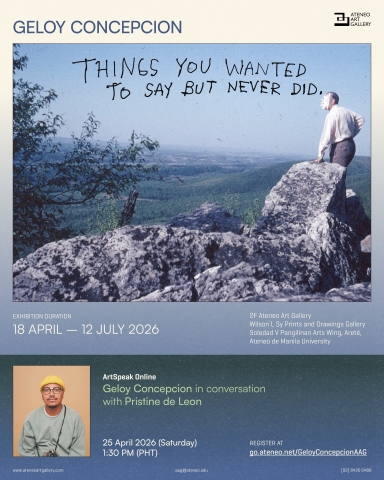
Things You Wanted to Say But Never Did: Geloy Concepcion’s six-year project makes Its exhibition debut at the Ateneo Art Gallery
Geloy Concepcion’s Things You Wanted To Say But Never Did comes to the Ateneo Art Gallery this 18 April 2026. After receiving almost 300,000 messages
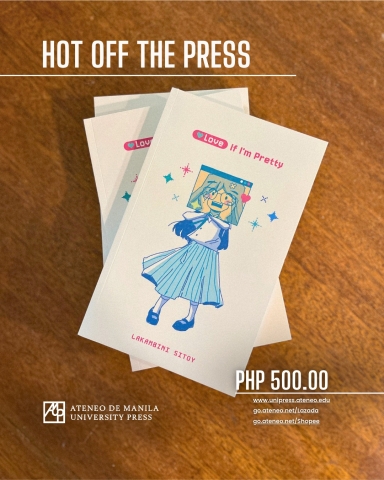
[Hot Off the Press] Love If I'm Pretty
New YA Release from the Ateneo Press Love If I’m Pretty tackles the nuances of growing up through complex characters and straightforward prose What do