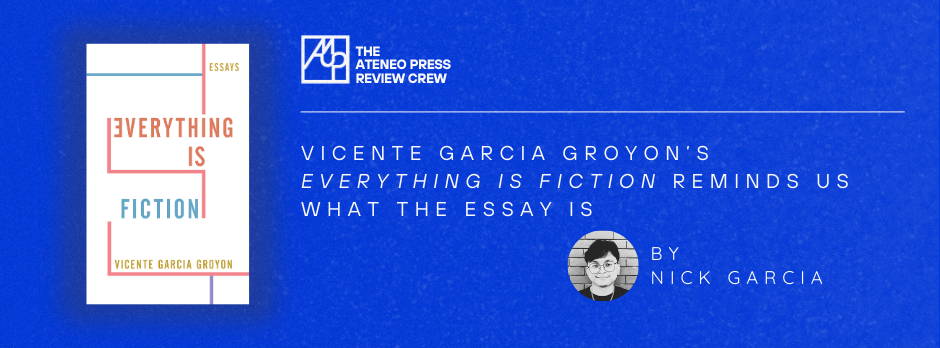
[Ateneo Press Review Crew] Vicente Garcia Groyon’s Everything is Fiction reminds us what the Essay is
25 Nov 2025 | Nick Garcia


The essay, loathe as I am to say it, already carries negative connotations. Three prime suspects easily come to mind: ChatGPT and other AI platforms, for obvious reasons; a "prince" who exploits trending topics, especially tragedies, by turning them into teachable moments on Facebook; and memers who respond "I ain't reading allat" to anyone who dares post something longer than a paragraph.
Though it's a newer literary genre compared to poetry or fiction, the essay has a long and distinguished tradition and is held in the highest regard. Its roots can be traced back to the 16th century, when French philosopher Michel de Montaigne wrote what he called essais (from the French verb essayer, “to try”), personal reflections on human life marked by introspection and sincerity. In his famous "The Author to the Reader," Montaigne shows how deeply human he is: “I desire therein to be viewed as I appear in mine own genuine, simple, and ordinary manner, without study and artifice: for it is myself I paint. My defects are therein to be read to the life, and any imperfections and my natural form, so far as public reverence hath permitted me... Thus, reader, myself am the matter of my book" (trans. W. Carew Hazlitt).
Ambition, honesty, fearlessness. These are qualities that an Essay with a capital E has, and the entries of Vicente Garcia Groyon's Everything is Fiction show exactly that.
Published by Ateneo de Manila University Press in 2022, the collection gathers 17 essays that Groyon wrote over a span of 25 years. It would soon spawn two more books comprising the Everything trilogy: Everything is Realism: Essays on Narrative Craft (University of Santo Tomas Publishing House, 2023) and Everything is First Person: More Essays (Grana Books, 2024).
Everything is Fiction is divided into three sections: “Choosing the Lonely Art,” which muses on the act of writing and being a Filipino writer; “Read the Classics, Boy,” which revisits specific writers and literary works; and “United States and Other Fictions,” which recounts Groyon's experiences as a fellow of the University of Iowa's International Writers Program.
Anyone who wishes to become an essayist or a writer in general owes it to themselves to read the book. Groyon's writing is elegant without being ornate, cerebral but remains grounded. He doesn't use highfalutin words and motherhood statements, yet he offers a rich, multisensory experience.
“Like the Moon toward a Village” is, in many ways, a masterclass in essay writing. It revolves around Groyon’s assigned trip to Spain to write about the poet Miguel Hernández, whose centenary was nearing at the time. Here, Groyon weaves together personal narrative, biography, criticism, and travelogue, producing a 48–page meditation on Hernández’s storied life. What makes it remarkable is that it's neither navel-gazing nor being too academic. Instead, Groyon simply harnesses the pure power of language to stimulate the mind and tug at the heartstrings of his readers.
Allow me to cite my favorite excerpt from the opening section, and may it grace your reading life as much as it did mine:
At the bus stop I notice a tallish woman, her fine blond hair cropped to a short, practical length, waiting quietly, lost in thought. In her hands, a white plastic bag, out of which peek the cheerful heads of summer flowers. On the bus, she stands clutching a handrail, despite the availability of seats, and stares into space. She's one of the handful of people left when the bus stops at its final destination—the gate of the Cementerio Municipal Nuestra Señora del Remedio. There's an air of routine in her manner—this seems a journey that she takes often. Spanish cemeteries do tend to be alive with the living, who faithfully leave flowers and prayers, but not before cleaning the tombs and niches with a variety of implements brought along for the purpose.
"An arched gateway houses offices on either side, beyond which extend the walls that enclose this city of the dead. Beyond the gate, canopies of bougainvilleas in full bloom explode in magenta, yellow, and purple, shading the main avenue of the cemetery. On either side, tombs and headstones march away in neat rows, interrupted only by processions of trees and walls of numbered niches piled one on another, back-to-back—high-rise flats for the departed. Even here, perhaps especially here, real estate remains at a premium.
"The woman has disappeared into the labyrinth of the cemetery, although I can imagine that she is doing what several other people here are doing today—filling a bucket with water from one of many spigots scattered throughout the cemetery and scrubbing a headstone, or a lápida, with brisk efficiency. Perhaps she is weeding the small patches of garden around a tomb or polishing the metalwork inlaid in marble or granite before laying her bouquet down beside a beloved's name. The air is infused with love, or duty; sometimes it's hard to tell which, and if anything, I feel like an interloper in this space where the devoted move with familiarity and treat each other with a camaraderie born out of the shared experience of loss. I, on the other hand, have come seeking a stranger, and this marks me as the outsider.
Pigeonholing aside, “Like the Moon toward a Village” is also literary journalism at its finest. As a media professional of nearly a decade, an AB Literature graduate, and an MFA Creative Writing student, I can only aspire to write something close to that.
I'm also delighted to know that Groyon is an "OG" writer who still writes by hand, as he details in "The Loneliness of the Longhand Writer." Not only does he harness pure language in his prose, but he also literally writes in the purest way possible. This reinforces his commitment to craftsmanship, one that's unadulterated by algorithms and AI. No "skill issue" there, as gamers love to say.
But above all, Groyon remains unassuming. Looking back, he acknowledges that his essays, particularly in “Choosing the Lonely Art,” are self-serving and romanticized with how they try to evaluate his creative process and his position in this ever-growing—and ever-chaotic—world of (Philippine) letters. He even admits to having “become more jaded and humbled about the profession over the years.”
The final entry, “On Marked Ground,” Groyon’s comprehensive assessment of his published short stories through the lens of gender and queer theory—and how he prefers to anchor on autobiography for the most part—is commendable for its candor, further proving his "commitment to truthfulness despite the falsehoods inherent in fiction, or the consequences."
Even if Groyon asserts in the introduction that he collected his essays as “largely an exercise in starving off oblivion, or an attempt to maintain control of my narrative,” they ultimately prove that he is one of the country’s most important writers. His essays, self-effacing as they may seem, reveal how he has matured, as all writers and artists should.
What makes Groyon different from other Filipino essayists, and even from many of his foreign contemporaries, is how he uses his fictionist background to craft essays with technical precision—all while retaining the humility of an avid learner still figuring things out. This, then, gives his reflections both intelligence and heart.
Moreover, writers like Groyon remind us what makes Philippine nonfiction special. While he writes in English (and excellently at that), the soul of his pieces is unmistakably Filipino, very much self-aware and allergic to pretense. His personal anecdotes are never self-serving, as they're mere jumping-off points for deeper meditations on our society, culture, and history. In effect, we're blessed with essays that don’t simply recount past events but also interrogate and contemplate the present state of affairs, so our future, no matter how uncertain and unpredictable, still finds a measure of light.
In an era when essays are being manufactured by AI, commodified by “princes,” and misconstrued as oversharing, Everything is Fiction reminds us what the essay truly is—and what it can still be.
In "The Crisis of the Filipino Writer," Groyon recalls supervising two fiction fellows at a national writing workshop, and how they "surprised" him on the last day by arriving at the same conclusion for "choosing the lonely art" that is writing: "[T]hey both just want to tell stories—stories that connect—and because of that desire, they are probably going to continue telling stories one way or the other."
"Above all, we write. Despite all, we write," Groyon concludes. Mismo. The very spirit of essay, after all, is trying.
Grab your copy in paperback: Website | Shopee and Lazada
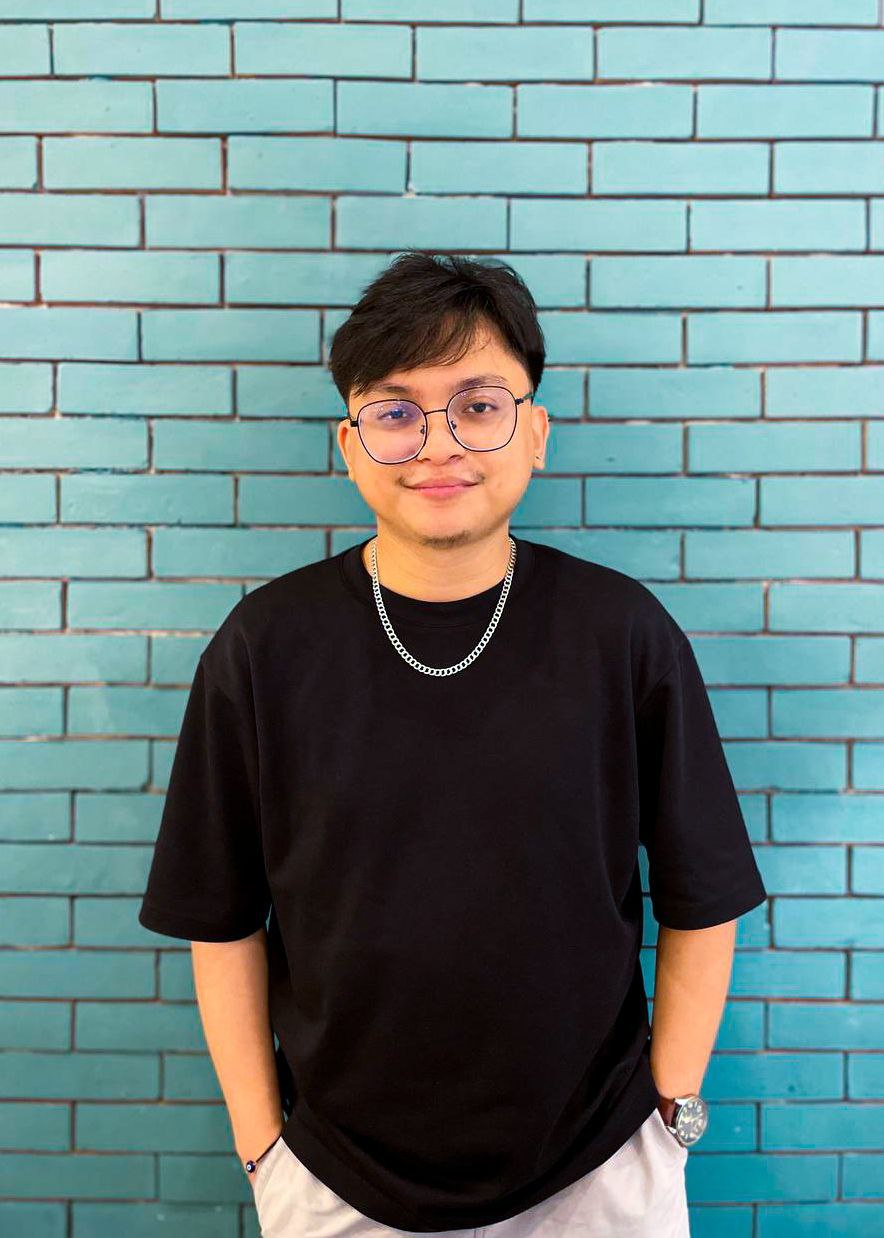
Nick Garcia is a journalist, essayist, literary critic, and poet. His debut poetry collection, Sa Aking Mga Kamay (Aklat Ulagad), was published in July 2025. His work has appeared in Luntian, Mountain Beacon, Voice & Verse Poetry Magazine, Dapitan, Rappler Voices, Inquirer Young Blood, PhilSTAR L!fe, and Cha: An Asian Literary Journal.
With a decade in media, he has worked with The Varsitarian, ONE News, and PhilSTAR L!fe. He now writes for radar, a startup launched in October. He is currently pursuing an MFA in Creative Writing at De La Salle University.
Recent News
You may also like these articles
[Hot Off the Press] Arkipelago
New book from the Ateneo Press Arkipelago provides a fascinating and fantastical twist on Philippine politics and history Our country is an archipelago of stories
Protecting Creativity: AIPO and Rizal Library Host Copyright Awareness Session for the Ateneo Community
On March 18, 2026, the Ateneo Intellectual Property Office (AIPO), in collaboration with the Rizal Library, successfully conducted a Copyright Awareness Session held on the

Holy Week 2026 Holidays (Memo # UHR2526-038)
Memo # UHR2526-038 31 March 2026 TO: All Employees FROM: [Sgd] Maria Victoria T Cortez, PhD Vice President for University Human Resources SUBJECT: Holy Week
ASOG’s Tobacco Control initiatives spotlighted in DOH National Technical Working Group for Tobacco Prevention and Control
On March 10 to 12, 2026, the Ateneo School of Government (ASOG), through its research and public policy unit, the Ateneo Policy Center, participated in
Things You Wanted to Say But Never Did: Geloy Concepcion’s six-year project makes Its exhibition debut at the Ateneo Art Gallery
Geloy Concepcion’s Things You Wanted To Say But Never Did comes to the Ateneo Art Gallery this 18 April 2026. After receiving almost 300,000 messages
[Hot Off the Press] Love If I'm Pretty
New YA Release from the Ateneo Press Love If I’m Pretty tackles the nuances of growing up through complex characters and straightforward prose What do